Allen-Bradley 1756-DMF30 ControlLogix Drive Module Series B: Industrial Data Link for Smart Factory Connectivity
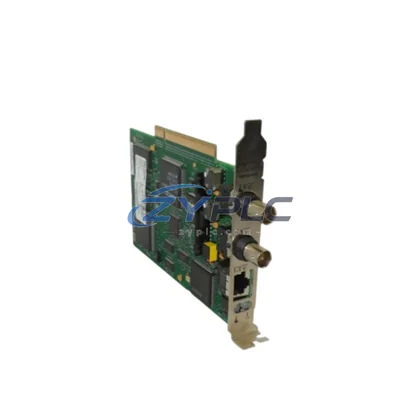
The Allen-Bradley 1756-DMF30 is a high-performance ControlLogix Drive Module (Series B) engineered to serve as the critical communication bridge between variable frequency drives, servo systems, and the broader ControlLogix automation architecture. Designed for demanding industrial environments, the 1756-DMF30 enables seamless multi-protocol data exchange across EtherNet/IP, ControlNet, and DeviceNet networks — making it an indispensable component in modern smart factory deployments where real-time data integrity, low-latency communication, and system-wide transparency are non-negotiable.
In today’s industrial landscape, the ability to move accurate process data from field-level devices to supervisory control systems without bottlenecks or protocol barriers defines operational excellence. The 1756-DMF30 addresses this challenge directly, acting as a gateway that consolidates drive status, speed references, fault diagnostics, and energy consumption data into a unified data stream accessible by the ControlLogix backplane — and from there, to SCADA platforms, MES layers, and cloud-based analytics systems.
Compatibility & Integration Notes
| Parameter |
Specification |
| SKU / Part Number |
1756-DMF30 (Series B) |
| Brand |
Allen-Bradley (Rockwell Automation) |
| Product Series |
ControlLogix 1756 |
| Primary Protocol |
EtherNet/IP (CIP) |
| Secondary Protocols |
ControlNet, DeviceNet, DriveLogix |
| Interface Type |
ControlLogix Backplane Module |
| Communication Role |
Drive-to-Controller Gateway / Motion Interface |
| Network Compatibility |
ControlLogix, CompactLogix, SCADA, HMI, MES |
| System Application |
VFD Integration, Servo Control, Smart Factory Automation |
| Transmission Capability |
Real-time cyclic and acyclic data exchange |
| Mounting |
1756 ControlLogix Chassis Slot |
| Origin |
United States |
| Warranty |
Warranty and support terms confirmed before quote — Tested Before Shipment |
Connected Automation Data Flow
The 1756-DMF30 sits at the heart of a layered industrial communication architecture. At the field level, variable frequency drives — such as the Allen-Bradley PowerFlex 755 and PowerFlex 527 — generate continuous streams of operational data: output frequency, motor current, torque demand, fault codes, and energy metrics. Without a dedicated drive interface module like the 1756-DMF30, this data remains siloed within the drive itself, invisible to the control layer above.
Once installed in a 1756 ControlLogix chassis alongside a 1756-L85E or 1756-L73 controller, the 1756-DMF30 maps drive parameters directly into the controller’s tag database via the ControlLogix backplane. The 1756-EN2T EtherNet/IP communication module then carries this consolidated data upstream to FactoryTalk View SE HMI stations and RSView SCADA servers, where operators gain real-time visibility into drive performance across the entire production line.
For facilities running mixed-protocol environments, the 1756-DMF30 works in conjunction with the 1756-DNB DeviceNet Scanner to aggregate data from legacy DeviceNet sensors, proximity switches, and actuators. Simultaneously, the 1756-CNB ControlNet Bridge Module maintains deterministic communication with remote I/O racks — such as the 1734 POINT I/O system — ensuring that discrete and analog signals from the plant floor reach the controller with guaranteed timing and zero data loss.
At the supervisory level, FactoryTalk Historian captures time-stamped drive data from the 1756-DMF30’s tag outputs, enabling trend analysis, predictive maintenance scheduling, and OEE (Overall Equipment Effectiveness) reporting. Edge gateway devices can further aggregate this data for transmission to cloud-based analytics platforms, completing the digital thread from motor shaft to enterprise dashboard.
In multi-axis motion applications, the 1756-DMF30 coordinates with the 1756-M02AE servo drive interface module to synchronize axis positioning data, ensuring that conveyor systems, robotic arms, and precision cutting machines operate in lockstep. This tight integration between drive modules and the ControlLogix motion engine eliminates the communication latency that would otherwise cause positioning errors in high-speed manufacturing processes.
Solving Data Isolation in Industrial Sites
One of the most persistent challenges in industrial automation is the fragmentation of communication protocols across different generations of equipment. A typical manufacturing facility may operate Allen-Bradley PowerFlex drives on DeviceNet, legacy sensors on Modbus RTU, and newer instrumentation on EtherNet/IP — creating data islands that prevent unified monitoring and control. The 1756-DMF30 directly addresses this by providing a standardized ControlLogix backplane interface that abstracts protocol differences, presenting all drive data to the controller in a consistent, accessible tag format.
Remote monitoring and diagnostics represent another critical capability enabled by the 1756-DMF30. When a drive fault occurs at a remote pump station or compressor skid, the module’s integration with the ControlLogix controller allows the fault code, timestamp, and operating conditions at the moment of failure to be automatically logged and transmitted to the SCADA system. Maintenance engineers can diagnose the root cause and dispatch the correct replacement parts before traveling to the site — reducing mean time to repair (MTTR) and minimizing unplanned downtime.
Production line transparency is further enhanced through the 1756-DMF30’s support for real-time energy monitoring. By exposing drive power consumption data to the ControlLogix tag database, energy management systems can track consumption per production unit, identify inefficient operating points, and trigger demand-response actions during peak tariff periods. This capability is increasingly mandated by ISO 50001 energy management standards and corporate sustainability reporting requirements.
System scalability is built into the 1756-DMF30’s design philosophy. As production capacity expands, additional drive modules can be added to the ControlLogix chassis without architectural redesign. The modular 1756 platform supports chassis sizes from 4-slot to 17-slot configurations, allowing the communication infrastructure to grow in parallel with the physical plant — protecting the initial automation investment while accommodating future expansion.
Every 1756-DMF30 unit supplied by ZYPLC undergoes functional communication testing prior to shipment, verifying backplane connectivity, protocol handshaking, and data integrity under simulated load conditions. This pre-shipment validation process ensures that the module arrives prepared for installation after site verification, reducing commissioning time and eliminating the risk of receiving a non-functional unit on a critical project timeline.
Industrial Connectivity FAQ
Q1: What communication protocols does the Allen-Bradley 1756-DMF30 support, and is it compatible with third-party SCADA systems?
The 1756-DMF30 supports EtherNet/IP (CIP), ControlNet, DeviceNet, and the DriveLogix communication interface natively. When installed in a ControlLogix chassis with an EtherNet/IP bridge module such as the 1756-EN2T, the drive data it exposes becomes accessible to any SCADA or HMI platform that supports OPC-DA or OPC-UA — including Wonderware, Ignition, FactoryTalk View SE, and Siemens WinCC. This makes the 1756-DMF30 a protocol-agnostic gateway suitable for heterogeneous automation environments.
Q2: How does the 1756-DMF30 ensure network stability and minimize communication latency in high-speed applications?
The 1756-DMF30 communicates via the ControlLogix backplane at the controller’s scan rate, which can be configured as low as 1ms for time-critical applications. Backplane communication is deterministic and isolated from Ethernet network congestion, ensuring that drive control commands and status feedback are exchanged with consistent, predictable timing. For applications requiring sub-millisecond synchronization — such as coordinated multi-axis motion — the module’s integration with the ControlLogix motion engine provides the necessary timing guarantees.
Q3: Can the 1756-DMF30 be used to expand an existing ControlLogix system without replacing the current controller?
Yes. The 1756-DMF30 is designed as a plug-in backplane module for the 1756 ControlLogix chassis family. It can be added to any available chassis slot without modifying the existing controller program structure, provided the controller firmware is compatible with Series B module requirements. This non-disruptive expansion capability makes it straightforward to add drive integration to an existing automation system during a planned maintenance window, without requiring a full system redesign or controller replacement.
Q4: What does the warranty and support terms confirmed before quote cover, and what testing is performed before shipment?
All 1756-DMF30 modules supplied by ZYPLC are Warranty terms are confirmed during quotation. Prior to shipment, each unit undergoes a structured pre-shipment test protocol that includes backplane communication verification, protocol handshaking confirmation, and data integrity validation under simulated operational load. Test records are available upon request. In the event of a warranty claim, ZYPLC provides direct technical support and expedited replacement to minimize impact on production operations.