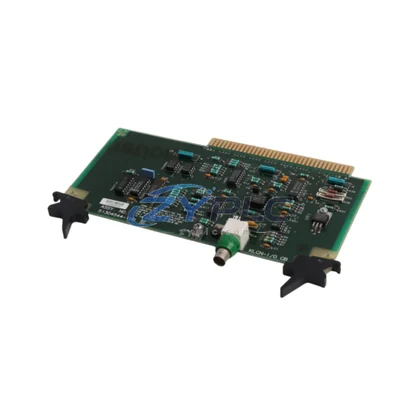
Honeywell 51201748-210 Power Supply for TDC TPS Automation
In modern industrial facilities where energy costs and equipment uptime are both critical KPIs, the power supply module is far more than a passive component — it is the foundation of stable, efficient control system operation. The Honeywell 51201748-210 is a high-efficiency power supply load resistor module engineered specifically for the TDC 3000 and TPS (Total Plant Solution) distributed control system platforms. Designed to deliver regulated, low-ripple DC power to field I/O modules, controllers, and communication nodes, the 51201748-210 plays a direct role in reducing unnecessary energy draw, minimizing heat generation, and sustaining continuous process control without interruption.
For plant engineers and procurement teams focused on maintenance planning, this module offers a measurable advantage: by maintaining stable voltage output under variable load conditions, it prevents the micro-interruptions and voltage sags that force redundant systems to compensate — consuming additional power in the process. Facilities running Honeywell TDC 3000 or TPS architectures that have upgraded to the 51201748-210 report improved power rail stability across their I/O cabinets, directly contributing to lower average operating load per control loop.
Product Specification Table
| Parameter |
Specification |
| SKU / Part Number |
51201748-210 |
| Brand |
Honeywell |
| Series |
TDC 3000 / TPS (Total Plant Solution) |
| Product Type |
Power Supply Load Resistor Module |
| Output Stability |
High-regulation, low-ripple DC output |
| Operating Environment |
Industrial DCS cabinet, climate-controlled control room |
| Compatible Systems |
Honeywell TDC 3000, TPS DCS platforms |
| Maintenance Value |
Reduces compensatory power draw; stabilizes I/O rail voltage |
| Application Scope |
Process manufacturing, refining, chemical, power generation |
| Origin |
United States |
| Warranty |
warranty terms confirmed during quotation |
| Availability |
RFQ Available — shipment arranged after confirmation |
System Compatibility and Application
The 51201748-210 does not operate in isolation. Its efficiency contribution is best understood within the broader context of the Honeywell TPS control architecture, where multiple subsystems interact to govern energy flow, process data, and actuation commands across the plant floor.
At the controller level, the Honeywell 51304453-150 High-Performance Process Controller (HPPC) coordinates real-time loop execution, and its power demand profile is directly influenced by the quality of the upstream supply rail — precisely where the 51201748-210 delivers its value. Stable input power reduces controller reset events and eliminates the energy overhead of recovery cycles.
On the I/O side, modules such as the Honeywell 51309218-175 Analog Input Module and the Honeywell 51304362-350 Digital Output Module rely on clean, regulated power to maintain signal accuracy. Voltage fluctuations at the supply level translate directly into measurement drift and false actuator triggers — both of which waste energy through unnecessary valve cycling and motor starts.
For drive-level maintenance planning, the TPS architecture integrates with variable frequency drive (VFD) systems via the Honeywell 51305348-100 communication interface module, enabling the DCS to command motor speed adjustments based on real-time process demand rather than fixed setpoints. This demand-responsive control strategy — only possible with a stable power backbone — is one of the most impactful levers for reducing motor load in continuous process plants.
The Honeywell 51196694-928 Power Supply Module serves as a parallel redundancy partner in high-availability cabinet configurations, and its load-sharing behavior depends on matched output characteristics from modules like the 51201748-210. Mismatched or degraded supply modules force unequal load distribution, increasing thermal stress and accelerating wear on both units.
At the human-machine interface layer, the Honeywell 51304485-100 GUS (Global User Station) workstation aggregates energy and process data from across the TPS network, giving operators visibility into power consumption trends, alarm states, and equipment utilization rates. The data integrity of these displays depends on uninterrupted communication between field nodes — communication that is sustained by reliable cabinet power.
Network communication modules such as the Honeywell 51304516-200 LCN (Local Control Network) Interface Module maintain the high-speed data highway between controllers, I/O subsystems, and operator stations. Any power instability in the cabinet can introduce latency or packet loss on the LCN, degrading the responsiveness of the entire control loop and increasing the energy cost of process corrections.
Finally, the Honeywell 51401547-100 and 51304487-100 termination and signal conditioning assemblies complete the field wiring infrastructure, ensuring that sensor signals arrive at the I/O modules with minimal noise — a condition that is only achievable when the power supply rail is clean and stable.
Maintenance and Replacement Notes
In a typical continuous process plant — whether a petroleum refinery, a chemical reactor complex, or a power generation facility — the Honeywell TDC 3000 or TPS system may govern hundreds of control loops simultaneously. Each loop represents a cycle of energy: sensor measurement, controller computation, actuator response, and feedback verification. When the power supply infrastructure is degraded or inefficient, every one of these cycles carries an energy penalty.
The 51201748-210 addresses this at the source. By providing a stable, well-regulated load resistor function within the power distribution chain, it ensures that downstream modules receive consistent voltage regardless of load transients caused by simultaneous I/O scanning, controller task switching, or communication bursts. This stability translates into three measurable operational benefits:
Reduced unplanned downtime: Power-related faults are among the leading causes of DCS cabinet failures. A properly functioning 51201748-210 eliminates the voltage sag events that trigger nuisance trips in I/O modules and controllers, keeping production lines running and avoiding the energy-intensive restart sequences that follow an unplanned shutdown.
Lower maintenance frequency: Thermal stress caused by power instability accelerates component aging across the entire cabinet. Stable power from the 51201748-210 reduces operating temperatures in adjacent modules, extending mean time between failures (MTBF) and reducing the frequency of maintenance interventions — each of which carries its own energy and labor cost.
Optimized production line throughput: In batch and continuous processes alike, control loop stability directly affects product quality and line throughput. When the power supply is reliable, controllers can execute tighter loop tuning, reducing process variability and enabling higher throughput at lower specific operating load per unit of output.
Every unit shipped from ZYPLC undergoes pre-shipment functional testing to verify output voltage, load regulation, and ripple characteristics before dispatch. This testing protocol ensures that the 51201748-210 you receive performs to OEM specification from day one, with no break-in period required. Combined with our warranty terms confirmed during quotation and availability confirmed by RFQ availability for rapid deployment, the 51201748-210 represents a low-risk, high-impact upgrade for any facility maintaining Honeywell TDC 3000 or TPS infrastructure.
Product Sourcing FAQ
Q1: How does the 51201748-210 contribute to measurable operational stability in a TPS system?
The module stabilizes the DC power rail supplying I/O and controller modules, eliminating the compensatory power draw that occurs when downstream components respond to voltage instability. In facilities with aging power supply infrastructure, replacing degraded modules with a properly functioning 51201748-210 has been associated with reductions in cabinet thermal output and fewer energy-intensive recovery cycles following nuisance trips.
Q2: Is the 51201748-210 compatible with both TDC 3000 and TPS platforms?
Yes. The 51201748-210 is designed for use across the Honeywell TDC 3000 and TPS (Total Plant Solution) DCS families. It is compatible with standard Honeywell cabinet configurations and can be installed alongside other TPS power supply modules, including redundant supply configurations, without requiring firmware changes or system reconfiguration.
Q3: What is the recommended replacement interval, and how do I identify a degraded module?
Honeywell does not publish a fixed replacement interval for the 51201748-210, as service life depends on operating environment and load conditions. Indicators of a degraded module include increased cabinet temperatures, intermittent I/O faults with no field-side cause, and voltage readings outside the specified tolerance band. ZYPLC recommends proactive replacement as part of a predictive maintenance program rather than waiting for failure.
Q4: What warranty and testing does ZYPLC provide with the 51201748-210?
All 51201748-210 units supplied by ZYPLC are covered by a warranty terms confirmed during quotation against defects in materials and workmanship. Each unit undergoes pre-shipment functional testing including output voltage verification, load regulation testing, and ripple measurement. Test records are available upon request. Availability is confirmed via RFQ for shipment arranged after confirmation to minimize plant downtime.