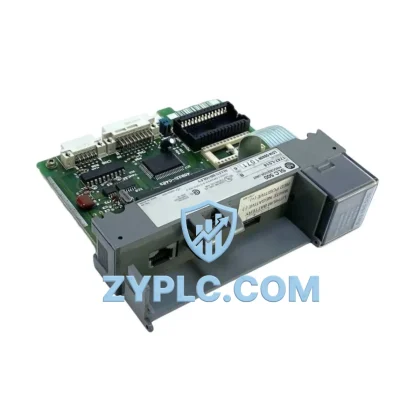
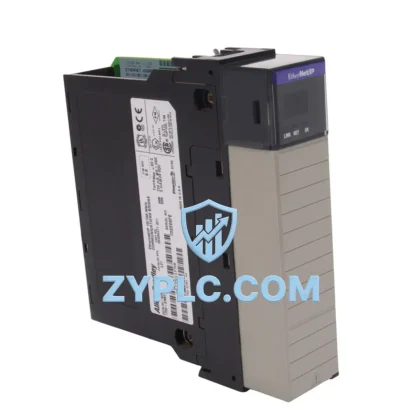
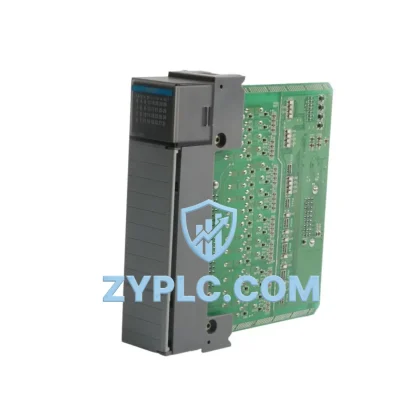
Allen-Bradley 1756-EN2F System-Ready EtherNet/IP Fiber for ControlLogix Architecture
The Allen-Bradley 1756-EN2F is a fiber-optic EtherNet/IP communication module engineered for deployment within the Rockwell Automation ControlLogix 1756 platform. Unlike conventional copper-based Ethernet bridges, the 1756-EN2F leverages multimode fiber connectivity to deliver superior electromagnetic immunity, extended transmission distances, and deterministic network performance across demanding industrial environments. Within a fully integrated control system architecture, this module occupies a critical position at the network layer — bridging the controller backplane to the plant-wide EtherNet/IP fabric with the signal integrity and latency consistency that process-critical applications demand.
System architects deploying the 1756-EN2F benefit from its Contextual Integration capability, which allows the module to participate seamlessly in both standard and redundant ControlLogix topologies. Whether the installation calls for a simplex controller arrangement or a fully redundant chassis pair using the 1756-RM2 redundancy module, the 1756-EN2F maintains consistent communication throughput without requiring topology-specific firmware variants. This architectural flexibility reduces spare parts complexity and simplifies long-term maintenance planning across multi-site operations.
From a system hierarchy perspective, the 1756-EN2F interfaces directly with the 1756-L8x and 1756-L7x series ControlLogix CPUs via the 1756-A series backplane chassis. The module’s fiber ports connect upstream to managed industrial switches — such as the Stratix 5700 or Stratix 8000 — enabling ring, star, or linear EtherNet/IP topologies depending on the redundancy and availability requirements of the application. Downstream, the network layer feeds I/O adapters including the 1734-AENTR POINT I/O EtherNet/IP adapter and the 1756-EN2T copper Ethernet bridge, allowing mixed-media network segments within the same control architecture.
At the I/O layer, the 1756-EN2F supports distributed I/O communication to remote chassis equipped with 1756-ENBT or 1756-EN2T bridge modules, as well as direct connections to intelligent field devices using the CIP (Common Industrial Protocol) over EtherNet/IP. This enables engineers to construct scalable, modular I/O architectures that can be expanded without disrupting the primary controller or network backbone. The module’s support for Class 1 and Class 3 CIP connections ensures compatibility with both cyclic I/O data exchange and explicit messaging for configuration and diagnostics.
Power integrity is maintained through the 1756-PA75 or 1756-PB75 series power supplies mounted within the same 1756-A chassis, providing regulated backplane power to the 1756-EN2F and co-resident modules. In redundant power configurations, dual power supply slots within larger chassis frames allow N+1 power redundancy without additional external switching hardware. This architecture ensures that a single power supply failure does not interrupt network communication or controller execution.
For human-machine interface integration, the 1756-EN2F’s EtherNet/IP connectivity supports direct communication with PanelView Plus 7 and PanelView 5500 HMI terminals over the same network fabric, eliminating the need for dedicated HMI communication processors. FactoryTalk View SE and FactoryTalk Historian SE can also connect to the controller via the 1756-EN2F’s network port, enabling real-time data acquisition, alarm management, and production reporting without additional gateway hardware.
At the execution layer, variable frequency drives such as the PowerFlex 755 and PowerFlex 525 communicate with the ControlLogix controller via EtherNet/IP through the same network segment served by the 1756-EN2F. This unified communication architecture eliminates protocol translation overhead and allows drive parameters, fault diagnostics, and motion commands to be managed directly from the controller program, reducing commissioning time and improving system transparency during maintenance cycles.
All units supplied by ZYPLC are covered by a 12-Month Warranty and have been functionally tested prior to dispatch. Stock availability is maintained to support both planned project deployments and urgent replacement requirements across manufacturing, power generation, petrochemical, water treatment, mining, metallurgy, packaging, and process control industries.
Architecture Specification Table
| Parameter |
Specification |
| System Role |
EtherNet/IP Fiber Communication Bridge — Network Layer |
| Platform |
Rockwell Automation ControlLogix 1756 Series |
| SKU / Catalog Number |
1756-EN2F |
| Communication Protocol |
EtherNet/IP (CIP Class 1 & Class 3) |
| Physical Interface |
Multimode Fiber Optic (100BASE-FX) |
| Network Speed |
100 Mbps Full Duplex |
| CIP Connections |
Up to 256 concurrent CIP connections |
| Backplane Interface |
1756 ControlLogix Backplane (1756-A series chassis) |
| Power Consumption |
Supplied via 1756 backplane (1756-PA75 / 1756-PB75) |
| Operating Temperature |
0°C to 60°C (32°F to 140°F) |
| Relative Humidity |
5% to 95% non-condensing |
| Redundancy Support |
Compatible with 1756-RM2 ControlLogix Redundancy Module |
| Certifications |
UL, CE, cUL (Class I Div 2) |
| Warranty |
12-Month Warranty — All units tested before dispatch |
Coordinated Control System Design
The 1756-EN2F achieves its full architectural value when deployed as part of a coordinated ControlLogix system rather than as a standalone communication device. In a typical multi-rack installation, the primary controller — a 1756-L83E or 1756-L85E ControlLogix CPU — resides in the local chassis alongside the 1756-EN2F, sharing the 1756-A17 or 1756-A10 backplane. The fiber module provides the network gateway through which the CPU exchanges I/O data with remote racks equipped with 1756-EN2T copper Ethernet bridges, maintaining sub-millisecond RPI (Requested Packet Interval) consistency across the EtherNet/IP ring.
In redundant controller architectures, a secondary chassis mirrors the primary using the 1756-RM2 redundancy module, with both chassis equipped with 1756-EN2F modules to ensure that network communication fails over transparently during a controller switchover event. The Stratix 5700 managed switch provides the network infrastructure for the redundant ring, with RSTP (Rapid Spanning Tree Protocol) or DLR (Device Level Ring) configured to eliminate single points of network failure.
Distributed I/O is connected via 1734-AENTR POINT I/O EtherNet/IP adapters mounted in remote panels, with each adapter hosting up to 63 I/O modules covering digital inputs, digital outputs, analog inputs, and specialty function modules. For high-density I/O requirements, 1756-IB32 digital input modules and 1756-OB32 digital output modules are installed in remote 1756 chassis, communicating back to the primary controller through the 1756-EN2F network path. Terminal modules such as the 1492-AIFM analog interface modules provide field wiring termination for analog I/O channels, maintaining signal integrity between field instruments and the I/O backplane.
At the drive and actuator layer, PowerFlex 755 AC drives receive speed references and return diagnostic data via EtherNet/IP, with the 1756-EN2F serving as the network gateway between the controller and the drive network segment. Safety functions are coordinated through the 1756-L8xS GuardLogix safety controller, which shares the same chassis and backplane as the standard ControlLogix CPU, with safety I/O communicated over the same EtherNet/IP network via CIP Safety protocol.
Application in Layered Automation Systems
The 1756-EN2F is deployed across a broad range of industrial sectors where fiber-optic immunity to electromagnetic interference is a system requirement rather than an option. In power generation and substation automation, the module’s fiber interface eliminates ground loop interference between control room and switchyard environments, where high-voltage switching events generate significant EMI that would corrupt copper Ethernet signals. The module’s Class I Division 2 certification also supports deployment in petrochemical and refinery control systems where flammable atmospheres require intrinsically safe or explosion-proof rated equipment in adjacent zones.
In water and wastewater treatment facilities, the 1756-EN2F supports long-distance fiber runs between pump stations and central SCADA control rooms, with distances exceeding the 100-meter limitation of copper Ethernet. Mining and metallurgical processing plants benefit from the module’s vibration tolerance and fiber immunity in environments where heavy machinery generates continuous electrical noise. For automotive and discrete manufacturing assembly lines, the module’s high CIP connection count supports simultaneous communication with multiple robot controllers, vision systems, and conveyor drives within a single EtherNet/IP network segment.
In packaging and material handling applications, the 1756-EN2F enables centralized controller architectures where a single ControlLogix CPU manages multiple production lines through distributed I/O nodes, reducing the total number of controllers required and simplifying the SCADA integration layer. Process industries including chemical batch processing and pharmaceutical manufacturing rely on the module’s deterministic communication performance to maintain precise timing between controller scan cycles and field device updates, which is critical for recipe-driven batch control sequences.
Architecture Engineering FAQ
Q1: Is the 1756-EN2F compatible with both simplex and redundant ControlLogix controller configurations?
Yes. The 1756-EN2F is fully compatible with standard simplex ControlLogix configurations using 1756-L7x or 1756-L8x CPUs, as well as redundant configurations using the 1756-RM2 redundancy module. In redundant systems, both the primary and secondary chassis require a 1756-EN2F module to ensure network communication continuity during controller switchover. No firmware changes are required between simplex and redundant deployments — the module’s behavior is governed by the controller’s redundancy configuration, not the module itself.
Q2: What fiber cable type and connector standard does the 1756-EN2F require, and what is the maximum transmission distance?
The 1756-EN2F uses 100BASE-FX multimode fiber with SC-type duplex connectors. The maximum transmission distance is 2 km over 62.5/125 µm or 50/125 µm multimode fiber at 100 Mbps. For installations requiring longer distances, a fiber media converter or managed switch with SFP fiber uplinks — such as the Stratix 5700 with fiber SFP modules — should be used to extend the network segment. All fiber patch cables and trunk cables should be tested for insertion loss before commissioning to ensure signal integrity at the module’s receiver.
Q3: What does the 12-Month Warranty cover, and how does ZYPLC support long-term maintenance and spare parts availability?
The 12-Month Warranty covers functional defects identified during normal operation under the module’s rated environmental and electrical conditions. All units supplied by ZYPLC are tested prior to dispatch to verify backplane communication, fiber port operation, and firmware integrity. For long-term maintenance planning, ZYPLC maintains stock of the 1756-EN2F and compatible ControlLogix components to support both scheduled preventive replacement and emergency breakdown scenarios. Customers requiring expedited delivery for critical system repairs are encouraged to contact the ZYPLC sales team directly to confirm current stock levels and lead times.
© 2026 ZYPLC. All rights reserved.
Original Source: https://zyplc.com
Contact: +86 19859288691 | plc.sales@zyplc.com