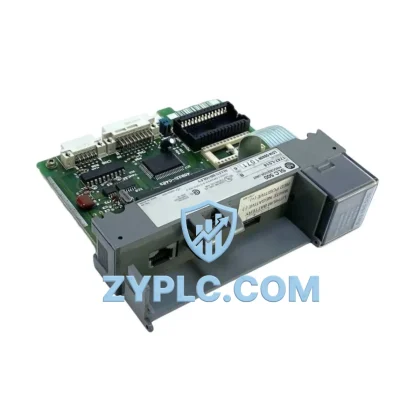
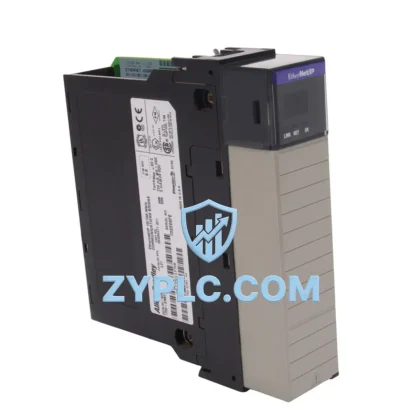
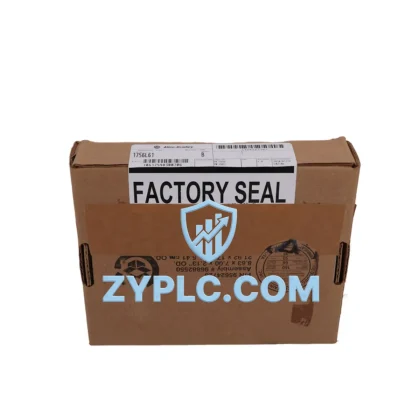
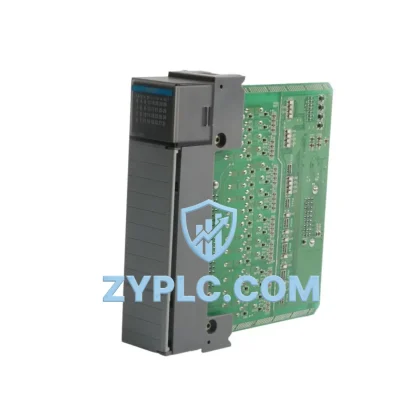
Allen-Bradley 1756-IF16 System-Ready Analog Input for ControlLogix Architecture
The Allen-Bradley 1756-IF16 is a 16-channel analog input module engineered for seamless integration within the Rockwell Automation ControlLogix platform. Rather than functioning as a standalone component, the 1756-IF16 occupies a precise role within a layered control system architecture — bridging the physical process environment and the CPU’s decision-making logic. In distributed manufacturing, power generation, petrochemical processing, and water treatment facilities, this module serves as the primary signal acquisition layer, converting real-world analog signals into structured digital data that feeds directly into the 1756-L series ControlLogix processors.
Understanding the 1756-IF16 requires viewing it within the full system hierarchy. At the control layer, a 1756-L73 or 1756-L85E ControlLogix CPU manages program execution and data routing. The 1756-IF16 resides in the I/O layer, installed within a 1756-A10 or 1756-A17 ControlLogix chassis alongside complementary modules such as the 1756-OF8 analog output module and 1756-IB32 digital input module. Power is supplied through the 1756-PA75 or 1756-PB75 power supply, ensuring stable, noise-isolated voltage delivery across the backplane. Communication between chassis — whether local or remote — is handled via the 1756-EN2T EtherNet/IP communication module or the 1756-CN2 ControlNet bridge, enabling deterministic data exchange across the network layer.
At the human-machine interface layer, operator stations running FactoryTalk View SE or PanelView Plus 7 terminals visualize the analog data collected by the 1756-IF16 in real time. Downstream, the execution layer may include PowerFlex 755 variable frequency drives or Kinetix servo drives responding to setpoint commands derived from the analog input values. This end-to-end signal flow — from field transmitter through the 1756-IF16, across the backplane, into the CPU, and out to the execution layer — defines the operational backbone of a ControlLogix-based control system.
The 1756-IF16 supports both current (4–20 mA) and voltage (±10 V, 0–10 V) input ranges, configurable per channel through RSLogix 5000 or Studio 5000 Logix Designer software. Its 16 single-ended or 8 differential channel configurations provide engineering flexibility for diverse sensor types including pressure transmitters, temperature transducers, flow meters, and level sensors. The module’s high-resolution 16-bit analog-to-digital conversion ensures measurement accuracy critical for closed-loop PID control strategies. Contextual Integration with the ControlLogix tag database allows each channel’s engineering unit scaling, alarm thresholds, and filter constants to be configured and stored directly within the controller project, eliminating the need for external calibration records and simplifying long-term maintenance.
From a system redundancy perspective, the 1756-IF16 can be deployed in redundant chassis configurations using the 1756-RM2 redundancy module pair. In such architectures, primary and secondary chassis each host a 1756-IF16, with the redundancy module managing automatic switchover in the event of a primary chassis fault — ensuring continuous analog signal acquisition without process interruption. This design is particularly valued in power utility substations, oil and gas pipeline monitoring, and pharmaceutical batch processing where unplanned downtime carries significant operational and regulatory consequences.
Installation and commissioning of the 1756-IF16 follow standard ControlLogix procedures. The module is hot-swappable within a powered chassis, allowing replacement without system shutdown — a critical advantage in continuous-process industries. Field wiring connects via the 1492-IFM series interface modules or directly to the module’s removable terminal block, with shielded cable recommended for analog signal integrity in electrically noisy environments. During commissioning, Studio 5000 Logix Designer’s module properties dialog provides channel-by-channel configuration, live data monitoring, and diagnostic fault reporting, reducing engineering time and accelerating system validation.
For long-term maintenance planning, the 1756-IF16 benefits from Rockwell Automation’s extensive spare parts ecosystem. Stocking a replacement module alongside the 1756-PA75 power supply and 1756-EN2T communication module ensures rapid recovery from hardware faults. All units supplied by ZYPLC are covered by a 12-Month Warranty, providing assurance of module authenticity, functional integrity, and post-sale technical support. Our inventory management approach prioritizes system-level availability — ensuring that the I/O modules, communication bridges, and power supplies that form a complete ControlLogix architecture are accessible from a single, reliable source.
Architecture Specification Table
| System Role |
Analog Input Module — I/O Layer, ControlLogix Architecture |
| Number of Channels |
16 single-ended / 8 differential |
| Input Range |
±10 V, 0–10 V, 0–5 V, 4–20 mA, 0–20 mA (configurable per channel) |
| Resolution |
16-bit analog-to-digital conversion |
| Backplane Current Draw |
250 mA @ 5 VDC; 2 mA @ 24 VDC |
| Operating Temperature |
0 °C to 60 °C (32 °F to 140 °F) |
| Communication |
ControlLogix backplane (1756 series chassis) |
| Compatible Chassis |
1756-A4, 1756-A7, 1756-A10, 1756-A13, 1756-A17 |
| Compatible CPUs |
1756-L6x, 1756-L7x, 1756-L8x ControlLogix processors |
| Programming Software |
RSLogix 5000 / Studio 5000 Logix Designer |
| Installation |
Hot-swappable, DIN rail or panel-mount chassis |
| Certifications |
UL, CE, C-Tick |
| Warranty |
12-Month Warranty (ZYPLC) |
Coordinated Control System Design
The 1756-IF16 achieves its full value when integrated within a coordinated ControlLogix system. A typical architecture begins with the 1756-L73 ControlLogix CPU as the central processing unit, executing ladder logic, function block, and structured text programs that reference analog input tags sourced from the 1756-IF16. The CPU resides in a 1756-A10 chassis powered by the 1756-PA75 AC power supply, which provides clean, regulated backplane power essential for analog measurement accuracy.
On the output side, the 1756-OF8 analog output module translates CPU-generated setpoints into 4–20 mA or voltage signals driving control valves, positioners, and variable speed drives. Digital status signals are managed by the 1756-IB32 digital input module and 1756-OB32 digital output module, completing the I/O layer. Network connectivity is established through the 1756-EN2T EtherNet/IP module, enabling integration with SCADA systems, historian servers, and remote I/O adapters over a standard Ethernet infrastructure.
In remote I/O architectures, the 1756-CN2 ControlNet communication module extends the control network to remote chassis housing additional 1756-IF16 modules, allowing analog signal acquisition across geographically distributed process areas without signal degradation. For system redundancy, the 1756-RM2 redundancy module synchronizes primary and secondary chassis, ensuring that analog input data remains continuously available to the CPU even during a chassis switchover event. Terminal-side wiring is simplified using 1492-IFM series interface modules, which provide pre-wired, labeled terminal blocks that reduce field wiring errors and accelerate commissioning.
Application in Layered Automation Systems
In manufacturing and assembly lines, the 1756-IF16 monitors tension, pressure, and temperature signals across multi-zone production processes, feeding real-time data to PID loops that maintain product quality and line throughput. In power generation and electrical utilities, the module acquires current transformer and voltage transducer signals for generator protection and load balancing applications, where measurement accuracy and system uptime are non-negotiable.
In petrochemical and oil and gas facilities, the 1756-IF16 handles signals from pressure transmitters and flow meters distributed across hazardous process areas, with the ControlLogix architecture providing the SIL-capable infrastructure required for safety instrumented system integration. Water and wastewater treatment plants rely on the module for continuous monitoring of flow, pH, turbidity, and dissolved oxygen sensors, with the ControlLogix CPU executing automated dosing and pump control sequences based on the acquired analog data.
In mining and metallurgical operations, the 1756-IF16 supports conveyor load monitoring, crusher pressure feedback, and furnace temperature acquisition — environments characterized by high electrical noise, vibration, and wide temperature variation, all within the module’s rated operating envelope. Packaging and material handling lines use the module for web tension control, fill-level verification, and servo axis feedback integration, where the 16-channel capacity allows a single module to serve an entire machine section, reducing chassis slot consumption and simplifying system architecture.
Architecture Engineering FAQ
Q1: Is the 1756-IF16 compatible with both older 1756-L6x and newer 1756-L8x ControlLogix processors?
Yes. The 1756-IF16 is compatible across the full range of ControlLogix processors, including the 1756-L61, 1756-L63, 1756-L71, 1756-L73, 1756-L83E, and 1756-L85E. Module configuration is managed through RSLogix 5000 (v16 and later) or Studio 5000 Logix Designer, with the module’s I/O tree entry automatically populating channel tags in the controller’s tag database. No hardware modifications are required when migrating between processor generations within the 1756 chassis platform.
Q2: Can the 1756-IF16 be used in a redundant ControlLogix chassis configuration, and what are the architecture requirements?
Yes. The 1756-IF16 is supported in ControlLogix redundancy systems using the 1756-RM2 redundancy module. Both the primary and secondary chassis must be populated with identical module configurations in the same slot positions. The 1756-SYNCH fiber-optic synchronization cable connects the two 1756-RM2 modules, enabling real-time data synchronization. During a switchover event, analog input data from the 1756-IF16 remains available to the active CPU within the redundancy switchover time, typically under 100 milliseconds, ensuring process continuity in critical applications.
Q3: What does the 12-Month Warranty cover, and how does ZYPLC support long-term spare parts availability for ControlLogix architectures?
The 12-Month Warranty provided by ZYPLC covers the 1756-IF16 against manufacturing defects and functional failures under normal operating conditions. In the event of a warranty claim, ZYPLC provides module replacement or repair support with documented traceability. For long-term maintenance planning, ZYPLC maintains inventory of complementary ControlLogix components — including 1756-PA75 power supplies, 1756-EN2T communication modules, 1756-OF8 output modules, and 1756-A10 chassis — enabling system-level procurement from a single source and reducing lead time risk for critical spare parts programs.
© 2026 ZYPLC. All rights reserved.
Original Source: https://zyplc.com
Contact: +86 19859288691 | plc.sales@zyplc.com