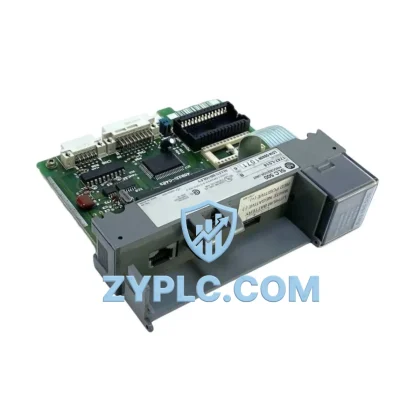
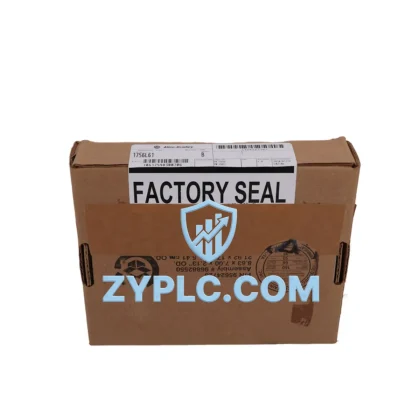
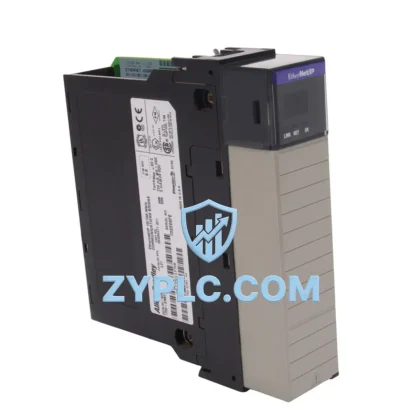
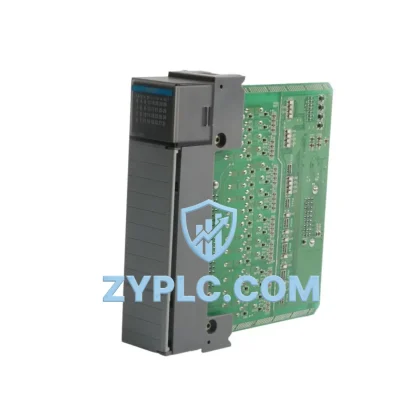
Allen-Bradley 1756-L55M12 Logix5555 System-Ready Processor for ControlLogix Architecture
The Allen-Bradley 1756-L55M12 Logix5555 Processor is a high-performance CPU module engineered for deployment within the ControlLogix 1756 platform — one of the most widely adopted distributed control architectures in industrial automation. With 750KB of user memory and full compatibility with the ControlLogix backplane ecosystem, this processor serves as the command nucleus of multi-layer automation systems spanning control, I/O, network, power, HMI, and execution layers. Its role is not simply to execute ladder logic or function block programs; it is to anchor system-wide coherence, enabling deterministic scan cycles, coordinated motion sequences, and seamless inter-module communication across the entire control cabinet.
In a fully realized ControlLogix architecture, the 1756-L55M12 operates in concert with a broad range of platform-native modules. The 1756-A17 or 1756-A10 chassis backplane provides the physical and electrical foundation, while 1756-PA75 or 1756-PB75 power supply modules deliver regulated 24VDC and 5VDC rails to sustain processor and I/O module operation under continuous industrial load. Discrete I/O is handled by modules such as the 1756-IB16 (16-point 24VDC input) and 1756-OB16E (16-point electronically fused output), while analog signal conditioning is managed by the 1756-IF16 analog input module, which supports 4–20mA and 0–10V field instrumentation. This layered I/O architecture ensures that the 1756-L55M12 maintains full signal visibility across process variables without compromising scan time integrity.
Network connectivity is a defining strength of the ControlLogix platform. The 1756-ENBT/A EtherNet/IP bridge module enables the 1756-L55M12 to participate in plant-wide Ethernet topologies, supporting both implicit (I/O) and explicit (MSG) messaging to SCADA systems, historian servers, and peer PLCs. For legacy fieldbus integration, the 1756-DNB DeviceNet scanner module extends the processor’s reach to distributed valve manifolds, variable frequency drives, and smart sensors operating on the DeviceNet protocol. ControlNet connectivity, where required for deterministic peer-to-peer communication, is supported through the 1756-CNB/D bridge module, making the 1756-L55M12 a true multi-network hub within complex plant architectures.
Human-machine interface integration is achieved through RSLinx Classic or FactoryTalk View SE, with the processor’s EtherNet/IP tag database directly accessible to PanelView Plus 6 or PanelView 5500 HMI terminals. This direct tag-based communication eliminates the need for intermediate data mapping, reducing configuration overhead and improving display refresh consistency during high-throughput production cycles. For motion control applications, the 1756-L55M12 supports coordinated axis control through SERCOS or analog motion modules such as the 1756-M02AE, enabling multi-axis synchronization for packaging lines, press feeders, and web tension control systems.
Redundancy is a critical design consideration in high-availability process environments. The 1756-L55M12 supports ControlLogix redundancy configurations when paired with a 1756-RM2/A redundancy module and a mirrored chassis assembly. In this configuration, primary and secondary processors maintain synchronized program and data table states, enabling bumpless switchover in the event of a CPU fault, power interruption, or communication failure. This architecture is particularly valued in continuous process industries — petrochemical distillation columns, water treatment clarifiers, and power generation control rooms — where unplanned downtime carries significant operational and safety consequences.
From an engineering and commissioning perspective, the 1756-L55M12 is fully supported by Studio 5000 Logix Designer, Rockwell Automation’s unified programming environment. Project files are forward-compatible with newer ControlLogix L7x and L8x processors, protecting engineering investment and simplifying future platform migrations. Firmware updates are managed through ControlFLASH, and online editing capabilities allow program modifications without halting the controlled process — a critical feature for facilities operating on 24/7 production schedules.
Long-term maintenance efficiency is supported by the module’s non-volatile memory architecture, which retains program and configuration data through power cycles without requiring a battery in standard operating modes. For installations requiring extended data retention during extended outages, the 1756-BATM battery module provides supplemental backup. Spare module availability is maintained through ZYPLC’s global inventory network, ensuring that replacement units can be sourced and dispatched within standard lead times, backed by a 12-Month Warranty covering manufacturing defects and functional failures under normal operating conditions.
Architecture Specification Table
| Parameter |
Specification |
| System Role |
Primary / Redundant CPU — ControlLogix 1756 Platform |
| User Memory |
750KB (program + data) |
| Processor Series |
Logix5555 (ControlLogix 1756) |
| Backplane Compatibility |
1756-Axx Series Chassis (1756-A4, A7, A10, A13, A17) |
| Communication Ports |
RS-232 (DF1 / DH-485) via 1756-CP3 cable |
| Network Integration |
EtherNet/IP, ControlNet, DeviceNet (via bridge modules) |
| Power Supply Compatibility |
1756-PA75, 1756-PB75, 1756-PA72, 1756-PB72 |
| Redundancy Support |
Yes — via 1756-RM2/A Redundancy Module |
| Operating Temperature |
0°C to 60°C (32°F to 140°F) |
| Relative Humidity |
5% to 95% non-condensing |
| Mounting |
ControlLogix 1756 chassis backplane slot |
| Programming Software |
RSLogix 5000 / Studio 5000 Logix Designer |
| Certifications |
UL, CE, C-Tick |
| Warranty |
12-Month Warranty (manufacturing defects & functional failures) |
Coordinated Control System Design
The 1756-L55M12 achieves its full operational potential when integrated within a coordinated ControlLogix system architecture. At the power layer, the 1756-PA75 AC power supply and 1756-PB75 DC power supply provide stable, regulated power to the chassis backplane, ensuring that all co-resident modules — including the processor, I/O, and communication bridges — operate within their specified electrical envelopes. At the I/O layer, the 1756-IB16 discrete input module and 1756-OB16E discrete output module handle digital field signals, while the 1756-IF16 analog input module processes continuous process variables such as flow, pressure, and temperature from 4–20mA transmitters.
Network layer coherence is maintained through the 1756-ENBT/A EtherNet/IP communication module, which connects the processor to plant Ethernet infrastructure, and the 1756-DNB DeviceNet scanner, which manages distributed device networks at the field level. For inter-controller communication in large plant architectures, the 1756-CNB/D ControlNet bridge module enables scheduled, deterministic data exchange between peer ControlLogix systems. At the HMI layer, PanelView Plus 6 terminals communicate directly with the 1756-L55M12 tag database over EtherNet/IP, providing operators with real-time process visualization and alarm management. For motion-intensive applications, the 1756-M02AE analog servo module coordinates multi-axis drive systems under the processor’s supervisory control, completing a fully integrated, layered automation architecture.
Application in Layered Automation Systems
The 1756-L55M12 is deployed across a wide spectrum of industrial sectors where system reliability, architectural scalability, and long-term maintainability are non-negotiable requirements. In discrete manufacturing environments — automotive body welding lines, electronics assembly conveyors, and metal stamping presses — the processor manages high-speed I/O scanning and coordinated motion sequences with deterministic cycle times. In continuous process industries such as petrochemical refining, the 1756-L55M12 anchors distributed control loops managing reactor temperature, column pressure, and flow ratio control, often operating within redundant chassis configurations to meet SIL 2 availability targets.
Water and wastewater treatment facilities rely on the ControlLogix platform for SCADA-integrated pump station control, chemical dosing automation, and filtration cycle sequencing, with the 1756-L55M12 providing the processing backbone for multi-site telemetry architectures. In power generation and electrical substation automation, the processor supports protection relay coordination, transformer tap changer control, and load dispatch sequencing. Mining and mineral processing operations deploy the 1756-L55M12 in conveyor drive control, crusher sequencing, and flotation cell management, where the combination of robust I/O capacity and EtherNet/IP connectivity supports both local panel control and remote SCADA supervision. Packaging and palletizing lines in food and beverage facilities benefit from the processor’s motion coordination capabilities, enabling synchronized multi-axis pick-and-place and case-packing operations at high throughput rates.
Architecture Engineering FAQ
Q1: Is the 1756-L55M12 compatible with current Studio 5000 Logix Designer versions, and can existing project files be migrated to newer ControlLogix processors?
The 1756-L55M12 is fully programmable with RSLogix 5000 and is supported in Studio 5000 Logix Designer for project editing and online monitoring. Project files created for the L55M12 can be converted and migrated to newer Logix 5570 or 5580 series processors using the Import/Export and project upgrade utilities within Studio 5000, preserving tag structures, routine logic, and HMI tag references. This migration path protects existing engineering investment while enabling platform modernization on a planned maintenance schedule.
Q2: What redundancy architecture is required to achieve bumpless switchover with the 1756-L55M12, and what additional modules are needed?
Redundancy with the 1756-L55M12 requires a mirrored chassis pair, each populated with identical processor, I/O bridge, and communication modules. The 1756-RM2/A redundancy module installed in each chassis manages state synchronization between primary and secondary processors over a dedicated fiber-optic redundancy link. Switchover is initiated automatically upon detection of a primary chassis fault, with crossover times typically under 100ms for most process applications. The 1756-ENBT/A EtherNet/IP modules in both chassis must be configured with the same IP address using the redundancy system’s virtual IP feature to maintain uninterrupted SCADA and HMI connectivity during switchover events.
Q3: What does the 12-Month Warranty cover, and how does ZYPLC support long-term spare parts availability for the 1756-L55M12?
The 12-Month Warranty provided by ZYPLC covers manufacturing defects and functional failures occurring under normal operating conditions from the date of shipment. Warranty claims are processed through direct technical review, and replacement units are dispatched from ZYPLC’s global inventory network to minimize system downtime. For long-term maintenance planning, ZYPLC maintains stock of the 1756-L55M12 and associated ControlLogix platform components — including power supplies, I/O modules, and communication bridges — to support both emergency replacement and scheduled preventive maintenance programs. Customers are encouraged to contact ZYPLC’s technical sales team at plc.sales@zyplc.com or +86 19859288691 to discuss multi-unit procurement, consignment stock arrangements, and extended support agreements.
© 2026 ZYPLC. All rights reserved.
Original Source: https://zyplc.com
Contact: +86 19859288691 | plc.sales@zyplc.com