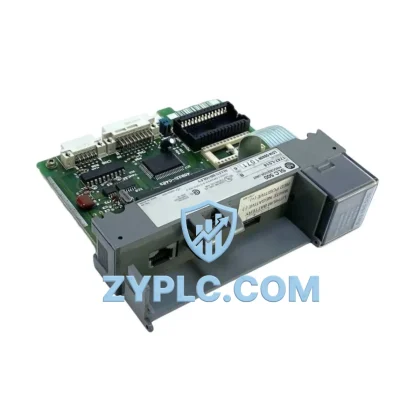
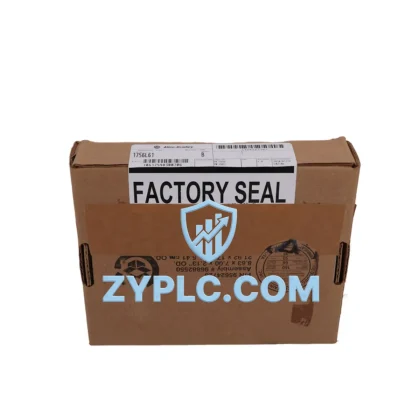
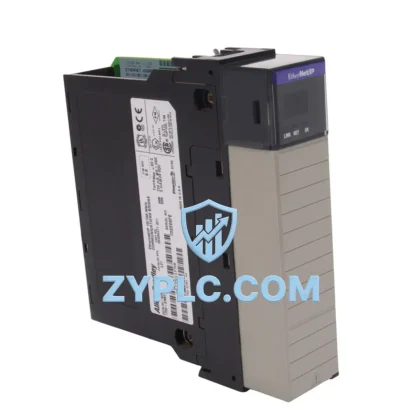
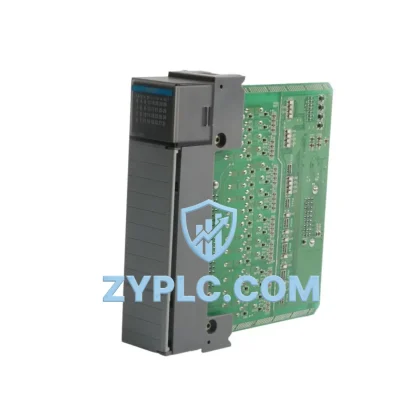
Allen-Bradley 1756-L55M24 System-Ready CPU for ControlLogix Architecture
The Allen-Bradley 1756-L55M24 is a high-performance ControlLogix CPU module engineered for seamless integration within the 1756 chassis-based control architecture. Designed by Rockwell Automation, this processor serves as the command core of multi-layer industrial automation systems, coordinating signal flow across control, I/O, network, power, HMI, and execution layers. Whether deployed in greenfield installations or as a replacement in legacy ControlLogix platforms, the 1756-L55M24 delivers the processing consistency, memory capacity, and communication bandwidth required for demanding process and discrete manufacturing environments.
In a complete ControlLogix system architecture, the 1756-L55M24 occupies the controller slot of the 1756 chassis backplane, interfacing directly with local and remote I/O modules, communication bridges, and redundancy controllers. Its architecture supports Producer/Consumer messaging over ControlNet and EtherNet/IP, enabling deterministic data exchange with peer controllers, remote I/O adapters, and SCADA systems. The CPU’s tag-based programming model in Studio 5000 Logix Designer allows engineers to structure logic hierarchically, reducing commissioning time and simplifying long-term maintenance across distributed plant assets.
System architects integrating the 1756-L55M24 typically pair it with the 1756-PA72 or 1756-PB72 power supply modules to ensure stable backplane voltage regulation across high-density I/O configurations. Local digital and analog I/O is handled through modules such as the 1756-IB16 (16-point 24VDC digital input), 1756-OB16E (16-point electronically fused digital output), and 1756-IF8 (8-channel analog input), all residing in the same 1756 chassis and communicating over the high-speed backplane bus. For remote I/O expansion, the 1756-EN2T EtherNet/IP communication module bridges the local rack to remote 1756 or 1794 FLEX I/O racks distributed across the plant floor.
Network layer integration is a core strength of the 1756-L55M24 architecture. The CPU natively supports ControlNet via the 1756-CNB or 1756-CNBR (redundant) bridge modules, and EtherNet/IP via the 1756-EN2T or 1756-EN3TR modules. These communication gateways enable the controller to exchange real-time data with Rockwell PanelView Plus HMI terminals, third-party SCADA platforms via OPC-DA/UA, and upstream MES or ERP systems. In redundancy-critical applications, the 1756-L55M24 can be paired with a 1756-RM2 redundancy module and a mirrored chassis to achieve bumpless switchover, ensuring continuous process operation during controller faults or planned maintenance windows.
The execution layer benefits from the 1756-L55M24’s deterministic scan cycle management, which coordinates output signals to variable frequency drives, servo amplifiers, pneumatic valve manifolds, and motor control centers. In packaging lines and conveyor systems, the CPU’s motion coordination tasks synchronize with Kinetix servo drives via the Integrated Motion on EtherNet/IP framework, eliminating the need for a separate motion controller and reducing cabinet footprint. For process industries, the CPU’s PID and advanced process control instructions interface directly with analog I/O modules and smart field instruments over HART or Foundation Fieldbus gateways.
Architecture Specification Table
| Parameter |
Specification |
| System Role |
ControlLogix Primary / Redundant CPU Controller |
| Platform |
Allen-Bradley 1756 ControlLogix |
| User Memory |
2 MB (expandable via 1756-M12 memory card) |
| I/O Capacity |
Up to 128,000 I/O points (local + remote) |
| Communication Protocols |
EtherNet/IP, ControlNet, DeviceNet (via bridge modules) |
| Backplane Interface |
1756 High-Speed Backplane Bus |
| Power Supply Compatibility |
1756-PA72 (AC), 1756-PB72 (DC) |
| Operating Voltage |
Supplied via 1756 chassis backplane |
| Operating Temperature |
0°C to 60°C (32°F to 140°F) |
| Relative Humidity |
5% to 95% non-condensing |
| Mounting |
1756 Chassis Slot (any slot) |
| Programming Software |
RSLogix 5000 / Studio 5000 Logix Designer |
| Redundancy Support |
Yes, with 1756-RM2 Redundancy Module |
| Certifications |
UL, CE, CSA, ATEX (zone 2) |
| Warranty |
12-Month Warranty (ZYPLC) |
Coordinated Control System Design
A fully realized ControlLogix system built around the 1756-L55M24 integrates multiple hardware layers that must be selected and configured as a cohesive architecture rather than individual components. At the power layer, the 1756-PA72 AC power supply provides regulated backplane power to all modules in the local chassis, while a redundant power supply configuration using dual 1756-PA72 units with a 1756-PSCA2 chassis adapter ensures uninterrupted operation in critical process environments.
At the I/O layer, the 1756-IB16 digital input module and 1756-OB16E digital output module handle discrete field signals, while the 1756-IF8 analog input module processes 4–20 mA signals from pressure transmitters, flow meters, and temperature sensors. For high-speed counter and encoder feedback, the 1756-HSC high-speed counter module integrates directly into the same chassis, sharing the backplane with the CPU and eliminating external signal conditioning hardware.
Network layer components such as the 1756-EN2T EtherNet/IP bridge module connect the local 1756 rack to remote I/O racks, peer controllers, and plant-level Ethernet infrastructure. For legacy ControlNet installations, the 1756-CNB bridge module maintains backward compatibility with existing network topologies. HMI connectivity is achieved through PanelView Plus 7 terminals communicating over EtherNet/IP, providing operators with real-time process visualization and alarm management tightly coupled to the 1756-L55M24’s tag database.
In redundancy architectures, the 1756-RM2 redundancy module synchronizes the primary 1756-L55M24 with a secondary controller chassis, enabling automatic bumpless switchover in under 10 milliseconds. This configuration is standard in power generation, oil and gas, and water treatment facilities where process continuity is non-negotiable. Terminal modules such as the 1492-AIFM series interface modules simplify field wiring to I/O modules, reducing installation time and enabling module replacement without rewiring during maintenance cycles.
Application in Layered Automation Systems
The 1756-L55M24 is deployed across a broad spectrum of industrial sectors where system architecture consistency and long-term maintainability are primary engineering objectives. In manufacturing and automotive assembly, the CPU coordinates multi-axis motion control, robotic cell integration, and conveyor sequencing within a unified ControlLogix platform, reducing the number of discrete controllers and simplifying network topology.
In power generation and electrical utilities, the 1756-L55M24 serves as the primary controller for turbine control panels, switchgear automation, and substation protection relay coordination. Its redundancy capability with the 1756-RM2 module meets the high-availability requirements of grid-connected generation assets. In petrochemical and refinery applications, the CPU manages continuous process loops including distillation column control, heat exchanger regulation, and compressor surge protection, interfacing with smart HART field instruments through 1756-IF8 analog modules.
For water and wastewater treatment facilities, the 1756-L55M24 controls pump station sequencing, chemical dosing systems, and SCADA telemetry over EtherNet/IP, supporting remote monitoring from centralized control rooms. In mining and mineral processing, the CPU handles crusher sequencing, conveyor load balancing, and flotation cell control in environments with high electrical noise, leveraging its robust backplane isolation and CE/CSA certifications. Packaging and food processing lines utilize the 1756-L55M24’s integrated motion capabilities to synchronize filling, sealing, and labeling stations with sub-millisecond timing precision.
Across all these applications, the 1756-L55M24 benefits from ZYPLC’s 12-Month Warranty coverage, ensuring that replacement units are tested, verified, and ready for immediate system integration. ZYPLC’s inventory of 1756-series components supports rapid deployment for both planned upgrades and emergency replacements, minimizing unplanned downtime and supporting the long-term lifecycle management of ControlLogix-based control systems.
Architecture Engineering FAQ
Q1: Is the 1756-L55M24 compatible with current Studio 5000 Logix Designer versions, and can it be used in a redundancy configuration?
Yes. The 1756-L55M24 is fully supported in RSLogix 5000 v16 through Studio 5000 Logix Designer v33 and later versions in compatibility mode. For redundancy, it must be paired with the 1756-RM2 redundancy module and a matched secondary chassis containing an identical 1756-L55M24. Both controllers must run the same firmware revision. ZYPLC supplies matched pairs with verified firmware and provides 12-Month Warranty coverage on all redundancy configurations.
Q2: What communication modules are required to integrate the 1756-L55M24 into an EtherNet/IP and ControlNet hybrid architecture?
For EtherNet/IP connectivity, the 1756-EN2T or 1756-EN3TR (dual-port, Device Level Ring capable) modules are recommended. For ControlNet, the 1756-CNB or 1756-CNBR (redundant media) bridge modules provide scheduled and unscheduled messaging. Both module types occupy standard 1756 chassis slots and are configured through RSNetWorx for ControlNet or the Studio 5000 I/O tree for EtherNet/IP. ZYPLC stocks all associated communication modules and can supply complete rack assemblies pre-configured for your architecture.
Q3: How does ZYPLC’s 12-Month Warranty and Contextual Integration support work for the 1756-L55M24?
Every 1756-L55M24 supplied by ZYPLC undergoes functional testing including backplane communication verification, memory integrity checks, and firmware validation prior to shipment. The 12-Month Warranty covers hardware defects and operational failures under normal industrial operating conditions. Contextual Integration support means ZYPLC’s technical team can advise on chassis slot assignment, power budget calculations, I/O module compatibility, and communication module selection to ensure the 1756-L55M24 integrates correctly into your existing or new ControlLogix architecture. Contact us at +86 19859288691 or [email protected] for pre-sales technical consultation.
© 2026 ZYPLC. All rights reserved.
Original Source: https://zyplc.com
Contact: +86 19859288691 | [email protected]