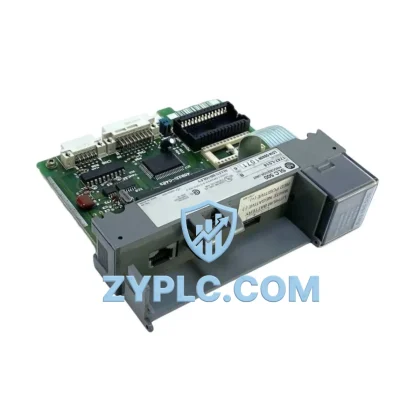
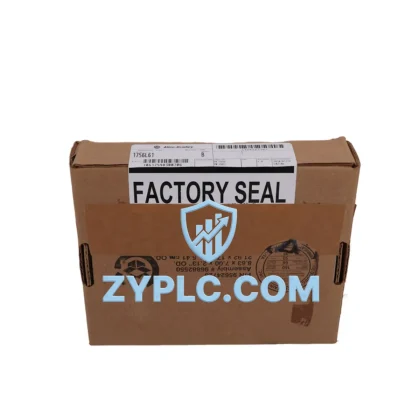
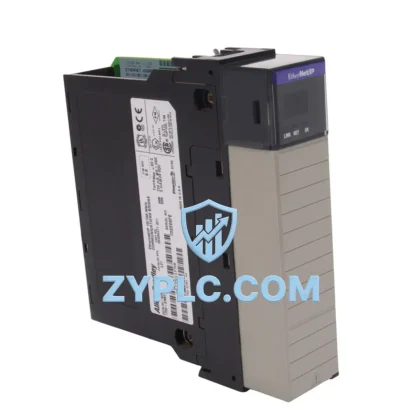
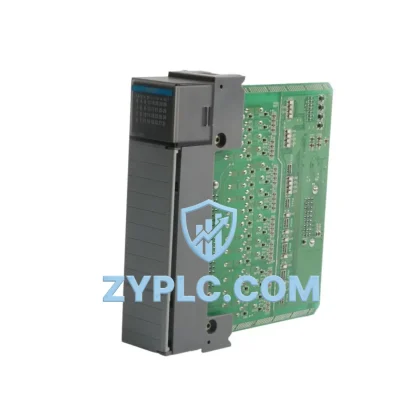
Allen-Bradley 1756-L71/B System-Ready CPU for ControlLogix Architecture
The Allen-Bradley 1756-L71/B is a high-performance Logix5571 CPU module engineered for deployment within the Rockwell Automation ControlLogix 1756 platform — one of the most widely adopted distributed control architectures in global industrial automation. Rather than functioning as a standalone controller, the 1756-L71/B is designed to operate as the central processing node within a layered, multi-tier control system, coordinating signal flow across I/O subsystems, communication networks, power infrastructure, human-machine interfaces, and field-level actuators. Its role in the architecture is to provide deterministic scan-cycle execution, scalable memory management, and seamless integration with the broader Rockwell ecosystem, making it a foundational component for engineers designing systems that demand long-term reliability, modular expandability, and structured redundancy.
With 2MB of user memory and support for up to 4,000 I/O points, the 1756-L71/B is positioned in the control layer of a typical automation hierarchy, sitting above the I/O layer and below the supervisory or SCADA layer. This positioning allows it to execute ladder logic, function block diagrams, structured text, and sequential function charts simultaneously, enabling complex multi-domain control strategies within a single chassis. The module is housed in the standard 1756 ControlLogix chassis — compatible with the 1756-A4, 1756-A7, 1756-A10, 1756-A13, and 1756-A17 backplane configurations — and communicates with co-resident modules via the ControlBus backplane at high-speed rates that eliminate inter-module latency in time-critical applications.
Architecture Specification Table
| Parameter |
Specification |
| System Role |
Primary CPU / Control Layer Processor — ControlLogix 1756 Platform |
| Catalog Number |
1756-L71/B |
| Controller Series |
Logix5571 — ControlLogix 1756 |
| User Memory |
2 MB |
| Maximum I/O Points |
4,000 (local + remote) |
| Communication Ports |
USB (programming), EtherNet/IP via 1756-EN2T/EN3TR modules |
| Backplane Compatibility |
1756-A4, 1756-A7, 1756-A10, 1756-A13, 1756-A17 |
| Power Supply Compatibility |
1756-PA72, 1756-PB72, 1756-PA75, 1756-PB75 |
| Operating Voltage |
Supplied via chassis backplane (no direct AC/DC input) |
| Operating Temperature |
0°C to 60°C (32°F to 140°F) |
| Relative Humidity |
5% to 95% non-condensing |
| Programming Software |
Studio 5000 Logix Designer v21 and above |
| Communication Protocols |
EtherNet/IP, ControlNet (via 1756-CN2), DeviceNet (via 1756-DNB) |
| Redundancy Support |
Yes — with 1756-RM2/A redundancy module and matched chassis pair |
| Installation Standard |
DIN rail or panel mount via 1756 chassis |
| Certifications |
UL, CE, cUL, ATEX (zone 2 with appropriate housing) |
| Warranty |
12-Month Warranty — covers manufacturing defects and functional failure |
Coordinated Control System Design
The 1756-L71/B achieves its full operational value when integrated within a complete ControlLogix system architecture. At the power layer, the 1756-PA72 or 1756-PB72 chassis power supply provides regulated backplane voltage to all co-resident modules, ensuring stable operation of the CPU and its peripheral cards under variable load conditions. Engineers designing high-availability systems often pair the 1756-L71/B with the 1756-RM2/A redundancy module, which enables controller redundancy through a synchronized primary-secondary chassis pair — a configuration commonly deployed in continuous process industries where unplanned downtime carries significant operational cost.
At the I/O layer, the 1756-L71/B communicates directly with local analog and digital I/O modules such as the 1756-IB16 (16-point 24VDC digital input), 1756-OB16E (16-point electronically fused digital output), and 1756-IF8 (8-channel analog input) installed in the same chassis. For distributed I/O architectures, the controller extends its reach via EtherNet/IP using the 1756-EN2T communication module, enabling connection to remote 1734 POINT I/O racks, 1769 CompactLogix expansion nodes, or third-party EtherNet/IP-compatible field devices across plant-wide networks.
At the network and communication layer, the 1756-CN2 ControlNet bridge module allows the 1756-L71/B to participate in deterministic, scheduled ControlNet topologies — particularly valuable in motion control and high-speed discrete manufacturing environments where EtherNet/IP’s non-deterministic characteristics are insufficient. For legacy integration, the 1756-DNB DeviceNet scanner module enables the controller to manage DeviceNet device networks, supporting drives, sensors, and valve manifolds that predate EtherNet/IP adoption.
At the human-machine interface layer, the 1756-L71/B integrates natively with PanelView Plus 7 terminals via EtherNet/IP, enabling operators to monitor real-time tag values, alarm states, and production metrics without additional protocol conversion. For supervisory integration, the controller’s tag database is accessible to Wonderware, FactoryTalk View SE, and third-party SCADA platforms through OPC-DA or OPC-UA server configurations, supporting plant-wide data aggregation and historian connectivity.
At the execution layer, the 1756-L71/B coordinates with PowerFlex 755 variable frequency drives via EtherNet/IP for closed-loop speed and torque control, and with Kinetix 6500 servo drives via integrated motion on EtherNet/IP (IMEC) for multi-axis coordinated motion. This architecture eliminates the need for dedicated motion controllers in many applications, consolidating control logic, motion profiles, and safety interlocks within a single Logix platform.
Application in Layered Automation Systems
In power generation and electrical substation automation, the 1756-L71/B serves as the primary controller for protection relay coordination, transformer monitoring, and switchgear sequencing. Its deterministic scan cycle and redundancy capability make it suitable for IEC 61850-compliant substation architectures when paired with appropriate protocol gateways.
In oil, gas, and petrochemical process control, the module is deployed in safety-instrumented system (SIS) adjacent architectures, managing process variable regulation, emergency shutdown sequencing, and compressor anti-surge control. Its compatibility with the 1756-L7SP Safety Controller allows engineers to implement SIL 2-rated safety functions within the same chassis family, simplifying cabinet design and reducing wiring complexity.
In water and wastewater treatment facilities, the 1756-L71/B manages pump station sequencing, chemical dosing control, and SCADA telemetry across geographically distributed lift stations. Its EtherNet/IP communication capability supports fiber-optic ring topologies that provide network redundancy across remote sites.
In automotive and discrete manufacturing, the controller coordinates robotic cell integration, conveyor sequencing, vision system triggers, and quality inspection interlocks. Its high I/O density and fast scan times support the tight cycle-time requirements of high-volume assembly lines.
In mining and mineral processing, the 1756-L71/B controls crusher sequencing, conveyor load balancing, and flotation cell management in environments characterized by high vibration, dust ingress, and wide temperature variation — conditions the module is rated to withstand within an appropriately specified enclosure.
Architecture Engineering FAQ
Q1: Is the 1756-L71/B compatible with existing 1756 ControlLogix chassis and power supplies already installed in my facility?
Yes. The 1756-L71/B is fully compatible with all standard 1756-series chassis (1756-A4 through 1756-A17) and all 1756-series power supplies including the 1756-PA72, 1756-PB72, 1756-PA75, and 1756-PB75. No chassis or power supply replacement is required when upgrading from earlier Logix5571 revisions. Programming migration from RSLogix 5000 projects is supported via Studio 5000 Logix Designer with standard import procedures.
Q2: Can the 1756-L71/B be configured for controller redundancy, and what additional hardware is required?
Yes. Controller redundancy requires a matched pair of 1756-L71/B modules installed in identical chassis configurations, connected via the 1756-RM2/A redundancy module and a dedicated 1756-RMCT7 fiber-optic cable. The redundancy system synchronizes program data, I/O state, and communication connections between primary and secondary controllers, enabling bumpless switchover in the event of a primary controller fault. Redundancy configuration is managed through the Redundancy Module Configuration Utility within Studio 5000.
Q3: What does the 12-Month Warranty cover, and what is the process for warranty claims?
The 12-Month Warranty covers all manufacturing defects, component failures, and functional deviations from published specifications under normal operating conditions. It does not cover damage resulting from incorrect installation, overvoltage events, or environmental exposure beyond rated limits. To initiate a warranty claim, contact ZYPLC at plc.sales@zyplc.com or +86 19859288691 with the module serial number, purchase documentation, and a description of the observed fault. Replacement or repair will be coordinated within the warranty period at no additional cost to the customer.
© 2026 ZYPLC. All rights reserved.
Original Source: https://zyplc.com
Contact: +86 19859288691 | plc.sales@zyplc.com