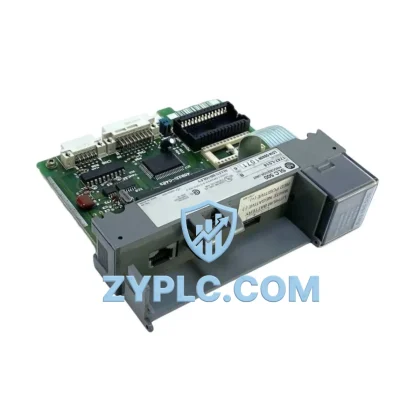
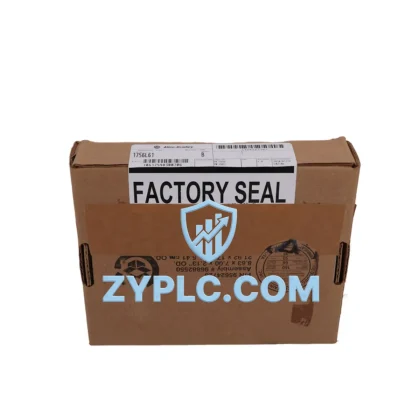
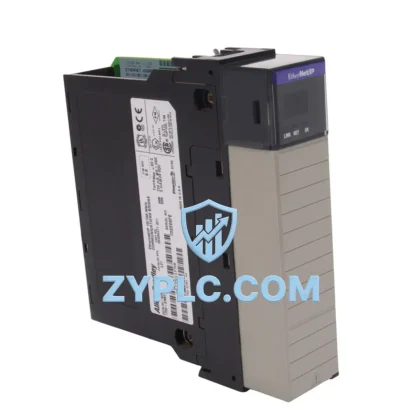
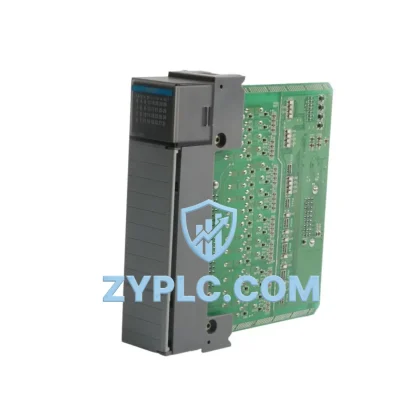
Allen-Bradley 1756-L71 System-Ready CPU for ControlLogix Architecture
The Allen-Bradley 1756-L71 is a high-performance ControlLogix CPU module engineered to serve as the central processing unit within Rockwell Automation’s Logix5000 control platform. Designed for demanding industrial environments, this processor delivers the computational power, memory capacity, and communication versatility required to anchor complex, multi-layer automation architectures. Whether deployed in discrete manufacturing, continuous process control, or hybrid applications, the 1756-L71 provides the system-level consistency and scalability that modern industrial operations demand.
Within a complete ControlLogix chassis-based architecture, the 1756-L71 occupies the control layer, coordinating signal acquisition from distributed I/O modules, executing ladder logic and function block programs, and managing upstream communication to supervisory systems. Its 2 MB user memory supports large-scale programs with structured data types, add-on instructions, and motion control routines, making it suitable for applications that require both high-speed processing and long-term program maintainability.
The 1756-L71 is fully compatible with the 1756 ControlLogix backplane, allowing seamless integration with a wide range of I/O, communication, and specialty modules within the same chassis. Engineers can populate the backplane with 1756-IB16 digital input modules, 1756-OB16E digital output modules, and 1756-IF8 analog input modules to build a comprehensive I/O layer that feeds real-time process data directly to the CPU. This tight backplane integration eliminates latency associated with remote I/O scanning and ensures deterministic control response across all connected field devices.
At the network layer, the 1756-L71 supports EtherNet/IP communication through the 1756-EN2T or 1756-EN3TR Ethernet bridge modules, enabling high-speed data exchange with SCADA systems, historian servers, and peer controllers. For legacy or specialized network requirements, the 1756-DNB DeviceNet bridge and 1756-CN2 ControlNet bridge modules extend the system’s communication reach without requiring additional CPU resources. This multi-network capability supports Contextual Integration across heterogeneous plant environments, allowing the 1756-L71 to serve as the integration hub for both modern and legacy field devices.
Power integrity is maintained through the 1756-PA75 or 1756-PB75 power supply modules, which provide regulated DC power to the ControlLogix chassis. For applications requiring high availability, redundant power configurations can be implemented alongside the 1756-RM2 redundancy module, enabling seamless CPU failover without process interruption. This redundancy architecture is particularly critical in power generation, oil and gas, and water treatment facilities where unplanned downtime carries significant operational and safety consequences.
The human-machine interface layer is typically served by PanelView Plus terminals communicating via EtherNet/IP, providing operators with real-time visualization of process variables managed by the 1756-L71. Engineering workstations running Studio 5000 Logix Designer connect directly to the CPU for program development, online monitoring, and firmware management, streamlining commissioning and ongoing maintenance workflows.
From a system architecture perspective, the 1756-L71 supports producer/consumer communication, allowing it to multicast data to multiple consuming devices simultaneously without duplicating network traffic. This capability is essential in coordinated motion systems, where the CPU must synchronize axis commands across multiple 1756-M02AE servo drive interface modules or Kinetix drive systems. The result is a tightly coupled execution environment where control, motion, and safety functions share a common programming environment and data namespace.
Long-term maintainability is a core design principle of the ControlLogix platform. The 1756-L71’s nonvolatile memory card slot accepts 1784-CF64 CompactFlash cards for program backup and automatic load-on-power-up functionality, reducing recovery time following unplanned shutdowns. Firmware updates are managed centrally through FactoryTalk Update Manager, ensuring that all controllers in a plant network remain synchronized to validated firmware versions without requiring individual on-site intervention.
ZYPLC maintains verified stock of the 1756-L71 with full functional testing prior to shipment. Each unit is covered by a 12-Month Warranty, providing assurance of operational reliability from the moment of installation. Our technical team supports pre-sales architecture consultation, helping engineers select compatible backplane, power, I/O, and communication modules to complete their ControlLogix system design efficiently.
Architecture Specification Table
| Parameter |
Specification |
| System Role |
ControlLogix CPU / Primary Controller |
| Platform |
Logix5000 / ControlLogix 1756 Series |
| User Memory |
2 MB |
| I/O Capacity |
Up to 128,000 I/O points (with remote I/O) |
| Communication Ports |
USB (programming), Backplane (EtherNet/IP via bridge modules) |
| Supported Networks |
EtherNet/IP, ControlNet, DeviceNet (via bridge modules) |
| Power Supply Compatibility |
1756-PA75, 1756-PB75 |
| Backplane Compatibility |
1756 ControlLogix Chassis (4, 7, 10, 13, 17-slot) |
| Operating Temperature |
0°C to 60°C |
| Relative Humidity |
5% to 95% (non-condensing) |
| Certifications |
UL, CE, C-Tick |
| Firmware Management |
Studio 5000 Logix Designer / FactoryTalk Update Manager |
| Warranty |
12-Month Warranty (ZYPLC) |
Coordinated Control System Design
The 1756-L71 achieves its full potential when integrated within a coordinated ControlLogix system architecture. A typical deployment begins with chassis selection — the 1756-A10 10-slot chassis provides sufficient capacity for the CPU alongside communication, I/O, and specialty modules. The 1756-PA75 AC power supply delivers stable chassis power, while the 1756-EN2T EtherNet/IP communication module connects the controller to the plant network, enabling real-time data exchange with MES and SCADA layers.
At the I/O layer, the 1756-IB16 16-point digital input module and 1756-OB16E 16-point electronically fused digital output module handle discrete field signals, while the 1756-IF8 8-channel analog input module processes continuous process variables such as temperature, pressure, and flow. For motion-intensive applications, the 1756-M02AE servo interface module coordinates axis control directly from the CPU’s motion task, maintaining synchronization across multi-axis systems without external motion controllers.
Redundancy is achieved through the 1756-RM2 redundancy module pair, which monitors CPU health and executes automatic switchover in the event of a primary controller fault. This configuration, combined with redundant 1756-EN3TR dual-port EtherNet/IP modules, ensures that both the control and network layers maintain continuous availability — a requirement in power distribution, chemical processing, and municipal water treatment applications.
Application in Layered Automation Systems
In automotive and discrete manufacturing environments, the 1756-L71 manages high-speed assembly line sequencing, coordinating conveyor drives, robotic welding cells, and vision inspection systems through a unified Logix5000 program. Its producer/consumer network model allows real-time data sharing between multiple controllers on the same EtherNet/IP network, enabling line-wide coordination without centralized bottlenecks.
In power generation and electrical substation applications, the 1756-L71 serves as the primary protection and control processor, interfacing with protective relays, switchgear, and energy metering systems through ControlNet or EtherNet/IP. Its deterministic scan time and redundancy support make it suitable for applications governed by IEC 61850 and NERC CIP compliance frameworks.
In oil and gas upstream and midstream facilities, the 1756-L71 controls wellhead automation, pipeline pressure regulation, and emergency shutdown sequences. Its compatibility with HART-enabled analog modules and Foundation Fieldbus gateway devices allows integration with intelligent field instruments, supporting advanced diagnostics and predictive maintenance programs.
In water and wastewater treatment plants, the 1756-L71 manages pump sequencing, chemical dosing, and filtration control across geographically distributed lift stations, communicating via fiber-optic EtherNet/IP networks to a central SCADA system. Its nonvolatile memory backup capability ensures rapid restart following power outages, minimizing treatment process disruption.
Architecture Engineering FAQ
Q1: Is the 1756-L71 compatible with existing 1756 ControlLogix chassis and power supplies already installed in my facility?
Yes. The 1756-L71 is fully compatible with all standard 1756 ControlLogix chassis variants (4, 7, 10, 13, and 17-slot) and with 1756-PA75 and 1756-PB75 power supply modules. No chassis or power supply replacement is required when upgrading from earlier L7x series processors, provided firmware compatibility is verified through Studio 5000 Logix Designer prior to installation.
Q2: Can the 1756-L71 be used in a redundant CPU configuration, and what additional modules are required?
Yes. The 1756-L71 supports ControlLogix redundancy when paired with the 1756-RM2 redundancy module. A redundant system requires two identical 1756-L71 CPUs in separate chassis, each equipped with matching communication modules (such as 1756-EN3TR dual-port Ethernet modules) and connected via the redundancy module fiber link. Rockwell Automation’s Redundancy Module firmware must be compatible with the CPU firmware revision. ZYPLC can assist with redundancy architecture planning and component sourcing.
Q3: What does the 12-Month Warranty cover, and how is a warranty claim processed?
ZYPLC’s 12-Month Warranty covers functional defects identified during normal operation under specified environmental conditions. If a 1756-L71 unit exhibits a verifiable hardware fault within the warranty period, ZYPLC will provide a replacement unit or repair service at no additional cost. Warranty claims are initiated by contacting our technical support team at plc.sales@zyplc.com or +86 19859288691, with a description of the fault condition and the original order reference.
© 2026 ZYPLC. All rights reserved.
Original Source: https://zyplc.com
Contact: +86 19859288691 | plc.sales@zyplc.com