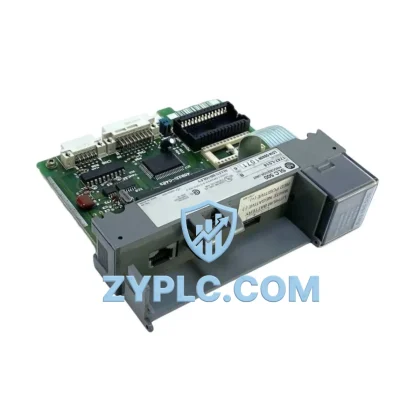
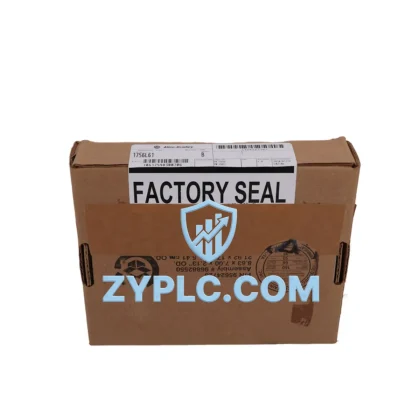
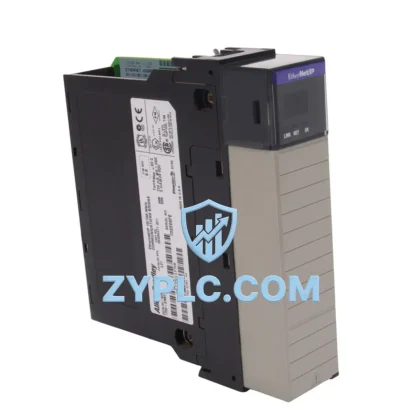
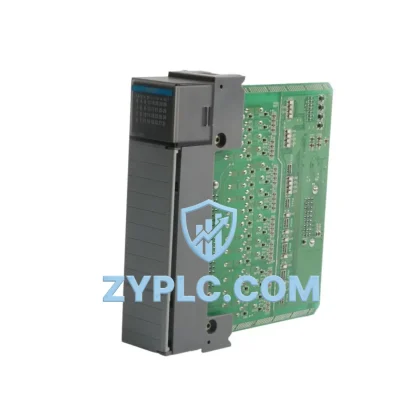
Allen-Bradley 1756-L72S System-Ready Safety Processor for ControlLogix Architecture
The Allen-Bradley 1756-L72S GuardLogix Logix5572S is a dual-processor safety PLC module engineered for deployment within the Rockwell Automation ControlLogix 1756 platform. Designed to serve as the central safety and standard control node in a unified chassis-based architecture, the 1756-L72S integrates seamlessly across the control layer, I/O layer, network layer, power layer, HMI layer, and execution layer — delivering a coherent, scalable, and redundant automation solution for demanding industrial environments.
In a complete ControlLogix system architecture, the 1756-L72S operates as the primary safety controller, coordinating standard and safety-rated I/O modules, managing EtherNet/IP and DeviceNet communications, and synchronizing with partner safety processors for SIL 2 / SIL 3 certified redundancy. Its dual-processor design — one standard Logix processor and one safety co-processor — enables simultaneous execution of standard and safety tasks within a single 1756 chassis, eliminating the need for separate safety racks and reducing overall panel footprint.
The processor supports up to 2 MB of standard user memory and 1 MB of safety memory, providing ample capacity for complex ladder logic, function block diagrams, structured text, and sequential function chart programs. Its native EtherNet/IP port enables direct integration with Rockwell’s Studio 5000 Logix Designer environment, supporting online edits, live diagnostics, and seamless firmware updates without system shutdown — a critical advantage for continuous-process industries such as petrochemical refining, power generation, and water treatment.
Within the layered automation hierarchy, the 1756-L72S communicates upward to SCADA and MES systems via EtherNet/IP, and downward to distributed I/O racks through the 1756 ControlBus backplane. It coordinates with 1756-EN2T or 1756-EN3TR EtherNet/IP communication modules for network redundancy, and interfaces with 1756-DNB DeviceNet bridge modules for legacy field device integration. The processor’s safety task execution is fully compatible with 1791DS and 1732DS ArmorBlock Guard I/O modules deployed in remote safety zones, enabling distributed safety architectures across large plant footprints.
Power integrity for the 1756-L72S is supplied through the 1756-PA75 or 1756-PB75 chassis power supply modules, which provide regulated 1.2 V, 3.3 V, 5 V, and 24 V DC rails to all modules within the 1756 chassis. For high-availability applications, dual power supply configurations using the 1756-PSCA2 power supply carrier allow hot-swap redundancy, ensuring uninterrupted processor operation during maintenance cycles. The processor’s low power consumption profile — typically under 4.5 W — minimizes thermal load within the control cabinet, supporting dense module configurations in 7-slot, 10-slot, or 17-slot 1756 chassis backplanes.
At the HMI layer, the 1756-L72S integrates natively with PanelView Plus 7 and PanelView 5500 operator terminals via EtherNet/IP, enabling real-time visualization of safety status, fault diagnostics, and process variables. FactoryTalk View SE and ME platforms can access safety tags directly from the GuardLogix tag database, providing operators with transparent safety state monitoring without additional programming overhead. This contextual integration between the safety processor and the HMI layer is a defining characteristic of the ControlLogix unified architecture.
For execution-layer coordination, the 1756-L72S interfaces with PowerFlex 755 and PowerFlex 527 variable frequency drives via EtherNet/IP, enabling safe torque-off (STO) and safe speed monitoring (SSM) functions to be executed directly from the safety task — eliminating the need for external safety relays in many drive-based safety circuits. This tight coupling between the safety processor and the drive layer reduces wiring complexity, shortens commissioning time, and improves overall system diagnostics.
From a system consistency and long-term maintenance perspective, the 1756-L72S supports Rockwell’s Integrated Architecture philosophy, allowing engineers to manage standard and safety programs, I/O configurations, network topologies, and motion axes from a single Studio 5000 project file. This unified engineering environment reduces the risk of configuration mismatches between safety and standard domains, accelerates FAT and SAT procedures, and simplifies spare-parts management — particularly important for facilities maintaining multi-year operational lifecycles.
ZYPLC maintains verified stock of the 1756-L72S with full traceability documentation, supporting rapid deployment for both new installations and emergency replacement scenarios. All units are supplied with a 12-Month Warranty covering manufacturing defects and functional performance, with technical support available throughout the warranty period to assist with installation, configuration, and system integration challenges.
Architecture Specification Table
| Parameter |
Specification |
| System Role |
GuardLogix Safety + Standard Controller (Dual Processor) |
| Platform |
Allen-Bradley ControlLogix 1756 Series |
| Standard User Memory |
2 MB |
| Safety User Memory |
1 MB |
| Safety Rating |
SIL 2 / SIL 3 (IEC 61508), PLe / Cat. 4 (ISO 13849) |
| Communication Ports |
1 × EtherNet/IP (native), ControlBus Backplane |
| Supported Networks |
EtherNet/IP, DeviceNet (via 1756-DNB), ControlNet (via 1756-CN2) |
| Power Consumption |
≤ 4.5 W (backplane) |
| Operating Temperature |
0 °C to 60 °C |
| Relative Humidity |
5% to 95% (non-condensing) |
| Chassis Compatibility |
1756-A4, 1756-A7, 1756-A10, 1756-A13, 1756-A17 |
| Programming Software |
Studio 5000 Logix Designer v21 and later |
| Certifications |
UL, CE, TÜV, cULus |
| Warranty |
12-Month Warranty (ZYPLC) |
Coordinated Control System Design
The 1756-L72S achieves its full architectural potential when deployed alongside complementary ControlLogix and GuardLogix components. Within the same 1756 chassis, the 1756-EN2T EtherNet/IP communication module provides a dedicated network interface for SCADA connectivity, while the 1756-DNB DeviceNet bridge module extends the safety controller’s reach to legacy field devices and safety light curtains on the DeviceNet network. For applications requiring ControlNet determinism, the 1756-CN2 ControlNet communication module enables scheduled, time-critical I/O updates between remote chassis and the primary GuardLogix rack.
Safety I/O expansion is achieved through 1756-IB16S and 1756-OB16S safety digital I/O modules installed in the same or remote 1756 chassis, providing SIL 2-rated discrete input and output channels for emergency stop circuits, safety gates, and light curtain interfaces. For analog process measurements in safety-instrumented systems, the 1756-IF8 analog input module delivers 16-bit resolution across 8 channels, supporting 4–20 mA and ±10 V field signals with full diagnostics. Power supply redundancy is maintained through paired 1756-PA75 power supply modules mounted on a 1756-PSCA2 power supply carrier, ensuring continuous backplane power during single-supply maintenance events.
At the operator interface layer, PanelView Plus 7 terminals connected via EtherNet/IP provide real-time safety status visualization, while FactoryTalk View SE server installations aggregate safety and standard tag data for plant-wide SCADA dashboards. Drive-level safety integration is completed through PowerFlex 755 drives with embedded safe torque-off capability, communicating with the 1756-L72S safety task via EtherNet/IP to execute STO commands without hardwired safety relay circuits.
Application in Layered Automation Systems
The 1756-L72S is deployed across a broad spectrum of industrial sectors where functional safety and system scalability are non-negotiable requirements. In automotive manufacturing, GuardLogix systems built around the 1756-L72S manage robotic welding cell safety zones, press guarding, and conveyor interlocks, with safety programs certified to PLe / Cat. 4 under ISO 13849. The processor’s ability to execute standard motion coordination and safety monitoring within a single chassis reduces the number of controllers required per production cell, lowering both capital cost and maintenance complexity.
In oil and gas and petrochemical processing, the 1756-L72S serves as the safety instrumented system (SIS) controller for emergency shutdown (ESD) and fire-and-gas (F&G) applications, operating in SIL 2 or SIL 3 configurations depending on the process hazard analysis outcome. Its compatibility with HART-enabled analog I/O modules and Foundation Fieldbus gateways allows integration with existing field instrument networks without replacing legacy wiring infrastructure.
For power generation and utilities, including thermal, hydro, and renewable energy facilities, the 1756-L72S provides turbine protection, generator excitation control interlocks, and grid synchronization safety logic. Its high-temperature operating range and vibration tolerance make it suitable for installation in turbine control rooms and switchgear buildings. Water and wastewater treatment facilities deploy the 1756-L72S for pump station safety interlocks, chemical dosing system protection, and SCADA-integrated alarm management, leveraging its EtherNet/IP connectivity for remote monitoring across geographically distributed pump stations.
In mining and metals processing, the processor manages conveyor belt safety systems, crusher protection circuits, and hoisting machine interlocks, where SIL 2 certification is mandated by regional mining safety regulations. Its robust operating temperature range and resistance to electrical noise make it well-suited for the harsh electromagnetic environments typical of mining control rooms.
Architecture Engineering FAQ
Q1: Is the 1756-L72S compatible with existing ControlLogix 1756 chassis and I/O modules already installed in my facility?
Yes. The 1756-L72S is fully compatible with all standard 1756 chassis backplanes (1756-A4 through 1756-A17) and coexists with standard ControlLogix I/O modules, communication modules, and motion modules within the same chassis. Safety I/O modules (1756-IB16S, 1756-OB16S) must be used for safety-rated circuits, while standard I/O modules continue to serve non-safety functions. No chassis hardware modifications are required for integration, and the processor is configured entirely through Studio 5000 Logix Designer, which manages both standard and safety program domains within a single project file.
Q2: Can the 1756-L72S be used in a redundant controller configuration, and what additional hardware is required?
The 1756-L72S supports ControlLogix redundancy when paired with a second 1756-L72S unit and the 1756-RM2 redundancy module. The redundancy module synchronizes program data, I/O state, and network connections between the primary and secondary chassis at scan-rate intervals, enabling bumpless switchover in the event of a primary controller fault. EtherNet/IP network redundancy is achieved through dual 1756-EN3TR modules configured in Device Level Ring (DLR) topology. This configuration is commonly specified for continuous-process applications in petrochemical and power generation facilities where unplanned downtime carries significant safety and financial consequences.
Q3: What does the 12-Month Warranty cover, and what support is available during the warranty period?
The 12-Month Warranty provided by ZYPLC covers all manufacturing defects and functional performance failures under normal operating conditions as specified in the product datasheet. Warranty coverage begins from the date of shipment and includes replacement or repair of defective units at no additional cost. During the warranty period, ZYPLC’s technical support team is available to assist with installation verification, Studio 5000 configuration guidance, network integration troubleshooting, and safety program validation support. For warranty claims or technical inquiries, contact ZYPLC at +86 19859288691 or [email protected].
© 2026 ZYPLC. All rights reserved.
Original Source: https://zyplc.com
Contact: +86 19859288691 | [email protected]