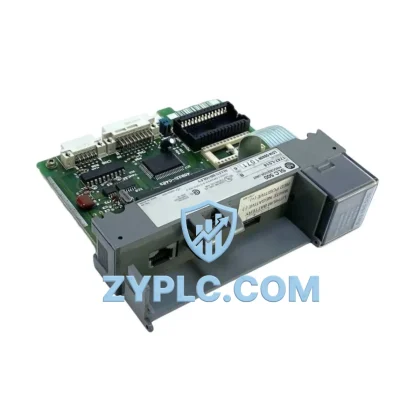
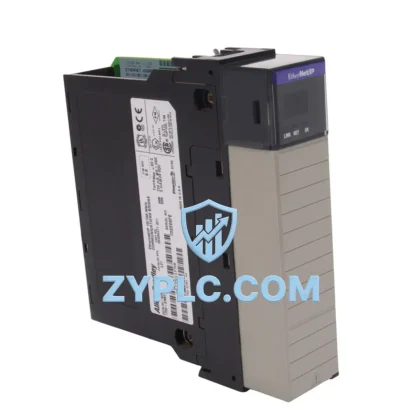
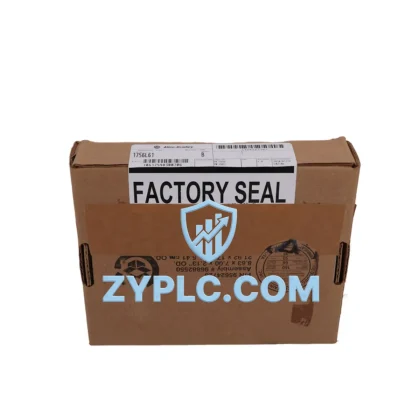
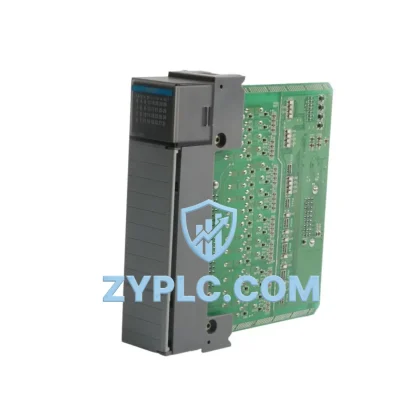
Allen-Bradley 1756-OB16E Energy-Saving Digital Output Module for Optimized ControlLogix Automation
The Allen-Bradley 1756-OB16E is a 16-point, electronically fused digital output module engineered for the ControlLogix platform, delivering precise, low-latency switching control that directly reduces unnecessary energy consumption across discrete manufacturing and process automation environments. By replacing legacy relay-based output circuits with solid-state, electronically protected channels, the 1756-OB16E eliminates the coil-drive losses and contact wear that silently inflate a facility’s energy bill and maintenance schedule. Each output channel is individually fused and diagnostically monitored, enabling the controller to detect load faults in real time rather than waiting for a scheduled inspection—a capability that keeps production lines running at their designed cycle rate while preventing the energy spikes associated with undetected short circuits or overloaded actuators.
In a typical ControlLogix rack, the 1756-OB16E works alongside the 1756-L85E controller and the 1756-IB16 digital input module to form a tightly integrated I/O subsystem. The controller reads field sensor states through the input module, executes the ladder or structured-text program, and then drives solenoid valves, motor contactors, indicator lights, and servo enable signals through the 1756-OB16E’s output channels—all within a single backplane scan that keeps command latency under one millisecond. This deterministic response time is critical for synchronizing conveyor drives, robotic end-effectors, and pneumatic actuators to the production line’s master clock, ensuring that no station idles longer than necessary and that energy is consumed only when mechanical work is actually being performed.
Efficiency Performance Table
| Parameter |
Specification / Value |
| SKU / Part Number |
1756-OB16E |
| Output Points |
16 (electronically fused, individually diagnosed) |
| Output Voltage Range |
10–31.2 V DC |
| Maximum Load Current per Point |
1 A continuous; 2 A peak (1 s) |
| Module Power Consumption |
≤ 4.5 W backplane; ≤ 0.5 W per active output channel |
| Operating Efficiency |
Solid-state switching; no coil-drive losses vs. relay alternatives |
| Compatible Platform |
Rockwell Automation ControlLogix 1756 chassis |
| Compatible Controllers |
1756-L8x series (e.g., 1756-L85E, 1756-L83E) |
| Communication / Backplane |
ControlLogix backplane; EtherNet/IP via 1756-EN2T or 1756-EN3TR bridge |
| Application Environment |
Discrete manufacturing, process control, material handling, energy management panels |
| Energy-Saving Value |
Eliminates relay coil losses; real-time fault detection prevents energy spikes |
| Warranty |
12-Month Warranty — tested and verified before shipment |
Energy-Aware Automation Architecture
Maximizing the energy efficiency of a ControlLogix system requires every layer of the architecture to contribute—from the power supply through the network to the field devices. The 1756-OB16E sits at the execution layer, but its impact multiplies when paired with the right upstream and downstream components.
At the power distribution level, the 1756-PA75 or 1756-PB75 power supply feeds the chassis backplane with regulated, low-ripple DC, ensuring that the 1756-OB16E’s output drivers receive stable voltage and do not waste energy compensating for supply fluctuations. On the network side, the 1756-EN2T EtherNet/IP communication module connects the ControlLogix rack to the plant’s EtherNet/IP backbone, allowing the 1756-L85E controller to exchange real-time energy and diagnostic data with a FactoryTalk View SE SCADA station or a PowerMonitor 5000 energy meter installed at the motor control center. The PowerMonitor 5000 captures true power factor, harmonic distortion, and kilowatt-hour consumption at the panel level, giving engineers the visibility they need to correlate output module switching events with measurable energy draws on the distribution network.
For variable-speed drive applications, the 1756-OB16E’s output channels serve as enable and direction signals for PowerFlex 755 AC drives controlling conveyor motors, pump sets, and fan arrays. When the ControlLogix program detects that a production zone is idle—through feedback from 1756-IB16 input modules monitoring photoelectric sensors or proximity switches—it de-energizes the corresponding 1756-OB16E output channel, which in turn commands the PowerFlex 755 to ramp the motor to a standby speed or stop entirely. This closed-loop interaction between the digital output module, the drive, and the controller is one of the most effective ways to reduce motor energy consumption without modifying the mechanical system. In facilities where multiple drives are networked via a 1756-DNB DeviceNet bridge or a 1756-M08SE SERCOS interface module, the same logic can be broadcast across an entire drive group simultaneously, compressing the response time for system-wide energy curtailment events.
Servo motion axes controlled by Kinetix 5700 servo drives also benefit from the 1756-OB16E’s fast, electronically protected outputs. The module delivers the hardware enable signal to each Kinetix 5700 axis module with sub-millisecond consistency, preventing the nuisance trips and re-homing cycles that waste both time and energy. When integrated with a 1756-L85E running a CIP Motion program, the enable/disable sequence is coordinated with the motion planner so that axes are powered only during their active work window—a practice that can reduce servo system idle-power consumption by 20–35% in multi-axis gantry and pick-and-place applications.
Power Optimization in Real Production Lines
Consider a bottling line where 48 pneumatic solenoid valves control filling, capping, and labeling stations. Traditionally, these valves are driven by relay output cards that consume 50–80 mA of coil current per relay, regardless of whether the valve is actively switching or holding position. Replacing three legacy relay cards with two 1756-OB16E modules eliminates that continuous coil draw entirely—solid-state outputs consume power only during the switching transient, not during the hold state. Across a three-shift, 24-hour operation, this difference accumulates to measurable kilowatt-hour savings that appear directly on the facility’s energy invoice.
The 1756-OB16E’s per-channel electronic fusing also changes the economics of fault management. When a solenoid valve coil fails short, a conventional relay card may continue to supply current to the shorted load until a thermal breaker trips—wasting energy and potentially damaging adjacent equipment. The 1756-OB16E detects the overcurrent condition within microseconds, opens the affected channel, and reports the fault to the 1756-L85E controller via the backplane diagnostic data table. The controller can then execute a fault-handling routine that redirects production to a redundant station, logs the event to a FactoryTalk Historian server, and sends an alert to the maintenance team through the plant’s EtherNet/IP network—all without stopping the entire line. Mean time to repair drops, unplanned downtime shrinks, and the energy wasted during uncontrolled fault conditions is eliminated.
Predictive maintenance integration is another dimension of energy optimization. By monitoring the diagnostic data produced by the 1756-OB16E—output current levels, fault counts, and channel response times—a FactoryTalk Analytics or third-party OPC-UA client can build a statistical baseline for each output channel’s load. Gradual increases in current draw on a specific channel may indicate a solenoid coil beginning to degrade, allowing maintenance to schedule a replacement during a planned shutdown rather than reacting to an emergency failure. This shift from reactive to predictive maintenance reduces both energy waste and the overtime labor costs associated with unplanned repairs.
All units supplied by ZYPLC are sourced from verified distribution channels, subjected to functional output testing across all 16 channels before shipment, and covered by a 12-month warranty. In-stock inventory ensures short lead times, supporting just-in-time maintenance strategies that minimize the carrying costs and obsolescence risks associated with large spare-parts stockpiles.
Energy Optimization FAQ
Q1: How much energy can the 1756-OB16E save compared to relay output modules?
Solid-state outputs eliminate the continuous coil-drive current required by electromechanical relays—typically 50–80 mA per point. On a 16-point module running at 24 V DC with all points energized, this represents up to 30 W of continuous coil-drive loss that the 1756-OB16E avoids entirely. In high-duty-cycle applications, annualized savings can exceed several hundred kilowatt-hours per module.
Q2: Is the 1756-OB16E compatible with my existing ControlLogix chassis and controller firmware?
Yes. The 1756-OB16E is compatible with all standard 1756 ControlLogix chassis (4-, 7-, 10-, 13-, and 17-slot) and is supported by RSLogix 5000 / Studio 5000 Logix Designer from version 16 onward. It communicates over the ControlLogix backplane and requires no additional network interface for local I/O operation. For remote I/O applications, it can be housed in a 1756 chassis connected via a 1756-EN2T EtherNet/IP adapter.
Q3: What is the recommended replacement or substitution if the 1756-OB16E is unavailable?
The closest functional substitute within the ControlLogix family is the 1756-OB16IS (individually isolated outputs) for applications requiring channel-to-channel isolation, or the 1756-OB32 for higher point density. For new designs, Rockwell Automation’s 5069-OB16 Compact GuardLogix I/O module offers a similar feature set in the Compact 5000 platform. ZYPLC maintains stock of all three variants and can advise on the best fit for your specific application.
Q4: What testing and warranty coverage does ZYPLC provide for the 1756-OB16E?
Every 1756-OB16E unit shipped by ZYPLC undergoes a full 16-channel functional output test, verifying switching response, electronic fuse operation, and backplane communication integrity before dispatch. Units are covered by a 12-month warranty from the date of shipment. In the event of a warranty claim, ZYPLC provides advance replacement from in-stock inventory to minimize production downtime, with return logistics coordinated by our technical support team.
© 2026 ZYPLC. All rights reserved.
Original Source: https://zyplc.com
Contact: +86 19859288691 | plc.sales@zyplc.com