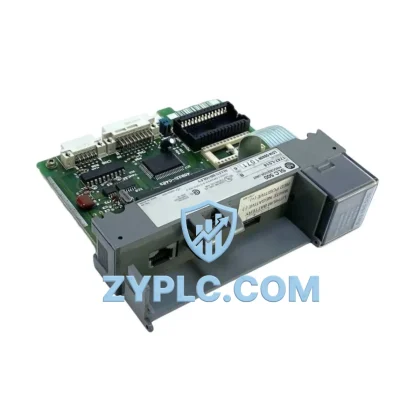
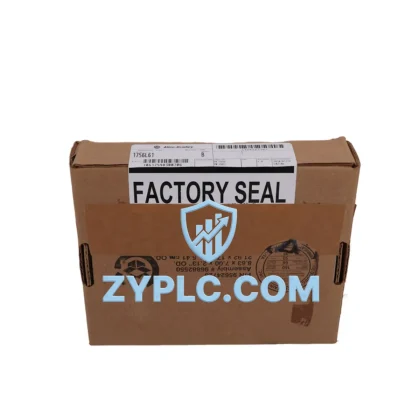
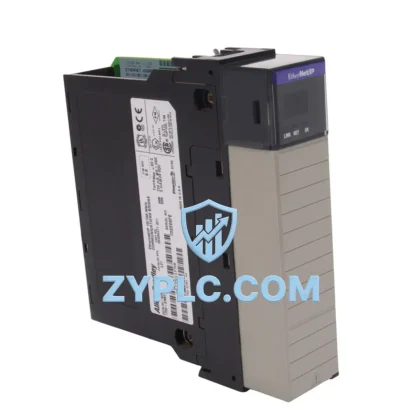
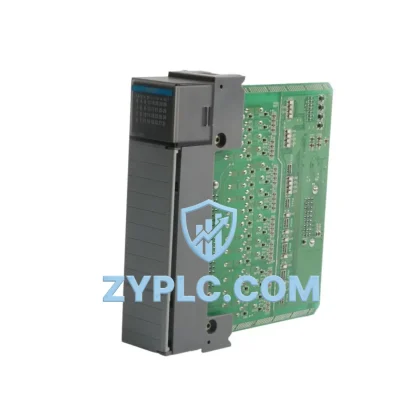
Allen-Bradley 1756-OB16I System-Ready Output Module for ControlLogix Architecture
The Allen-Bradley 1756-OB16I is a 16-point isolated digital output module engineered for seamless integration within the Rockwell Automation ControlLogix 1756 platform. Rather than functioning as a standalone component, the 1756-OB16I is designed to operate as a precision output layer within a fully coordinated control system architecture — bridging the logic decisions of the controller tier with the physical execution layer of field devices, actuators, solenoids, and motor starters. Its isolated output design ensures that each channel maintains electrical independence, protecting the backplane and upstream controller assets from field-side voltage transients, ground loops, and inductive load disturbances that are common in heavy industrial environments.
In a layered automation architecture, the 1756-OB16I occupies the discrete output position within the I/O tier, receiving commanded states from the ControlLogix CPU — such as the 1756-L73 or 1756-L85E — via the 1756 ControlBus backplane. The module’s isolated channel architecture supports 10–30V DC field devices at up to 1A per point, making it suitable for driving 24VDC solenoid valves, relay coils, pilot lights, and variable frequency drive enable signals across manufacturing, power distribution, and process control applications. Its point-level isolation eliminates common-mode interference that would otherwise compromise signal integrity in mixed-voltage control cabinets.
System architects integrating the 1756-OB16I into a ControlLogix chassis benefit from its compatibility with the full 1756 ecosystem. When paired with a 1756-PA75 or 1756-PB75 power supply module, the chassis power budget is maintained with predictable current draw, supporting high-density I/O configurations without derating. The module slots into any position within a 1756-A7, 1756-A10, or 1756-A17 chassis, enabling flexible rack layouts that balance I/O density with thermal management requirements. For redundant architectures, the 1756-OB16I can be deployed in mirrored chassis configurations managed by a 1756-RM2 redundancy module, ensuring that output states are maintained without interruption during controller switchover events.
From a network and communications perspective, the 1756-OB16I operates transparently under EtherNet/IP and ControlNet topologies managed by communication bridge modules such as the 1756-EN2T or 1756-CN2. In distributed I/O architectures, remote 1756 chassis containing 1756-OB16I modules can be addressed over EtherNet/IP using the Logix Designer tag-based addressing model, eliminating the need for separate I/O mapping tables and reducing commissioning time significantly. This integration model also supports online firmware updates and live I/O diagnostics without requiring system shutdown, a critical advantage in continuous process environments.
At the human-machine interface layer, operator stations running FactoryTalk View SE or ME can display real-time output channel status sourced directly from 1756-OB16I diagnostic tags, enabling maintenance personnel to identify de-energized outputs, blown fuses, or wiring faults without physical panel inspection. This diagnostic transparency reduces mean time to repair (MTTR) and supports predictive maintenance strategies in facilities operating under IEC 62443 cybersecurity and ISA-88 batch control frameworks.
For system engineers managing long-term spare parts strategies, the 1756-OB16I represents a stable, widely deployed module with broad cross-compatibility across ControlLogix generations. Maintaining a verified inventory of tested 1756-OB16I modules — alongside complementary components such as the 1756-IB16I isolated input module, 1756-IF8 analog input module, and 1756-OF8 analog output module — ensures that unplanned downtime events can be resolved within hours rather than days. All units supplied by ZYPLC are covered by a 12-Month Warranty and have undergone functional verification testing prior to shipment.
Architecture Specification Table
| Parameter |
Specification |
| System Role |
Discrete Digital Output — ControlLogix I/O Tier |
| Output Points |
16 Points, Point-Level Isolated |
| Output Voltage Range |
10–30V DC |
| Output Current per Point |
1A maximum |
| Total Module Current |
8A maximum (all points energized) |
| Backplane Current Draw |
120mA @ 5.1V DC |
| Isolation Voltage |
Group-to-group: 250V AC continuous |
| Communication Interface |
1756 ControlBus Backplane (EtherNet/IP, ControlNet via bridge) |
| Compatible Chassis |
1756-A4, 1756-A7, 1756-A10, 1756-A13, 1756-A17 |
| Compatible Controllers |
1756-L6x, 1756-L7x, 1756-L8x ControlLogix CPUs |
| Operating Temperature |
0–60°C (32–140°F) |
| Relative Humidity |
5–95% non-condensing |
| Certifications |
UL, CE, CSA, C-Tick |
| Warranty |
12-Month Warranty (ZYPLC Verified) |
| Contextual Integration |
Full Contextual Integration with ControlLogix 1756 Platform |
Coordinated Control System Design
The 1756-OB16I achieves its full performance potential when deployed as part of a coordinated ControlLogix system rather than as an isolated replacement component. A typical high-availability architecture begins at the controller tier with a redundant pair of 1756-L73 or 1756-L85E CPUs managed by the 1756-RM2 redundancy module, which synchronizes controller memory states at scan-cycle intervals to ensure bumpless transfer during failover. The 1756-PA75 chassis power supply provides regulated 5.1V and 24V DC backplane power, while a secondary 1756-PB75 DC-input power supply can be added for dual-feed power redundancy in critical applications.
Within the I/O tier, the 1756-OB16I works in close coordination with the 1756-IB16I isolated digital input module, which captures field device feedback signals — limit switches, proximity sensors, and flow switch contacts — and returns them to the controller for logic evaluation. Analog process variables are handled by the 1756-IF8 analog input module and 1756-OF8 analog output module, which manage 4–20mA and 0–10V signals from transmitters, positioners, and variable speed drives. Together, these modules form a complete discrete and analog I/O layer capable of supporting complex interlocked process sequences.
At the network layer, the 1756-EN2T EtherNet/IP communication module connects the local ControlLogix chassis to the plant-wide EtherNet/IP network, enabling peer-to-peer produced/consumed tag communication with remote chassis, SCADA systems, and historian servers. In legacy installations, the 1756-CN2 ControlNet bridge module provides deterministic I/O scanning for motion and safety-critical applications. Terminal block assemblies using 1492-CABLE wiring systems connect the 1756-OB16I field-side terminals to marshalling panels, reducing wiring errors and enabling pre-tested cable assemblies to be swapped during maintenance windows without rewiring.
Application in Layered Automation Systems
The 1756-OB16I is deployed across a wide range of industrial sectors where reliable discrete output control is essential to process integrity. In automotive manufacturing, the module drives solenoid valves on pneumatic assembly fixtures, controlling clamp, weld, and transfer sequences at cycle times measured in milliseconds. Its isolated output architecture prevents ground faults on one fixture from propagating to adjacent stations, maintaining line availability in high-throughput body-in-white and powertrain assembly environments.
In electrical power distribution substations, the 1756-OB16I provides trip and close commands to circuit breaker control circuits, operating within IEC 61850-compliant protection and control architectures. The module’s 10–30V DC output range is compatible with standard substation control voltage levels, and its point-level isolation meets the electrical separation requirements of IEC 60255 relay protection standards. Redundant ControlLogix chassis configurations ensure that protection functions remain available during planned maintenance or unplanned controller faults.
In petrochemical and refinery applications, the 1756-OB16I controls shutdown valve actuators, pump motor starters, and flare ignition systems within Safety Instrumented System (SIS) architectures designed to IEC 61511 functional safety standards. While the 1756-OB16I itself is a standard (non-SIL-rated) module, it is commonly deployed in the basic process control system (BPCS) layer alongside SIL-rated safety controllers, providing the operational control outputs that manage normal process conditions while the safety layer handles emergency shutdown functions.
Water and wastewater treatment facilities use the 1756-OB16I to control pump station motor starters, chemical dosing pump enables, and UV disinfection system contactors across distributed lift station networks. The module’s compatibility with EtherNet/IP remote I/O architectures allows a single ControlLogix controller to manage multiple geographically distributed pump stations over fiber-optic Ethernet infrastructure, reducing the need for local PLCs at each station and centralizing maintenance and diagnostics.
Architecture Engineering FAQ
Q1: Is the 1756-OB16I compatible with all ControlLogix chassis and controller generations?
The 1756-OB16I is compatible with all standard 1756-series chassis (1756-A4 through 1756-A17) and all ControlLogix controller generations from the 1756-L6x through the current 1756-L8x series. It is configured and addressed using Logix Designer (Studio 5000) software, and its module definition is included in the standard RSLogix 5000 and Studio 5000 module library. No special firmware or add-on profile is required for basic I/O operation, though the latest module firmware should be applied to access diagnostic features available in newer controller revisions.
Q2: Can the 1756-OB16I be used in a redundant ControlLogix architecture, and how is output state managed during controller switchover?
Yes. In a redundant ControlLogix system managed by the 1756-RM2 redundancy module, the 1756-OB16I maintains its last commanded output state during the switchover interval, which typically completes within one controller scan cycle. The redundancy system synchronizes output image data between the primary and secondary controllers continuously, so the secondary controller assumes control with an accurate representation of all output states. Engineers should configure output fault states in the module properties to define safe fallback behavior in the event of a communication interruption between the controller and the I/O chassis.
Q3: What does the 12-Month Warranty cover, and what support is available for system integration?
All 1756-OB16I modules supplied by ZYPLC are covered by a 12-Month Warranty against manufacturing defects and functional failures under normal operating conditions. Each unit undergoes functional verification testing prior to shipment, including output channel actuation testing and backplane communication verification. For system integration support, ZYPLC’s technical team provides pre-sales architecture consultation to confirm module compatibility with existing chassis, power supply budgets, and controller firmware versions. Replacement units are dispatched within 24 hours for warranty claims, minimizing system downtime for critical applications.
© 2026 ZYPLC. All rights reserved.
Original Source: https://zyplc.com
Contact: +86 19859288691 | [email protected]