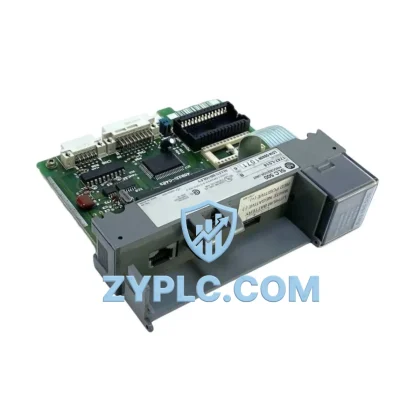
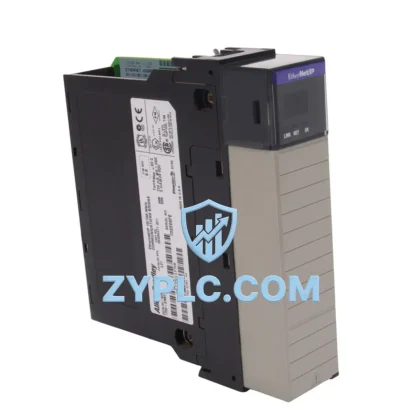
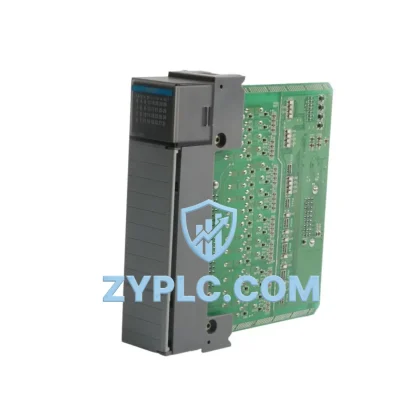
Allen-Bradley 1756-OB32/A System-Ready Digital Output for ControlLogix Architecture
The Allen-Bradley 1756-OB32/A is a 32-point 24VDC sourcing digital output module engineered for seamless integration within the Rockwell Automation ControlLogix 1756 Series control platform. Rather than functioning as a standalone component, this module is designed to operate as a precision output layer within a fully coordinated automation architecture — connecting the logic decisions of the CPU to the physical execution layer of field devices, actuators, solenoids, and relay-driven loads.
In modern industrial control environments — spanning discrete manufacturing, power distribution, petrochemical processing, water treatment, mining operations, and metallurgical production — the reliability of the digital output layer is foundational to system integrity. The 1756-OB32/A delivers that reliability through its high-density 32-channel configuration, solid-state output design, and native compatibility with the ControlLogix backplane communication architecture. Its role within the system is not merely to switch signals, but to sustain the signal fidelity, timing accuracy, and electrical isolation that complex multi-layer automation demands.
When deployed alongside a 1756-L73 or 1756-L85E ControlLogix CPU, the 1756-OB32/A participates in a tightly synchronized I/O scan cycle managed through the 1756-A10 or 1756-A17 chassis backplane. The CPU’s ladder logic or function block programs issue output commands that are transmitted across the backplane at deterministic scan rates, ensuring that field-side actuators respond within the timing windows required by the process. This determinism is critical in applications such as packaging line sequencing, conveyor control, and valve actuation in process plants.
From a power architecture perspective, the 1756-OB32/A operates in conjunction with the 1756-PA75 or 1756-PB75 chassis power supply, which provides the regulated backplane voltage required for stable module operation. Proper power budgeting across the chassis — accounting for the combined load of CPU modules, communication modules, and I/O modules — is essential during system commissioning. Engineers integrating the 1756-OB32/A into a new or expanded ControlLogix rack should verify chassis power headroom using Rockwell’s system sizing tools before finalizing the hardware configuration.
Network-layer integration is equally important. In distributed control architectures, the 1756-OB32/A may reside in a remote chassis connected to the primary controller via a 1756-EN2T EtherNet/IP communication module or a 1756-DNB DeviceNet bridge module. This allows the output module to be physically located near the field devices it controls — reducing wiring runs and improving signal integrity — while remaining under the logical control of a centralized or redundant CPU. EtherNet/IP-based I/O connections support both unicast and multicast configurations, enabling flexible topology design for large-scale systems.
For applications requiring high availability, the 1756-OB32/A integrates naturally into ControlLogix redundancy architectures. When paired with a 1756-RM2 redundancy module and a mirrored chassis configuration, the system can execute automatic controller switchover without disrupting the output state of field devices. This capability is particularly valued in continuous process industries — such as oil refining, chemical production, and power generation — where unplanned output interruptions carry significant operational and safety consequences.
Human-machine interface integration is supported through the broader ControlLogix ecosystem. PanelView Plus 7 HMI terminals communicate with the controller via EtherNet/IP, providing operators with real-time visibility into output channel states, fault conditions, and diagnostic data. The 1756-OB32/A supports per-channel diagnostics accessible through Studio 5000 Logix Designer, enabling maintenance engineers to identify open-load faults, short-circuit conditions, or thermal overload events without physical inspection of the field wiring.
Terminal block wiring for the 1756-OB32/A is accomplished using the 1756-TBCH or 1756-TBS6H removable terminal assemblies, which allow the module to be replaced during maintenance without disturbing field wiring. This design significantly reduces mean time to repair (MTTR) in production environments where minimizing downtime is a priority. Combined with the module’s hot-swap capability within a powered ControlLogix chassis, maintenance teams can execute module replacements during scheduled windows or even during controlled production pauses without full system shutdown.
Architecture Specification Table
| Parameter |
Specification |
| System Role |
32-Point Digital Output Module — ControlLogix I/O Layer |
| Output Points |
32 sourcing DC outputs |
| Output Voltage |
10–31.2V DC |
| Output Current (per point) |
1A continuous |
| Output Current (per module) |
10A max (all points energized) |
| Backplane Communication |
ControlLogix 1756 Series backplane |
| Communication Protocol |
EtherNet/IP (via 1756-EN2T), DeviceNet (via 1756-DNB) |
| Isolation |
Optical isolation between field and backplane |
| Operating Temperature |
0–60°C (32–140°F) |
| Relative Humidity |
5–95% non-condensing |
| Mounting |
1756-A4, 1756-A7, 1756-A10, 1756-A13, 1756-A17 chassis |
| Diagnostics |
Per-channel fault detection via Studio 5000 Logix Designer |
| Terminal Assembly |
1756-TBCH / 1756-TBS6H (removable, field-wiring retained) |
| Hot-Swap Support |
Yes — module replaceable under power |
| Certifications |
UL, CE, cUL |
| Warranty |
12-Month Warranty — covered by ZYPLC quality assurance program |
Coordinated Control System Design
The 1756-OB32/A achieves its full performance potential when deployed as part of a coordinated ControlLogix system architecture. A typical high-availability configuration begins with a 1756-L85E controller — Rockwell’s highest-capacity ControlLogix CPU — managing program execution and I/O scheduling across multiple chassis. The 1756-PA75 power supply provides stable backplane power, while the 1756-RM2 redundancy module enables automatic failover between primary and secondary controller chassis, ensuring that output states are preserved across switchover events.
On the input side, the 1756-IB32 32-point digital input module mirrors the output module’s channel density, allowing engineers to maintain a balanced I/O architecture within a single chassis slot pair. Analog process variables are handled by the 1756-IF16 analog input module, whose data feeds into the CPU’s control loops and influences the discrete output commands issued to the 1756-OB32/A. This tight coupling between analog measurement and discrete actuation is characteristic of well-designed process control architectures.
Network connectivity is provided by the 1756-EN2T EtherNet/IP communication module, which bridges the ControlLogix backplane to the plant’s industrial Ethernet network. Remote I/O chassis — potentially housing additional 1756-OB32/A modules positioned near field equipment — connect to the primary controller via EtherNet/IP adapter modules, extending the system’s physical reach without sacrificing scan-time performance. For legacy DeviceNet device integration, the 1756-DNB scanner module provides protocol bridging within the same chassis.
At the field termination level, 1492-AIFM8-F-5 analog interface modules and 1492-IFM20F-24-F digital interface modules from Allen-Bradley’s 1492 series provide structured wiring solutions that complement the 1756-OB32/A’s removable terminal assemblies. These interface modules reduce panel wiring complexity and support modular replacement strategies that align with the output module’s hot-swap design philosophy.
Application in Layered Automation Systems
In discrete manufacturing environments — such as automotive assembly, electronics production, and consumer goods packaging — the 1756-OB32/A serves as the primary interface between the ControlLogix controller and the pneumatic valve banks, motor starter relays, and indicator light arrays that constitute the execution layer. Its 32-channel density allows a single module to control an entire production cell’s discrete outputs, reducing chassis slot consumption and simplifying system documentation.
In power generation and electrical substation automation, the module’s optical isolation and solid-state output design provide the electrical noise immunity required in high-voltage environments. Output channels drive protection relay trip coils, breaker control circuits, and annunciator panels, with the ControlLogix CPU executing IEC 61131-3 ladder logic programs that implement protection and control schemes compliant with utility industry standards.
Petrochemical and refinery applications leverage the 1756-OB32/A within Safety Instrumented System (SIS) adjacent architectures, where the module controls shutdown valve actuators, emergency depressurization systems, and flare ignition circuits. While the standard 1756-OB32/A is not a SIL-rated safety module, it operates alongside GuardLogix safety controllers in architectures where standard and safety I/O are segregated by function but share a common network infrastructure.
Water and wastewater treatment facilities deploy the module to control pump motor starters, chemical dosing pump relays, UV disinfection system contactors, and aeration blower control circuits. The module’s wide operating temperature range and humidity tolerance make it suitable for installation in outdoor or semi-outdoor control panels common in water infrastructure projects.
Mining and metallurgical operations — including ore processing, smelting, and rolling mill control — rely on the 1756-OB32/A’s robust output current capacity to drive heavy-duty relay coils and solenoid valves in high-vibration, high-temperature environments. The module’s diagnostic capabilities allow maintenance teams to monitor output health remotely via the plant’s SCADA system, reducing the need for physical inspections in hazardous areas.
Architecture Engineering FAQ
Q1: Is the 1756-OB32/A compatible with all ControlLogix chassis sizes, and can it be mixed with other 1756 Series I/O modules in the same chassis?
Yes. The 1756-OB32/A is compatible with all standard ControlLogix chassis — including the 1756-A4, 1756-A7, 1756-A10, 1756-A13, and 1756-A17 — and can be freely mixed with other 1756 Series modules including digital input modules (1756-IB32), analog modules (1756-IF16, 1756-OF8), and communication modules (1756-EN2T, 1756-DNB) within the same chassis. Module placement should be planned to optimize backplane power distribution and minimize thermal concentration.
Q2: How does the 1756-OB32/A behave during a ControlLogix redundancy switchover, and will output states be maintained?
In a properly configured ControlLogix redundancy system using the 1756-RM2 redundancy module, the secondary controller maintains a synchronized copy of the primary controller’s output data table. During an automatic switchover event, the secondary controller assumes control and the output modules — including the 1756-OB32/A — continue to receive output commands without interruption. The switchover process is designed to complete within the configured RPI (Requested Packet Interval) window, minimizing any transient output state changes. Proper redundancy configuration and testing during commissioning is essential to validate this behavior for each specific application.
Q3: What does the 12-Month Warranty cover for the 1756-OB32/A, and what support is available for long-term maintenance planning?
ZYPLC’s 12-Month Warranty covers the 1756-OB32/A against manufacturing defects and functional failures under normal operating conditions. Warranty claims are supported by ZYPLC’s technical team, who can assist with failure diagnosis, module testing, and replacement coordination. For long-term maintenance planning, ZYPLC maintains inventory of 1756 Series modules to support customers managing aging ControlLogix installations where Rockwell Automation has announced product lifecycle transitions. Customers are encouraged to contact ZYPLC at [email protected] or +86 19859288691 to discuss multi-unit stocking agreements and extended support arrangements.
© 2026 ZYPLC. All rights reserved.
Original Source: https://zyplc.com
Contact: +86 19859288691 | [email protected]