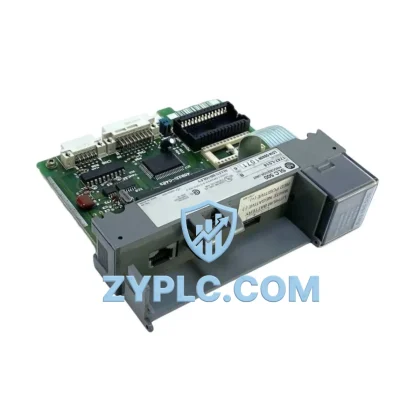
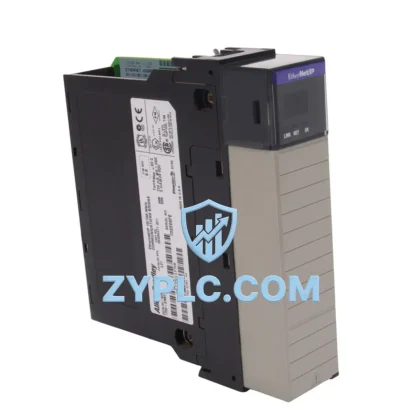
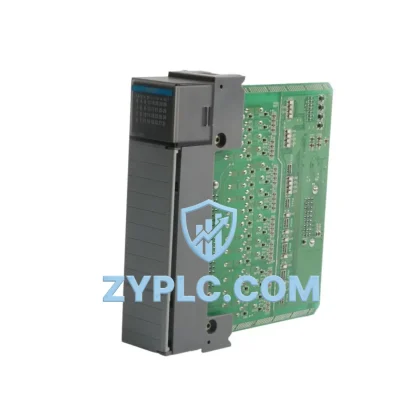
Allen-Bradley 1756-OF6VI System-Ready Isolated Output for ControlLogix Architecture
The Allen-Bradley 1756-OF6VI is a six-channel isolated analog output module engineered for seamless integration within the Rockwell Automation ControlLogix 1756 platform. Designed to operate as a precision signal-conditioning layer between the controller and field-level actuators, this module plays a critical role in maintaining signal integrity across complex, multi-tier industrial control architectures. Whether deployed in continuous process control, discrete manufacturing, or hybrid automation environments, the 1756-OF6VI delivers the electrical isolation, output resolution, and system-level compatibility required for demanding industrial applications.
In a fully layered automation system, the 1756-OF6VI occupies the analog output position within the I/O layer, receiving setpoint commands from the CPU layer and translating them into precise 4–20 mA or 0–10 VDC signals directed to field devices such as control valves, variable frequency drives, and positioners. Its channel-to-channel and channel-to-backplane isolation architecture ensures that ground loops, transient surges, and electrical noise from the field side do not propagate into the controller backplane, protecting upstream components including the 1756-L8x series ControlLogix CPUs and the 1756-PA75 or 1756-PB75 power supply modules.
The module installs directly into any 1756 series chassis — including the 1756-A4, 1756-A7, 1756-A10, and 1756-A17 — and communicates over the ControlLogix backplane using the standard 1756 I/O messaging protocol. This allows the 1756-OF6VI to be addressed and configured through Studio 5000 Logix Designer, enabling engineers to define output scaling, fault states, and ramp rates at the tag level without additional hardware configuration tools. Integration with the 1756-EN2T or 1756-EN3TR EtherNet/IP communication modules allows remote I/O monitoring and diagnostics via standard Ethernet infrastructure, supporting both local and distributed control topologies.
Architecture Specification Table
| Parameter |
Specification |
| System Role |
Analog Output — I/O Layer (ControlLogix Architecture) |
| Output Channels |
6 Channels, Individually Isolated |
| Output Signal Range |
4–20 mA / 0–20 mA / ±10 VDC (software selectable) |
| Output Resolution |
16-bit (1 in 65,535) |
| Isolation |
Channel-to-channel and channel-to-backplane isolation |
| Isolation Voltage |
250 VAC continuous (channel-to-backplane) |
| Backplane Communication |
1756 ControlLogix Backplane (proprietary high-speed bus) |
| Compatible Chassis |
1756-A4, 1756-A7, 1756-A10, 1756-A13, 1756-A17 |
| Power Consumption |
325 mA @ 5 VDC (backplane); 2 mA @ 24 VDC |
| Operating Temperature |
0°C to 60°C (32°F to 140°F) |
| Relative Humidity |
5% to 95% non-condensing |
| Certifications |
UL, CE, C-Tick, ATEX (Zone 2) |
| Firmware Compatibility |
Studio 5000 Logix Designer v21 and above |
| Warranty |
12-Month Warranty — Covered by ZYPLC Quality Assurance Program |
Coordinated Control System Design
The 1756-OF6VI achieves its full performance potential when deployed as part of a coordinated ControlLogix system architecture. At the controller layer, the 1756-L83E or 1756-L85E ControlLogix CPU manages the execution of ladder logic, function block, and structured text programs that generate the analog setpoint values consumed by the 1756-OF6VI. These setpoints are passed across the 1756 backplane at scan rates synchronized with the controller task configuration, ensuring deterministic output updates aligned with process requirements.
Power integrity for the entire chassis is maintained by the 1756-PA75 AC input power supply or the 1756-PB75 DC input variant, both of which provide regulated 5 VDC and 24 VDC rails to all installed modules. For applications requiring high availability, a redundant power supply configuration using dual 1756-PA75 units with the 1756-PSCA2 power supply chassis adapter ensures uninterrupted operation even during a single power supply failure.
Network connectivity is provided by the 1756-EN2T EtherNet/IP bridge module, which enables the ControlLogix system to participate in plant-wide SCADA and DCS integration over standard Ethernet. For legacy installations requiring DeviceNet or ControlNet connectivity, the 1756-DNB DeviceNet scanner or 1756-CN2 ControlNet module can be co-installed in the same chassis, allowing the 1756-OF6VI to serve as the analog output resource for multi-network control architectures.
At the human-machine interface layer, operator visualization of the analog output values and process variables is typically handled by PanelView Plus 7 terminals communicating via EtherNet/IP, providing real-time trending, alarm management, and setpoint adjustment capabilities without requiring direct access to the controller programming environment. Terminal block wiring to field devices is simplified using 1492-AIFM analog interface modules, which provide pre-wired connections between the 1756-OF6VI and field instrumentation, reducing installation time and wiring errors in high-density panel designs.
Application in Layered Automation Systems
In petrochemical and refinery process control applications, the 1756-OF6VI is commonly deployed to drive control valve positioners and flow control loops where signal isolation is mandatory due to the presence of hazardous area equipment and long cable runs between the control room and field junction boxes. The module’s 250 VAC channel-to-backplane isolation rating ensures compliance with IEC 61511 functional safety requirements for SIL-rated loops when used in conjunction with appropriate safety instrumented system (SIS) architecture.
In power generation and substation automation environments, the 1756-OF6VI provides isolated analog outputs for AVR (automatic voltage regulator) setpoint control, turbine governor speed reference signals, and reactive power compensation commands. Its compatibility with the ControlLogix redundancy system — using the 1756-RM2 redundancy module — allows hot-standby controller configurations where the analog output module continues to drive field devices without interruption during a controller switchover event.
For water and wastewater treatment facilities, the module drives variable frequency drives controlling pump speed, chemical dosing pump stroke length, and aeration blower output. The ability to configure individual channel fault states — holding last value, ramping to a defined safe output, or driving to zero — ensures that process upsets during controller faults do not result in uncontrolled actuator behavior, a critical requirement for environmental compliance and equipment protection.
In mining and mineral processing operations, the 1756-OF6VI supports conveyor speed control, crusher feed rate regulation, and flotation cell level control through isolated 4–20 mA outputs to field-mounted I/P transducers and VFD analog inputs. The module’s wide operating temperature range and vibration tolerance make it suitable for installation in control rooms adjacent to heavy processing equipment.
Architecture Engineering FAQ
Q1: Is the 1756-OF6VI compatible with ControlLogix redundancy systems, and what configuration is required?
Yes. The 1756-OF6VI is fully compatible with ControlLogix redundancy configurations using the 1756-RM2 redundancy module. In a redundant chassis pair, the module must be installed in the same slot position in both the primary and secondary chassis. Redundancy qualification requires that both chassis run identical firmware revisions and that the Studio 5000 project is configured with the redundancy enhancement firmware (RMCT) enabled. Output crossloading between primary and secondary controllers ensures bumpless transfer during switchover events.
Q2: How should the 1756-OF6VI be configured for safe-state output behavior during a controller fault?
Each output channel of the 1756-OF6VI can be independently configured for one of three fault state behaviors: hold last state, ramp to a user-defined value over a configurable time period, or drive immediately to a defined safe output value. These settings are configured within the module properties dialog in Studio 5000 Logix Designer under the Configuration tab. For SIL-rated applications, the fault state must be validated as part of the functional safety assessment and documented in the safety requirements specification (SRS).
Q3: What does the 12-Month Warranty cover, and how is a warranty claim processed through ZYPLC?
The 12-Month Warranty provided by ZYPLC covers verified manufacturing defects, functional failures under normal operating conditions, and firmware-related malfunctions confirmed through diagnostic testing. Physical damage, improper installation, or operation outside published electrical ratings are excluded. To initiate a warranty claim, contact ZYPLC at plc.sales@zyplc.com or +86 19859288691 with the module serial number, purchase documentation, and a description of the observed fault. ZYPLC will arrange return merchandise authorization (RMA) and provide a replacement or repaired unit within the agreed service timeline.
© 2026 ZYPLC. All rights reserved.
Original Source: https://zyplc.com
Contact: +86 19859288691 | plc.sales@zyplc.com