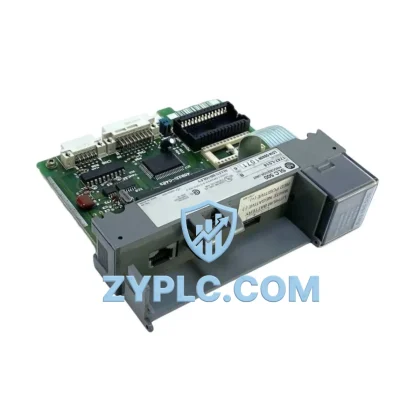
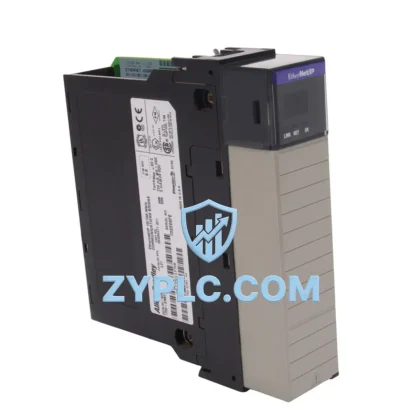
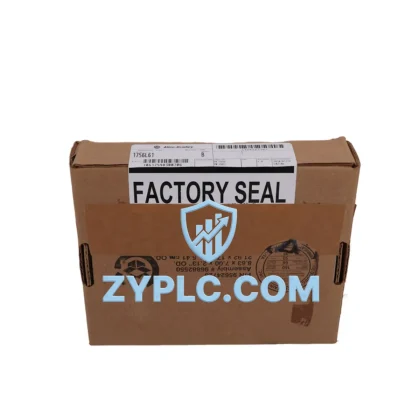
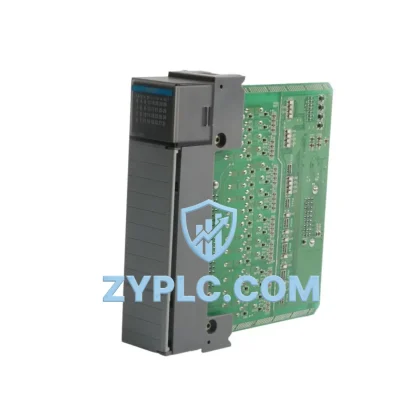
Allen-Bradley 1756-OF8I System-Ready Isolated Analog Output for ControlLogix Architecture
In a fully integrated ControlLogix control system, every module must contribute to signal fidelity, architectural consistency, and long-term operational reliability. The Allen-Bradley 1756-OF8I is an 8-channel isolated analog output module engineered specifically for the 1756 ControlLogix chassis platform. Its role within the control hierarchy is not simply to convert digital values to analog signals — it is to serve as the precision interface between the controller’s execution layer and the physical process, ensuring that each output channel maintains electrical isolation, accurate resolution, and deterministic response across demanding industrial environments.
Understanding the 1756-OF8I requires viewing it within the broader ControlLogix system architecture. At the control layer, the 1756-L8x series processors — such as the 1756-L83E or 1756-L85E — execute the ladder logic or structured text programs that generate the setpoint values delivered to this module. These processors communicate with the 1756-OF8I over the ControlLogix backplane, a high-speed internal bus that enables deterministic data exchange between all modules seated in the 1756-A7, 1756-A10, or 1756-A17 chassis. The backplane architecture eliminates the latency and noise susceptibility of external wiring between the controller and I/O, making the 1756-OF8I a natural fit for high-precision process control applications.
At the power layer, the 1756-PA75 or 1756-PB75 power supply modules provide the regulated DC power required by the chassis and all installed modules, including the 1756-OF8I. Proper power budgeting across the chassis is essential when deploying multiple analog output modules, and the isolated design of the 1756-OF8I helps prevent ground loops and common-mode interference from propagating between channels or into the chassis power rail. This isolation is particularly valuable in applications where output channels drive actuators, control valves, or variable frequency drives operating at different electrical potentials.
Architecture Specification Table
| Parameter |
Specification |
| System Role |
Isolated Analog Output Module — ControlLogix I/O Layer |
| Output Channels |
8 Channels, Individually Isolated |
| Output Signal Range |
0–20 mA / 4–20 mA / ±10 VDC (software configurable per channel) |
| Resolution |
16-bit (voltage), 15-bit + sign (current) |
| Isolation Voltage |
Channel-to-channel and channel-to-backplane isolation |
| Backplane Communication |
ControlLogix 1756 High-Speed Backplane |
| Compatible Chassis |
1756-A4, 1756-A7, 1756-A10, 1756-A13, 1756-A17 |
| Operating Temperature |
0°C to 60°C (32°F to 140°F) |
| Power Consumption |
Backplane: 1.0 A @ 5 VDC; 3.0 A @ 24 VDC (typical) |
| Certifications |
UL, CE, C-Tick |
| Mounting |
1756 ControlLogix Chassis Slot (any slot) |
| Warranty |
12-Month Warranty — Tested, Verified, Ready for Deployment |
Coordinated Control System Design
The 1756-OF8I does not operate in isolation — it is one node in a coordinated system architecture that spans multiple functional layers. At the network layer, EtherNet/IP communication modules such as the 1756-EN2T or 1756-EN2TR provide the bridge between the ControlLogix backplane and the plant-wide Ethernet infrastructure. These communication modules allow the 1756-L8x processor to exchange data with SCADA systems, historian servers, and remote I/O adapters while simultaneously managing the local I/O modules, including the 1756-OF8I, over the backplane.
For applications requiring redundancy, the 1756-OF8I can be deployed in a ControlLogix redundancy system alongside the 1756-RM2 redundancy module. In a redundant architecture, the primary and secondary chassis each contain a matched set of I/O modules, and the redundancy module manages automatic switchover in the event of a primary controller or chassis failure. This design ensures that analog output signals to critical actuators — such as control valves in a refinery or dosing pumps in a water treatment plant — are never interrupted by a single point of failure.
On the input side, the 1756-IF16 or 1756-IF8 analog input modules work in tandem with the 1756-OF8I to form closed-loop control loops entirely within the ControlLogix chassis. The processor reads process variable signals from the analog input modules, executes PID or advanced control algorithms, and writes corrected setpoints back to the 1756-OF8I output channels. This tight integration between input and output modules, all communicating over the same high-speed backplane, minimizes loop scan time and maximizes control precision.
At the human-machine interface layer, PanelView Plus 7 terminals connected via EtherNet/IP provide operators with real-time visibility into the analog output values generated by the 1756-OF8I. Operators can monitor channel status, adjust setpoints within defined limits, and acknowledge alarms — all without interrupting the control program execution on the 1756-L8x processor. This seamless integration between the HMI layer and the I/O layer is a hallmark of the ControlLogix platform’s contextual integration capability.
Application in Layered Automation Systems
The 1756-OF8I finds application across a wide range of process and discrete manufacturing industries. In oil and gas processing facilities, the module drives control valve positioners that regulate flow rates of hydrocarbons through separation trains, with each output channel independently isolated to prevent interference between adjacent control loops operating at different process pressures. In power generation plants, the module provides setpoint signals to turbine governor systems and excitation controllers, where signal accuracy and channel isolation are critical to grid stability.
In water and wastewater treatment facilities, the 1756-OF8I controls chemical dosing pumps and aeration blower variable frequency drives, with the 4–20 mA output range providing a standardized interface to a wide variety of field devices from different manufacturers. In pharmaceutical manufacturing, the module’s high resolution and channel isolation support precise control of temperature, pressure, and flow in validated batch processes, where regulatory compliance requires documented signal accuracy and traceability.
In metallurgical and mining operations, the 1756-OF8I manages furnace temperature setpoints, conveyor speed references, and hydraulic pressure control loops in environments characterized by high electrical noise, vibration, and wide temperature swings. The module’s robust isolation design and ControlLogix chassis mounting provide the mechanical and electrical stability required for continuous operation in these demanding conditions. In packaging and material handling lines, the module coordinates speed references for multiple servo drives and pneumatic valve controllers, enabling synchronized motion profiles that maximize throughput and minimize product waste.
Architecture Engineering FAQ
Q1: Can the 1756-OF8I be mixed with non-isolated analog output modules in the same ControlLogix chassis?
Yes. The ControlLogix chassis architecture allows any combination of 1756-series modules to be installed in any slot, regardless of module type. The 1756-OF8I can coexist with non-isolated analog output modules such as the 1756-OF8, digital I/O modules, and communication modules in the same chassis. The processor’s I/O configuration in Studio 5000 Logix Designer manages each module independently, and the isolated design of the 1756-OF8I ensures that its channels do not electrically interact with adjacent modules. This flexibility allows engineers to optimize chassis slot utilization based on application requirements and cost constraints.
Q2: What are the compatibility requirements for integrating the 1756-OF8I into an existing ControlLogix redundancy architecture?
The 1756-OF8I is compatible with ControlLogix redundancy systems using the 1756-RM2 redundancy module. Both the primary and secondary chassis must contain identical module configurations, including the same catalog number, firmware revision, and slot position for all I/O modules. The redundancy system synchronizes output data between the primary and secondary controllers, ensuring that the 1756-OF8I in the secondary chassis is always ready to assume control without a bump in the analog output signals. Engineers should verify firmware compatibility between the 1756-OF8I, the 1756-L8x processor, and the 1756-RM2 module using the Rockwell Automation Product Compatibility and Download Center (PCDC) before deployment.
Q3: What does the 12-Month Warranty cover, and how does it support long-term maintenance planning?
The 12-Month Warranty covers verified functionality of the 1756-OF8I across all eight output channels, including signal accuracy, channel isolation integrity, backplane communication, and hardware condition. Each unit is tested prior to shipment to confirm compliance with Allen-Bradley specifications. For maintenance engineers managing aging ControlLogix systems, this warranty provides assurance that replacement modules sourced through ZYPLC will perform identically to new factory units, supporting planned maintenance schedules, spare parts inventory strategies, and capital expenditure justification. The warranty also supports contextual integration planning, ensuring that replacement modules can be dropped into existing chassis configurations without requiring recalibration or software changes.
© 2026 ZYPLC. All rights reserved.
Original Source: https://zyplc.com
Contact: +86 19859288691 | plc.sales@zyplc.com