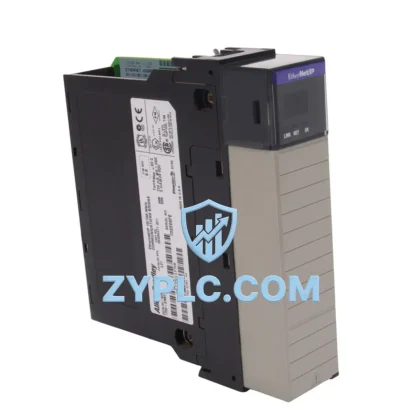
Allen-Bradley 1756-PA75/B System-Ready Power Supply for ControlLogix Architecture
The Allen-Bradley 1756-PA75/B is a high-capacity AC power supply module engineered for seamless integration within the Rockwell Automation ControlLogix 1756 platform. Rated at 75W output, this module delivers stable, regulated DC power to the 1756 chassis backplane, sustaining the full operational load of CPU modules, I/O modules, communication adapters, and specialty cards simultaneously. In large-scale distributed control architectures — spanning manufacturing, power generation, petrochemical processing, water treatment, mining, metallurgy, and continuous process industries — the 1756-PA75/B serves as the foundational power layer upon which all upstream and downstream control functions depend.
Unlike standalone power supplies, the 1756-PA75/B is designed with system-level thinking at its core. Its role is not simply to convert AC mains voltage to DC rail power; it is to ensure that every module seated in the 1756 chassis — from the 1756-L85E ControlLogix 5580 CPU to the 1756-EN3TR dual-port EtherNet/IP communication module — receives clean, uninterrupted power within the tight tolerances required for deterministic control. In redundant architectures, the 1756-PA75/B pairs with a second power supply module in a 1756-PSCA2 power supply chassis adapter configuration, enabling hot-swap capability and eliminating single points of failure at the power layer.
Architecture Specification Table
| Parameter |
Specification |
| System Role |
Chassis Backplane Power Supply — ControlLogix 1756 Platform |
| Input Voltage |
85–265V AC, 47–63 Hz (universal input range) |
| Output Power |
75W continuous to 1756 chassis backplane |
| Output Voltage |
5.1V DC (backplane), 24V DC (field power auxiliary) |
| Inrush Current |
≤ 40A peak at 265V AC |
| Operating Temperature |
0°C to 60°C (32°F to 140°F) |
| Relative Humidity |
5–95% non-condensing |
| Mounting |
1756 chassis slot (left-most position, dedicated power slot) |
| Communication |
Backplane power bus — no independent network interface |
| Certifications |
UL, CE, cUL, C-Tick |
| Series |
1756 ControlLogix Series B |
| Contextual Integration |
Full compatibility with 1756 Series chassis, CPU, I/O, and communication modules |
| Warranty |
12-Month Warranty — all units tested and verified prior to shipment |
Coordinated Control System Design
The 1756-PA75/B does not operate in isolation — it is the electrical foundation of a coordinated, multi-layer control system. In a typical ControlLogix architecture, the power supply module occupies the leftmost slot of a 1756-A17 or 1756-A10 chassis, immediately adjacent to the 1756-L85E or 1756-L83E ControlLogix 5580 CPU. The CPU executes the ladder logic, function block, and structured text programs that govern the entire process, while the 1756-PA75/B ensures that the CPU’s internal memory, I/O scan cycles, and EtherNet/IP communication tasks are never interrupted by power instability.
On the I/O layer, the 1756-PA75/B supports the simultaneous operation of digital input modules such as the 1756-IB32 (32-point 24V DC input), digital output modules such as the 1756-OB32 (32-point 24V DC output), and analog modules such as the 1756-IF16 (16-channel analog input) and 1756-OF8 (8-channel analog output). These modules interface directly with field instruments — pressure transmitters, flow meters, temperature sensors, and control valves — translating physical process variables into digital data that the CPU can act upon in real time.
At the network layer, the 1756-EN3TR dual-port EtherNet/IP communication module connects the ControlLogix chassis to the plant-wide SCADA network, historian servers, and remote I/O adapter racks. The 1756-PA75/B must sustain the power demands of this communication module without voltage sag, as any instability at the backplane level can cause communication timeouts and trigger fault conditions across the entire control network. In systems using DeviceNet or ControlNet, the 1756-DNB DeviceNet scanner or 1756-CN2 ControlNet module may also be present in the same chassis, further increasing the total power demand that the 1756-PA75/B is engineered to handle.
For human-machine interface integration, the ControlLogix system typically connects to a PanelView Plus 7 HMI terminal via EtherNet/IP, with the 1756-PA75/B indirectly supporting HMI responsiveness by maintaining stable CPU and communication module operation. In redundant controller configurations, a 1756-RM2 redundancy module coordinates primary and secondary chassis synchronization, and the 1756-PA75/B in each chassis must deliver consistent power to ensure that switchover events are seamless and do not disrupt the process.
Application in Layered Automation Systems
In discrete manufacturing environments — automotive assembly, electronics production, and packaging lines — the 1756-PA75/B powers ControlLogix systems that coordinate servo drives, pneumatic actuators, vision systems, and conveyor controls. The 75W output capacity accommodates fully populated chassis configurations, making it suitable for high-density I/O applications where dozens of modules must operate concurrently without power contention.
In power generation and electrical substation automation, the 1756-PA75/B supports ControlLogix systems performing protection relay coordination, transformer monitoring, and switchgear control. The wide AC input range (85–265V AC) makes it compatible with both 110V and 220V electrical infrastructure, a critical requirement in international power utility projects. The module’s compliance with IEC and UL standards ensures it meets the stringent safety requirements of electrical utility environments.
In petrochemical and refinery applications, the 1756-PA75/B operates within SIL-rated safety instrumented systems alongside the 1756-L8SP Safety CPU, providing the stable power foundation required for emergency shutdown (ESD) and fire and gas (F&G) detection systems. In water treatment and municipal infrastructure, the module powers ControlLogix systems managing pump stations, filtration processes, and SCADA-connected remote terminal units (RTUs). In mining and metallurgical operations, where ambient temperatures and vibration levels are elevated, the 1756-PA75/B’s industrial-grade design ensures reliable operation across the full environmental range specified for the 1756 platform.
Architecture Engineering FAQ
Q1: Can the 1756-PA75/B support a fully populated 1756-A17 chassis with mixed CPU, I/O, and communication modules?
Yes. The 1756-PA75/B is rated at 75W continuous output, which is sufficient to power a fully populated 1756-A17 17-slot chassis in most standard configurations. However, the total power budget must be calculated by summing the backplane current draw of all installed modules — including the CPU, all I/O modules, and communication adapters. If the total load approaches or exceeds 75W, a second 1756-PA75/B in a redundant power supply configuration using the 1756-PSCA2 adapter is recommended to maintain system stability and eliminate the risk of brownout conditions.
Q2: Is the 1756-PA75/B compatible with both Series A and Series B 1756 chassis, and does firmware version affect compatibility?
The 1756-PA75/B (Series B) is designed for use with all current 1756 chassis variants, including the 1756-A4, 1756-A7, 1756-A10, 1756-A13, and 1756-A17. It is backward compatible with Series A chassis hardware. Firmware version on the CPU module (1756-L8x series) does not affect power supply compatibility, as the 1756-PA75/B operates at the hardware backplane level independently of software or firmware state. Contextual Integration with the full 1756 ecosystem is maintained across all supported chassis and CPU revisions.
Q3: What does the 12-Month Warranty cover, and what is the process for warranty claims or long-term maintenance support?
All 1756-PA75/B units supplied by ZYPLC are covered by a 12-Month Warranty from the date of shipment, covering manufacturing defects, component failure under normal operating conditions, and verified electrical faults. Units are tested and inspected prior to dispatch. For warranty claims, customers should contact ZYPLC directly with the order reference and a description of the fault. ZYPLC also provides long-term maintenance support, including access to replacement units, technical consultation on system architecture compatibility, and assistance with integration into existing ControlLogix control system designs. Spare unit stocking is recommended for critical process applications to minimize unplanned downtime.
© 2026 ZYPLC. All rights reserved.
Original Source: https://zyplc.com
Contact: +86 19859288691 | plc.sales@zyplc.com