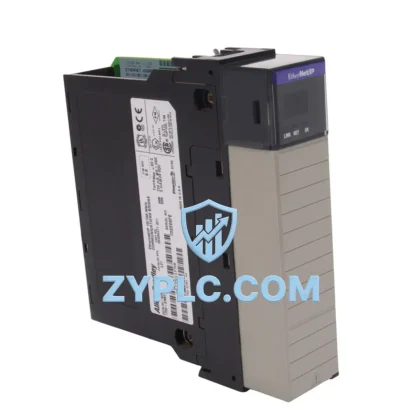
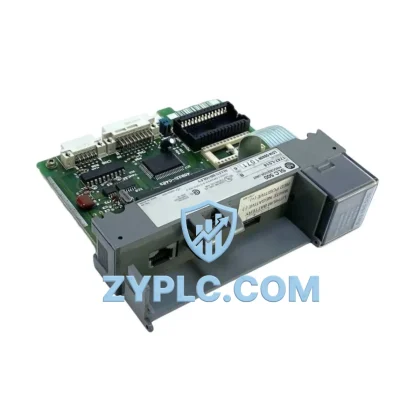
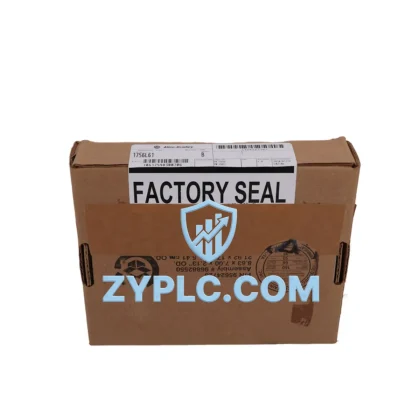
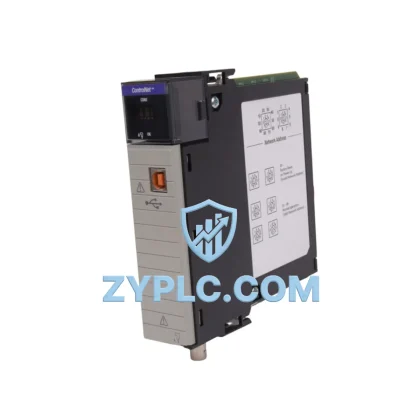
Allen-Bradley 1756-RMC1 System-Ready Redundancy Module for ControlLogix Architecture
The Allen-Bradley 1756-RMC1 Redundancy Module is a mission-critical component engineered for high-availability ControlLogix control system architectures. Rather than functioning as a standalone device, the 1756-RMC1 operates as the backbone of a fully synchronized redundant controller pair, ensuring that industrial processes in power generation, oil & gas, water treatment, and advanced manufacturing never experience unplanned downtime due to a single point of failure at the controller level. Its role within the 1756 chassis ecosystem is to manage the continuous state synchronization between a primary and secondary 1756-L7x or 1756-L8x controller, enabling bumpless switchover in the event of a hardware fault, communication loss, or planned maintenance event.
In a layered automation architecture, the 1756-RMC1 sits at the control layer — the nerve center that coordinates signal acquisition from the I/O layer, executes logic, and communicates decisions upward to the supervisory and HMI layers. Its presence fundamentally changes the risk profile of the entire system. Without redundancy, a controller fault cascades into process shutdown. With the 1756-RMC1 properly integrated, the secondary controller assumes control within milliseconds, preserving output states, retaining tag data, and maintaining communication with all downstream field devices and upstream SCADA systems. This level of Contextual Integration across system layers is what separates a resilient architecture from a fragile one.
Architecture Specification Table
| System Role |
Controller Redundancy Synchronization Module |
| Compatible Controllers |
1756-L71, 1756-L72, 1756-L73, 1756-L74, 1756-L75, 1756-L8x Series |
| Chassis Compatibility |
1756 ControlLogix Chassis (4, 7, 10, 13, 17-slot) |
| Redundancy Type |
Hot-standby, bumpless switchover |
| Synchronization Link |
Dedicated fiber-optic redundancy cable (1756-RMC1 to 1756-RMC1) |
| Switchover Time |
< 500 ms (typical, application-dependent) |
| Communication Capability |
EtherNet/IP, ControlNet (via co-resident communication modules) |
| Power Requirement |
Supplied via 1756 chassis backplane; compatible with 1756-PA72 / 1756-PB72 power supplies |
| Installation Environment |
Panel-mount, DIN-rail chassis; IP20 enclosure rating; 0–60°C operating range |
| Firmware Compatibility |
Requires matching firmware revision across primary and secondary chassis |
| Warranty |
12-Month Warranty — tested, verified, and ready for system integration |
Coordinated Control System Design
The 1756-RMC1 does not operate in isolation — its value is realized only when it is part of a fully coordinated redundant system architecture. A typical deployment pairs two 1756-L73 or 1756-L75 controllers, each seated in its own 1756-A17 seventeen-slot chassis, with one 1756-RMC1 module installed in each chassis. The two modules are connected via a dedicated fiber-optic synchronization cable, forming a private redundancy link that continuously mirrors the primary controller’s tag database, I/O state, and program execution context to the secondary.
At the power layer, each chassis is independently powered by a 1756-PA72 AC power supply or a 1756-PB72 DC power supply, ensuring that a power fault in one chassis does not compromise the other. For applications requiring enhanced power resilience, dual power supplies within a single chassis can be configured using the 1756-PSCA2 power supply chassis adapter, further eliminating single points of failure at the electrical layer.
The I/O layer in a redundant ControlLogix system typically employs remote I/O racks connected via ControlNet or EtherNet/IP. Modules such as the 1756-EN2TR EtherNet/IP communication module (with dual-port ring topology support) or the 1756-CN2R ControlNet module provide the network redundancy that complements the controller redundancy delivered by the 1756-RMC1. Remote I/O chassis housing 1756-IB16 digital input modules, 1756-OB16E digital output modules, and 1756-IF16 analog input modules remain continuously accessible to both the primary and secondary controllers, ensuring that field signal integrity is maintained through any switchover event.
At the network and communication layer, the 1756-EN2T or 1756-EN3TR EtherNet/IP bridge modules installed in each redundant chassis allow both controllers to maintain active communication sessions with upstream SCADA servers, historian platforms, and MES systems. Upon switchover, the secondary controller inherits all open communication sessions, preventing data loss at the supervisory layer. For legacy ControlNet-based architectures, the 1756-CN2 module provides equivalent bridging capability.
Human-machine interface integration is equally seamless. PanelView Plus 7 terminals and FactoryTalk View SE clients connected via EtherNet/IP automatically re-establish communication with the newly promoted primary controller within the switchover window, maintaining operator visibility without manual intervention. This end-to-end Contextual Integration — from field device to HMI — is the defining characteristic of a properly engineered ControlLogix redundant system built around the 1756-RMC1.
Application in Layered Automation Systems
Power Generation & Utilities: In thermal, hydro, and combined-cycle power plants, the 1756-RMC1 is deployed in turbine control, boiler management, and balance-of-plant automation systems where an unplanned controller fault could trigger a full unit trip. The redundant ControlLogix architecture ensures that protection logic, interlock sequences, and analog control loops remain active through any hardware event.
Oil, Gas & Petrochemical: Upstream wellhead controllers, midstream pipeline SCADA RTUs, and downstream refinery DCS migration projects all benefit from the 1756-RMC1’s ability to maintain continuous process control. In SIL-rated safety applications, the redundant architecture supports the availability requirements of IEC 61511-compliant safety instrumented systems when integrated with a 1756 GuardLogix safety controller pair.
Water & Wastewater Treatment: Municipal water authorities operating large pumping stations, filtration plants, and distribution networks rely on ControlLogix redundancy to meet regulatory uptime requirements. The 1756-RMC1 ensures that dosing control, pump sequencing, and SCADA telemetry remain uninterrupted even during scheduled controller firmware updates — a critical advantage for 24/7 utility operations.
Mining & Metals Processing: Conveyor systems, crusher controls, flotation cell automation, and smelter process control in mining and metallurgical applications demand high-availability controllers. The 1756-RMC1 enables planned maintenance on the primary controller chassis without halting production, reducing the cost of scheduled outages and improving overall equipment effectiveness (OEE).
Packaging & Discrete Manufacturing: High-speed packaging lines and automotive assembly systems use ControlLogix redundancy to protect against the revenue impact of unplanned stoppages. The 1756-RMC1’s sub-500ms switchover time ensures that servo drives, vision systems, and robotic cells coordinated by the ControlLogix platform experience no perceptible interruption during a controller transition.
Architecture Engineering FAQ
Q1: Is the 1756-RMC1 compatible with both 1756-L7x and 1756-L8x series controllers, and are there firmware requirements for the redundant pair?
Yes. The 1756-RMC1 supports ControlLogix L7x and L8x series controllers. The critical requirement is that both the primary and secondary controllers must run identical firmware revisions, and both 1756-RMC1 modules must also share the same firmware version. Mismatched firmware will prevent the redundancy link from establishing. Rockwell Automation’s Redundancy Module Configuration and Upgrade Tool (RMCUT) is used to manage firmware alignment across the redundant chassis pair before commissioning.
Q2: Can the 1756-RMC1 be integrated into an existing non-redundant ControlLogix system, and what architectural changes are required?
Yes, but the upgrade requires careful planning. A second chassis of the same slot count, a matching controller, a second set of communication modules (1756-EN2T or 1756-CN2), and a second 1756-RMC1 must be added. The existing controller program must be reviewed for redundancy-incompatible instructions, and I/O must be migrated to remote racks accessible by both chassis. Our engineering team can assist with compatibility assessment and migration planning as part of the 12-Month Warranty support package.
Q3: What does the 12-Month Warranty cover for the 1756-RMC1, and how is long-term spare parts availability managed?
Our 12-Month Warranty covers hardware defects, functional failures under normal operating conditions, and provides access to technical support for integration and commissioning questions. Each 1756-RMC1 unit is tested prior to shipment to verify synchronization link functionality and backplane communication integrity. For long-term spare parts management, we recommend maintaining at least one spare 1756-RMC1 per redundant system pair in your site inventory. We maintain stock of 1756-RMC1 modules and associated redundancy cables to support rapid replacement needs across our global customer base.
© 2026 ZYPLC. All rights reserved.
Original Source: https://zyplc.com
Contact: +86 19859288691 | [email protected]