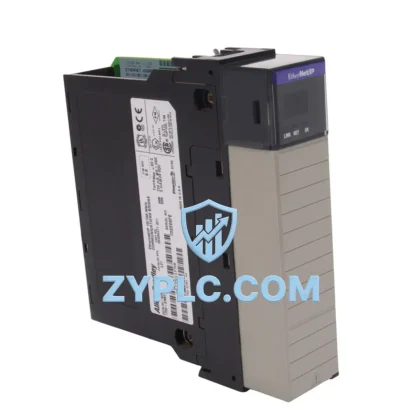
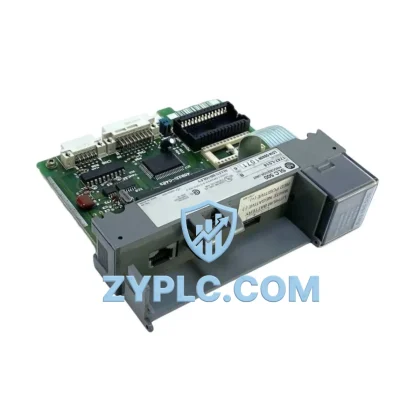
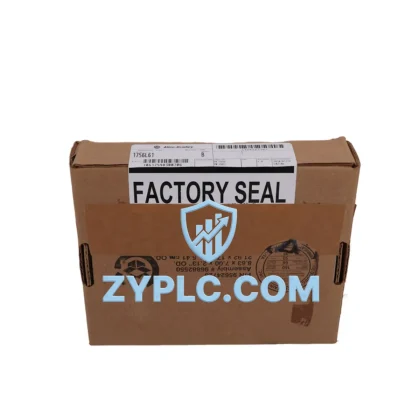
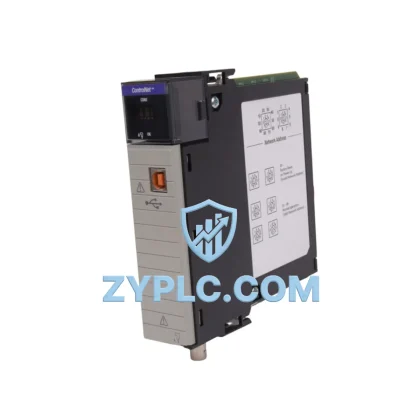
Allen-Bradley 1756-TBSH System-Ready Terminal Block for 1756 ControlLogix Architecture
The Allen-Bradley 1756-TBSH is a screw-type terminal block assembly engineered specifically for the ControlLogix 1756 platform, providing a reliable and maintainable field-wiring interface within layered industrial automation architectures. Rather than functioning as a standalone component, the 1756-TBSH occupies a critical position at the I/O layer of the control hierarchy — bridging field instrumentation, actuators, and sensors to the digital intelligence of the ControlLogix backplane. In complex process environments where signal integrity, wiring density, and long-term serviceability are non-negotiable, the 1756-TBSH delivers the structural consistency that system architects and maintenance engineers depend on.
In a fully integrated ControlLogix system, the 1756-TBSH mates directly with analog and digital I/O modules such as the 1756-IB16, 1756-OB16E, 1756-IF8, and 1756-OF8 — modules that handle discrete inputs, discrete outputs, analog inputs, and analog outputs respectively. The terminal block’s screw-type design ensures secure, vibration-resistant field connections that remain stable across the thermal cycling and mechanical stress typical of industrial enclosures. This mechanical reliability directly supports the signal fidelity that the ControlLogix CPU — typically a 1756-L73 or 1756-L85E — depends on for deterministic scan-cycle execution.
At the control layer, the 1756-L85E CPU coordinates all logic execution across the chassis, communicating with I/O modules over the ControlLogix backplane at high speed. The 1756-TBSH ensures that the field-side wiring termination does not become a bottleneck or failure point in this architecture. Proper termination at the I/O layer is essential for maintaining the data accuracy that feeds into ladder logic, function block diagrams, and structured text routines running on the CPU. When the 1756-TBSH is correctly installed and torqued to specification, it eliminates intermittent signal faults that can cause nuisance trips or false diagnostics in the control program.
From a network and communications perspective, the ControlLogix platform typically integrates EtherNet/IP communication modules such as the 1756-EN2T or 1756-EN3TR for supervisory connectivity to SCADA systems, historian servers, and HMI panels. The 1756-TBSH supports this architecture indirectly by ensuring that the I/O data presented to the network layer is clean and consistent. In redundant controller configurations using the 1756-RM2 redundancy module, accurate I/O data is especially critical — any wiring fault at the terminal block level can compromise the synchronization between primary and secondary controllers, undermining the entire redundancy investment.
Power distribution within the ControlLogix chassis is managed by the 1756-PA75 or 1756-PB75 power supply modules, which provide regulated DC power to the backplane and all installed modules. The 1756-TBSH, as a passive wiring interface, does not draw backplane power, but its correct installation ensures that field-powered devices — sensors, transmitters, and actuators — receive stable signal returns without ground loops or common-mode noise that could corrupt analog readings. In high-density I/O applications, the 1756-TBSH’s organized terminal layout also simplifies cable management within the control cabinet, reducing the risk of accidental cross-wiring during commissioning or maintenance.
For human-machine interface integration, ControlLogix systems commonly pair with PanelView Plus 7 terminals or FactoryTalk View SE stations that display real-time process data sourced from the I/O modules connected through the 1756-TBSH. The accuracy of the displayed values — flow rates, temperatures, pressures, valve positions — depends entirely on the integrity of the field wiring terminations. A loose or corroded terminal connection at the 1756-TBSH level will manifest as erratic readings on the HMI, leading to operator confusion and potential process upsets. The 1756-TBSH’s robust screw-type terminals mitigate this risk across the full service life of the installation.
Architecture Specification Table
| Parameter |
Specification |
| System Role |
Field-Wiring Terminal Interface for ControlLogix 1756 I/O Modules |
| Compatible Modules |
1756-IB16, 1756-OB16E, 1756-IF8, 1756-OF8, 1756-IA16, 1756-OA16 |
| Terminal Type |
Screw-Type (TBSH = Spring Housing Variant) |
| Platform Series |
Allen-Bradley ControlLogix 1756 |
| Wiring Capacity |
Up to 36 field-side terminals (module-dependent) |
| Conductor Range |
14–22 AWG (solid or stranded) |
| Installation Method |
Direct plug-in to compatible 1756 I/O module face |
| Operating Temperature |
0°C to 60°C (32°F to 140°F) |
| Relative Humidity |
5% to 95% non-condensing |
| Communication Role |
Passive field-wiring interface; supports EtherNet/IP and ControlNet I/O architectures |
| Mounting Environment |
Panel-mount within ControlLogix chassis enclosure |
| Country of Origin |
United States |
| Warranty |
12-Month Warranty — covers manufacturing defects and functional integrity |
Coordinated Control System Design
The 1756-TBSH is most effectively deployed as part of a coordinated ControlLogix system architecture where each layer contributes to overall reliability and maintainability. A typical system design integrating the 1756-TBSH would include the following components working in concert:
At the CPU layer, the 1756-L73 or 1756-L85E controller manages all program execution and I/O scanning. These processors communicate with I/O modules over the high-speed ControlLogix backplane, with scan times measured in milliseconds. The quality of field data reaching the CPU is directly dependent on the wiring integrity maintained by the 1756-TBSH at the module face.
The 1756-PA75 power supply provides stable 1.2A backplane power, ensuring that all modules — including the analog I/O modules connected via the 1756-TBSH — operate within their specified voltage tolerances. Voltage fluctuations at the power supply level can cause analog modules to report offset readings, making stable power a prerequisite for accurate field data.
For I/O expansion across multiple chassis, the 1756-EN2T EtherNet/IP communication module enables distributed I/O architectures where remote chassis — each equipped with their own 1756-TBSH-terminated I/O modules — communicate with the local controller over standard Ethernet infrastructure. This architecture supports large-scale installations in petrochemical plants, water treatment facilities, and power generation stations where field devices are distributed across wide geographic areas.
In redundant system designs, the 1756-RM2 redundancy module pairs with a secondary chassis to provide automatic controller failover. In these configurations, the 1756-TBSH’s reliable field connections are essential — any intermittent wiring fault that causes I/O data discrepancies between the primary and secondary controllers can trigger unnecessary switchovers, disrupting process continuity.
The 1756-IB16 16-point discrete input module and 1756-OB16E 16-point discrete output module are among the most common I/O modules paired with the 1756-TBSH in machine control and process automation applications. For analog process control, the 1756-IF8 8-channel analog input module and 1756-OF8 8-channel analog output module rely on the 1756-TBSH for precise 4–20mA and 0–10V signal termination.
At the HMI layer, PanelView Plus 7 terminals connected via EtherNet/IP display real-time process values sourced from the I/O modules wired through the 1756-TBSH. Operators rely on these displays for process monitoring, alarm acknowledgment, and manual control interventions — all of which depend on accurate field data originating at the terminal block level.
Application in Layered Automation Systems
The Allen-Bradley 1756-TBSH finds application across a broad spectrum of industrial sectors where the ControlLogix platform is the preferred control architecture.
In manufacturing and assembly automation, the 1756-TBSH terminates signals from proximity sensors, photoelectric detectors, servo drive feedback signals, and pneumatic valve solenoids. High-speed discrete I/O modules connected via the 1756-TBSH enable cycle times measured in milliseconds, supporting high-throughput packaging lines, automotive assembly stations, and robotic welding cells.
In power generation and electrical utilities, ControlLogix systems with 1756-TBSH-terminated analog I/O modules monitor generator output parameters, transformer temperatures, and switchgear status. The terminal block’s vibration-resistant screw connections are particularly valued in environments where electrical switching operations generate mechanical shock.
In petrochemical and refinery applications, the 1756-TBSH terminates 4–20mA signals from pressure transmitters, flow meters, and temperature sensors connected to 1756-IF8 analog input modules. The ControlLogix system processes these signals to control distillation column temperatures, reactor pressures, and pipeline flow rates with the precision required for safe and efficient operation.
In water and wastewater treatment, distributed ControlLogix architectures use the 1756-TBSH across multiple remote I/O panels to monitor pump status, valve positions, and water quality parameters. The terminal block’s straightforward wiring interface simplifies field commissioning by maintenance technicians who may not be PLC specialists.
In mining and minerals processing, the 1756-TBSH supports conveyor control systems, crusher monitoring, and flotation cell automation where the ControlLogix platform manages complex interlocking logic across multiple process stages. The terminal block’s durability in dusty, high-vibration environments makes it a preferred choice for long-term installations.
Architecture Engineering FAQ
Q1: Is the 1756-TBSH compatible with all ControlLogix 1756 I/O modules, and how do I verify compatibility before installation?
The 1756-TBSH is designed for specific ControlLogix 1756 I/O modules that use the TBSH wiring system. Compatibility is determined by the I/O module’s catalog number and its specified terminal block type. Before installation, cross-reference the I/O module’s installation instructions (available from Rockwell Automation) to confirm that the TBSH terminal block is the correct wiring interface. Mixing incompatible terminal blocks with I/O modules can result in improper seating, signal errors, or physical damage to the module connector. Our team can assist with compatibility verification prior to order fulfillment.
Q2: How does the 1756-TBSH support long-term maintenance efficiency in a ControlLogix architecture?
The 1756-TBSH’s plug-in design allows field wiring to remain connected to the terminal block while the I/O module is removed for replacement or testing — a significant advantage during planned maintenance windows or unplanned module failures. This wiring-stays-connected approach eliminates the need to re-terminate field wires when swapping modules, reducing maintenance time from hours to minutes and minimizing the risk of wiring errors during module replacement. In conjunction with the ControlLogix platform’s online programming capabilities, this makes the 1756-TBSH a key enabler of high-availability system architectures. All units supplied by ZYPLC are covered by a 12-Month Warranty against manufacturing defects.
Q3: What installation and torque specifications should be followed for the 1756-TBSH to ensure signal integrity in analog I/O applications?
For analog I/O applications where signal accuracy is critical, terminal screw torque must be applied within the manufacturer’s specified range — typically 0.5 to 0.8 N·m (4.4 to 7.1 lb·in) for the 1756-TBSH screw terminals. Under-torqued connections create high-resistance joints that introduce voltage drops and noise into 4–20mA loops, causing analog modules to report inaccurate process values. Over-torqued connections can damage conductor insulation or strip terminal threads, creating intermittent faults that are difficult to diagnose. Use a calibrated torque screwdriver during initial installation and re-verify torque values during the first scheduled maintenance inspection. Shielded cable with proper shield grounding at the panel end is also recommended for analog signal runs exceeding 10 meters.
© 2026 ZYPLC. All rights reserved.
Original Source: https://zyplc.com
Contact: +86 19859288691 | [email protected]