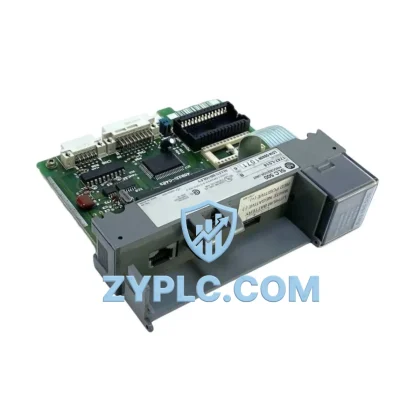
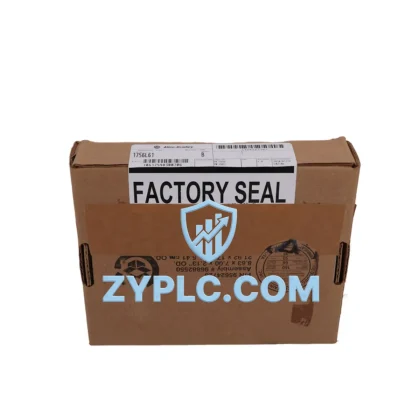
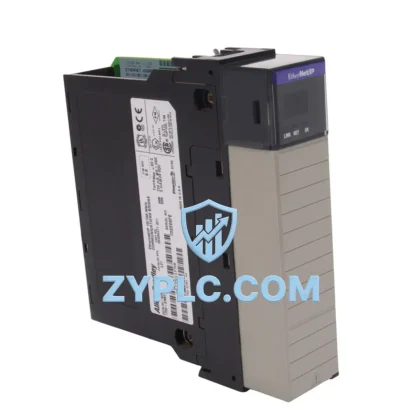
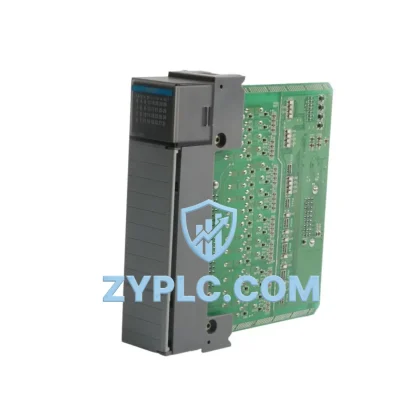
Allen-Bradley 1769-L19ER-BB1B System-Ready CPU for CompactLogix Architecture: Control System Integration and Upstream-Downstream Coordination
The Allen-Bradley 1769-L19ER-BB1B is a CompactLogix 5370 L1 series programmable logic controller designed to serve as the central processing unit within compact, high-density industrial control architectures. As a system-ready CPU, the 1769-L19ER-BB1B is engineered not merely as a standalone device, but as the coordinating intelligence within a layered automation framework — managing signal flow from field-level I/O modules, communicating across EtherNet/IP networks, interfacing with operator HMI panels, and synchronizing with upstream supervisory systems. Its role within the CompactLogix platform makes it a foundational component for engineers designing scalable, maintainable, and redundancy-aware control systems across manufacturing, utilities, and process industries.
Within a complete control system architecture, the 1769-L19ER-BB1B occupies the control layer, where it executes ladder logic, function block diagrams, and structured text programs while managing real-time I/O scanning cycles. The controller integrates directly with the 1769 Compact I/O backplane, allowing engineers to expand digital and analog I/O capacity by adding modules such as the 1769-IQ16 (16-point digital input), 1769-OB16 (16-point digital output), 1769-IF4 (4-channel analog input), and 1769-OF2 (2-channel analog output) — all within the same compact rail-mounted assembly. This tight integration between the CPU and I/O layer eliminates the need for remote I/O adapters in smaller machine-level applications, reducing wiring complexity and improving diagnostic transparency.
At the network layer, the 1769-L19ER-BB1B supports dual EtherNet/IP ports, enabling Device Level Ring (DLR) topology for network-level fault tolerance without requiring additional managed switches. This capability allows the controller to maintain communication continuity with distributed I/O adapters such as the 1734-AENTR (POINT I/O EtherNet/IP adapter) and remote I/O racks, even in the event of a single cable or node failure. The dual-port architecture also supports linear and star topologies, giving system designers flexibility in how they structure plant-floor networks. Integration with Rockwell Automation’s Studio 5000 Logix Designer software ensures that the 1769-L19ER-BB1B can be programmed, commissioned, and maintained using the same development environment as larger ControlLogix and GuardLogix platforms, preserving engineering investment and reducing retraining requirements.
At the power layer, the 1769-L19ER-BB1B operates on 24V DC input power, compatible with standard DIN-rail mounted power supplies commonly used in CompactLogix panel builds. Engineers typically pair this controller with regulated 24V DC power supplies rated at 5A or higher to ensure stable operation across the full I/O expansion range. The controller’s onboard power budget supports the local 1769 I/O bus, and system designers should account for total bus current draw when configuring multi-module expansion assemblies.
For human-machine interface integration, the 1769-L19ER-BB1B communicates natively with PanelView Plus 7 terminals and PanelView 800 graphic terminals via EtherNet/IP, enabling operators to monitor process variables, acknowledge alarms, and adjust setpoints without requiring additional communication gateways. In applications where legacy serial HMI panels are in use, the controller’s USB programming port can be leveraged for direct laptop-based diagnostics, while EtherNet/IP remains the primary production network interface.
At the execution layer, the 1769-L19ER-BB1B coordinates with variable frequency drives (VFDs), servo drives, and smart actuators through EtherNet/IP implicit messaging, enabling closed-loop speed and position control without dedicated motion controllers in simpler applications. For more demanding motion requirements, the controller can be integrated with Kinetix 300 or Kinetix 350 servo drives via EtherNet/IP, extending the system’s motion control capability while maintaining a unified programming environment.
Architecture Specification Table
| Parameter |
Specification |
| Model / SKU |
1769-L19ER-BB1B |
| Brand |
Allen-Bradley (Rockwell Automation) |
| Series |
CompactLogix 5370 L1 |
| System Role |
Central Processing Unit (CPU) — Control Layer |
| Memory |
1 MB User Memory (Program + Data) |
| I/O Capacity |
Up to 16 local 1769 Compact I/O modules |
| Communication Ports |
2 × EtherNet/IP (DLR capable), 1 × USB (programming) |
| Network Protocol |
EtherNet/IP (CIP), Device Level Ring (DLR) |
| Power Supply Input |
24V DC |
| Operating Temperature |
0°C to 60°C (32°F to 140°F) |
| Mounting |
DIN Rail / Panel Mount |
| Programming Software |
Studio 5000 Logix Designer |
| Languages Supported |
Ladder Diagram, Function Block, Structured Text, Sequential Function Chart |
| Certifications |
UL, CE, RCM |
| Origin |
United States |
| Warranty |
12-Month Warranty (ZYPLC) |
Coordinated Control System Design
The 1769-L19ER-BB1B achieves its full architectural value when deployed as part of a coordinated system rather than in isolation. In a typical machine-level control panel, the controller sits at the center of a tightly integrated assembly: the 1769-PA2 power supply provides regulated 24V DC to the local I/O bus; the 1769-IQ16 and 1769-OB16 modules handle discrete field signals from sensors, pushbuttons, and solenoid valves; and the 1769-IF4 analog input module processes 4–20 mA signals from pressure transmitters and flow meters. On the network side, the dual EtherNet/IP ports connect the controller to a 1734-AENTR POINT I/O adapter for remote I/O expansion in distributed panel configurations, while a PanelView Plus 7 terminal provides the operator interface. For motion-intensive applications, a Kinetix 350 servo drive receives velocity and position commands via EtherNet/IP implicit messaging, enabling coordinated multi-axis control within the same Logix programming environment. This architecture — spanning the 1769-L19ER-BB1B CPU, local 1769 I/O, remote POINT I/O, EtherNet/IP network, PanelView HMI, and Kinetix drives — represents a complete, validated control system topology that minimizes integration risk and accelerates commissioning timelines.
Application in Layered Automation Systems
The 1769-L19ER-BB1B is widely deployed across industries where compact, reliable, and network-capable control is required at the machine or skid level. In manufacturing and packaging lines, the controller manages conveyor sequencing, reject gate actuation, and product counting, integrating with vision systems and barcode readers via EtherNet/IP. In water and wastewater treatment facilities, the 1769-L19ER-BB1B controls pump stations, valve sequencing, and level monitoring, with SCADA connectivity provided through EtherNet/IP to upstream FactoryTalk View SE servers. In the food and beverage sector, the controller’s compact form factor and DIN-rail mounting make it ideal for hygienic panel builds where space is constrained and washdown environments demand sealed enclosures. In mining and minerals processing, the controller handles crusher sequencing, conveyor interlocking, and motor protection relay integration, benefiting from its robust operating temperature range and DLR network resilience. In oil and gas skid automation, the 1769-L19ER-BB1B manages wellhead control panels and separator skids, where its EtherNet/IP connectivity enables integration with remote telemetry units and SCADA systems. Across all these applications, the controller’s Contextual Integration capability — its ability to operate within a broader Logix-based control hierarchy — ensures that machine-level data is available to plant-level MES and ERP systems without requiring custom middleware or protocol converters.
Architecture Engineering FAQ
Q1: Is the 1769-L19ER-BB1B compatible with existing CompactLogix 5370 L1 system configurations, and can it replace an older L1 controller without reprogramming?
The 1769-L19ER-BB1B is fully compatible with the CompactLogix 5370 L1 platform and can be used as a direct replacement for other L1-series controllers within the same chassis and I/O configuration. Program files developed in Studio 5000 Logix Designer for other L1 controllers can typically be downloaded to the 1769-L19ER-BB1B with minimal modification, provided that the I/O module configuration and network topology remain consistent. Engineers should verify firmware revision compatibility and confirm that the replacement controller’s memory capacity meets the program and data requirements of the existing application before commissioning.
Q2: How does the dual EtherNet/IP port support DLR topology, and what are the benefits for system availability?
The 1769-L19ER-BB1B’s dual EtherNet/IP ports support Device Level Ring (DLR) topology, which provides automatic network fault detection and recovery at the device level without requiring managed switches or additional network hardware. In a DLR ring, if a single cable segment or node fails, the ring supervisor (which can be the 1769-L19ER-BB1B itself or a compatible switch) detects the fault and reconfigures the network path within milliseconds, maintaining communication with all connected devices. This capability is particularly valuable in applications where network downtime results in production loss or safety risks, such as conveyor systems, pump stations, and process control skids.
Q3: What does the 12-Month Warranty cover, and how does ZYPLC support long-term maintenance for the 1769-L19ER-BB1B?
ZYPLC’s 12-Month Warranty covers the 1769-L19ER-BB1B against manufacturing defects and functional failures under normal operating conditions for a period of twelve months from the date of purchase. During the warranty period, ZYPLC provides replacement or repair services for units that fail to meet published specifications. Beyond the warranty period, ZYPLC maintains inventory of the 1769-L19ER-BB1B and compatible 1769 Compact I/O modules to support long-term maintenance and spare parts programs, reducing the risk of extended downtime due to component unavailability. For engineering support, commissioning assistance, and system architecture consultation, customers can contact ZYPLC directly at +86 19859288691 or [email protected].
© 2026 ZYPLC. All rights reserved.
Original Source: https://zyplc.com
Contact: +86 19859288691 | [email protected]