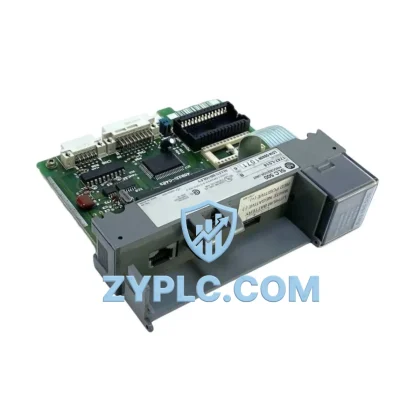
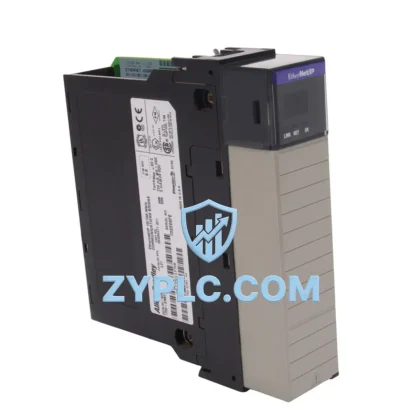
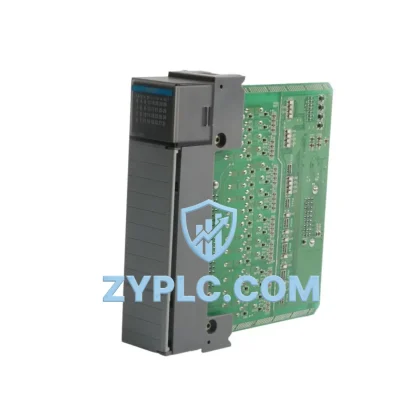
Allen-Bradley 1769-L30ER System-Ready Controller for 1769 Architecture: Control System Architecture and Upstream-Downstream Coordination
The Allen-Bradley 1769-L30ER CompactLogix controller is engineered as a central processing node within the Rockwell Automation 1769 modular I/O architecture. Rather than functioning as a standalone device, the 1769-L30ER is designed to operate as the command hub of a layered automation system — coordinating signal flow across the control layer, I/O layer, network layer, power layer, HMI layer, and execution layer simultaneously. Its embedded EtherNet/IP port and integrated motion coordination capability make it a system-consistent choice for engineers designing scalable, redundancy-aware, and maintainable industrial control platforms.
In a complete 1769-based control architecture, the 1769-L30ER sits at the control layer, receiving process data from distributed I/O modules such as the 1769-IQ16 (16-point digital input), 1769-OB16 (16-point digital output), 1769-IF4 (4-channel analog input), and 1769-OF2 (2-channel analog output). These modules mount directly to the CompactLogix local chassis or expansion backplane, enabling tight signal integration without additional communication overhead. The controller’s local I/O bus supports up to 16 expansion modules, providing sufficient I/O density for mid-range process and discrete applications.
At the network layer, the 1769-L30ER communicates natively over EtherNet/IP, enabling seamless integration with upstream SCADA systems, historian platforms, and MES layers. For legacy or field-level device integration, the 1769-L30ER can be paired with communication gateway modules such as the 1769-ASCII or external protocol converters supporting PROFIBUS, Modbus RTU, or DeviceNet — ensuring that the controller serves as a true contextual integration point across heterogeneous network environments. This contextual integration capability is critical in brownfield modernization projects where existing field devices must be retained while the control platform is upgraded.
The power layer supporting the 1769-L30ER typically includes the 1769-PA2 or 1769-PB2 power supply modules, which provide regulated 24 VDC bus power to the I/O backplane. Proper power architecture design — including load calculation, power budget verification, and redundant power supply consideration — is essential to ensure system stability under full I/O load conditions. Engineers should verify that the total current draw of all installed 1769 I/O modules does not exceed the rated output of the selected power supply module.
At the HMI layer, the 1769-L30ER integrates directly with PanelView Plus 7 terminals via EtherNet/IP, enabling real-time visualization of process variables, alarm management, and operator control without requiring additional communication middleware. The controller’s tag-based programming model in Studio 5000 Logix Designer allows HMI tag binding to be established at the controller level, reducing configuration complexity and improving system consistency across multi-panel installations.
For execution layer coordination, the 1769-L30ER supports integrated motion control via the Kinetix 350 or Kinetix 5100 servo drives over EtherNet/IP, enabling synchronized multi-axis motion sequences to be programmed and managed within a single Logix project. This eliminates the need for a separate motion controller in applications requiring coordinated axis control, reducing cabinet footprint and simplifying system commissioning.
From a redundancy design perspective, while the 1769-L30ER itself operates in a simplex configuration, system-level redundancy can be achieved through network-level redundancy using dual EtherNet/IP ring topologies (DLR — Device Level Ring), ensuring that a single cable fault does not interrupt communication between the controller and distributed I/O or HMI devices. For applications requiring controller-level redundancy, engineers may consider migrating to the ControlLogix 1756-L8xE platform with 1756-RM2 redundancy modules, while retaining 1769 I/O modules at remote adapter nodes via 1769-AENTR EtherNet/IP adapters.
In terms of engineering commissioning efficiency, the 1769-L30ER supports online program editing, partial import/export of routines, and controller firmware upgrade via ControlFLASH — all of which reduce planned downtime during system modifications and firmware maintenance cycles. The controller’s non-volatile memory retains the user program and configuration data through power cycles without requiring a battery, simplifying long-term maintenance planning.
For long-term inventory and supply chain management, ZYPLC maintains verified stock of the 1769-L30ER alongside compatible 1769 I/O modules, power supplies, and communication adapters. All units are subject to functional testing prior to shipment and are covered by a 12-Month Warranty, providing procurement teams with confidence in both product authenticity and post-delivery support continuity.
Architecture Specification Table
| Parameter |
Specification |
| System Role |
CompactLogix CPU — Control Layer Node, 1769 Architecture |
| SKU / Catalog Number |
1769-L30ER |
| Brand / Manufacturer |
Allen-Bradley (Rockwell Automation) |
| Series |
CompactLogix 5370 L3 |
| Processor Memory |
1 MB User Memory (I/O, Logic, Data) |
| Local I/O Modules Supported |
Up to 16 x 1769 I/O Modules |
| Communication Ports |
2 x EtherNet/IP (embedded dual-port switch) |
| Motion Axes Supported |
Up to 16 axes (EtherNet/IP-based) |
| Power Supply Compatibility |
1769-PA2 / 1769-PB2 |
| Operating Voltage |
24 VDC (via backplane bus) |
| Operating Temperature |
0°C to 60°C |
| Relative Humidity |
5% to 95% (non-condensing) |
| Mounting |
DIN Rail or Panel Mount |
| Programming Software |
Studio 5000 Logix Designer v21+ |
| Communication Protocol |
EtherNet/IP, CIP, DLR (Device Level Ring) |
| Contextual Integration |
SCADA, MES, HMI, Motion, Remote I/O via EtherNet/IP |
| Warranty |
12-Month Warranty (ZYPLC) |
| Origin |
United States |
Coordinated Control System Design
The 1769-L30ER achieves its full architectural value when deployed as part of a coordinated system rather than in isolation. A typical 1769-based control panel integrating this controller would include the following coordinated components:
The 1769-PA2 AC power supply provides regulated backplane power to the local I/O bus, while 1769-IQ16 digital input modules capture discrete field signals from limit switches, proximity sensors, and pushbuttons. 1769-OB16 digital output modules drive solenoid valves, motor starters, and indicator lamps. For process variable acquisition, 1769-IF4 analog input modules convert 4–20 mA or 0–10 V signals from pressure transmitters, flow meters, and temperature sensors into engineering unit values within the controller’s tag database.
At the network boundary, the 1769-AENTR EtherNet/IP adapter extends the 1769 I/O bus to remote chassis locations, enabling distributed I/O architectures where field junction boxes are located far from the main control panel. This adapter supports DLR topology, providing network-level fault tolerance without requiring managed switches at every node.
For HMI integration, a PanelView Plus 7 terminal connected via EtherNet/IP provides the operator interface layer, with tag-based data binding directly to the 1769-L30ER’s controller tags. For motion applications, Kinetix 5100 EtherNet/IP servo drives receive coordinated motion commands from the controller, enabling multi-axis synchronization for conveyor indexing, robotic pick-and-place, or web tension control applications.
Terminal block modules such as the 1492-CABLE series pre-wired cables and 1492-IFM interface modules simplify field wiring connections to the 1769 I/O modules, reducing installation time and wiring error risk during commissioning. Safety relay modules integrated into the control cabinet provide hardwired E-stop and safety gate monitoring circuits that operate independently of the PLC program, ensuring SIL-compliant safety architecture.
Application in Layered Automation Systems
The 1769-L30ER is deployed across a wide range of industrial sectors where mid-range processing capability, compact form factor, and EtherNet/IP connectivity are required within a layered automation architecture.
In manufacturing and assembly lines, the controller manages discrete I/O sequences for conveyor systems, robotic cell coordination, and quality inspection stations. Its integrated motion capability allows it to synchronize servo-driven positioning axes with vision system triggers and downstream packaging equipment.
In power distribution and electrical substation applications, the 1769-L30ER monitors breaker status, transformer temperatures, and bus voltage levels via analog input modules, reporting data upstream to SCADA systems over EtherNet/IP for real-time grid monitoring and alarm management.
In petrochemical and refinery process control, the controller manages continuous process loops including flow control, pressure regulation, and temperature profiling. Its analog I/O integration with PID instruction blocks in Studio 5000 enables closed-loop control of process variables with configurable alarm limits and historian data logging.
In water and wastewater treatment facilities, the 1769-L30ER controls pump sequencing, valve actuation, and chemical dosing systems. Remote I/O expansion via 1769-AENTR adapters allows a single controller to manage distributed pump stations across a treatment plant without requiring additional CPUs at each remote location.
In mining and metallurgical processing, the controller supervises conveyor belt drives, crusher motor starters, and ore sorting systems. Its robust operating temperature range and DIN rail mounting make it suitable for installation in field control panels subject to vibration and temperature variation.
In packaging and material handling applications, the 1769-L30ER coordinates high-speed discrete I/O sequences for filling machines, labeling stations, and palletizing systems, with motion integration enabling precise servo-driven product positioning and reject actuation.
Architecture Engineering FAQ
Q1: Is the 1769-L30ER compatible with existing 1769 CompactLogix I/O modules already installed in my system?
Yes. The 1769-L30ER is fully compatible with the 1769 I/O module family, including digital input/output, analog input/output, and specialty modules. The controller communicates with all 1769 I/O modules via the local backplane bus using the CIP protocol. Existing I/O module configurations can be imported into Studio 5000 Logix Designer projects targeting the 1769-L30ER, minimizing re-engineering effort during controller replacement or system expansion. Verify firmware revision compatibility between the controller and any existing 1769-AENTR remote adapters to ensure consistent communication behavior.
Q2: What are the EtherNet/IP network architecture options for the 1769-L30ER in a multi-controller system?
The 1769-L30ER’s embedded dual-port EtherNet/IP switch supports both linear and Device Level Ring (DLR) network topologies. In a DLR configuration, the controller participates as a ring supervisor or ring node, providing automatic network reconfiguration in the event of a single cable or device fault — typically within milliseconds. For multi-controller systems, each 1769-L30ER can be assigned a unique IP address and integrated into a common EtherNet/IP network, enabling produced/consumed tag communication between controllers for coordinated system-level data exchange without requiring a dedicated communication module.
Q3: What does the 12-Month Warranty cover, and what support is available for long-term maintenance of the 1769-L30ER?
ZYPLC’s 12-Month Warranty covers functional defects identified during normal operating conditions within twelve months of the shipment date. All 1769-L30ER units are functionally tested prior to dispatch to verify processor operation, communication port functionality, and I/O bus integrity. For long-term maintenance planning, ZYPLC maintains ongoing inventory of the 1769-L30ER and compatible 1769 I/O modules, power supplies, and communication adapters, enabling rapid replacement procurement without extended lead times. Technical support for installation, commissioning, and architecture compatibility questions is available via direct contact with the ZYPLC engineering team.
© 2026 ZYPLC. All rights reserved.
Original Source: https://zyplc.com
Contact: +86 19859288691 | [email protected]