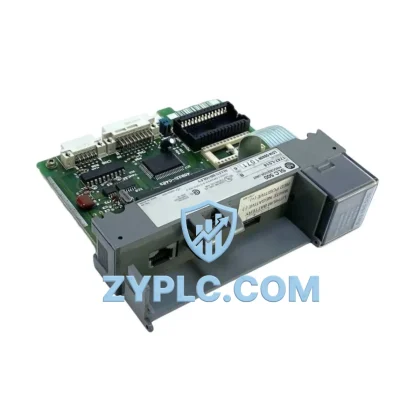
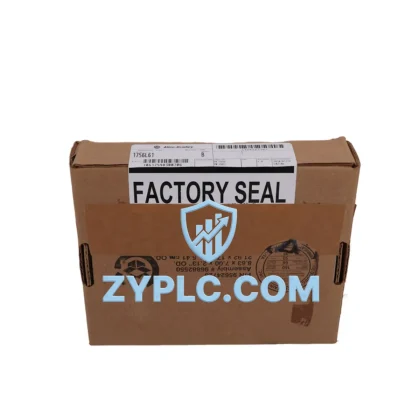
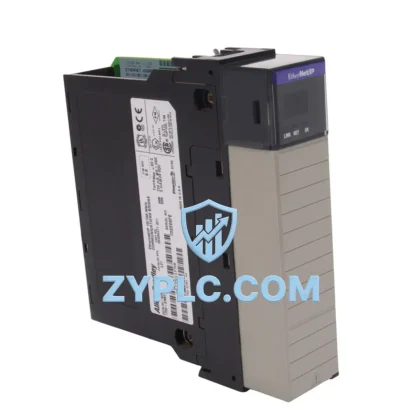
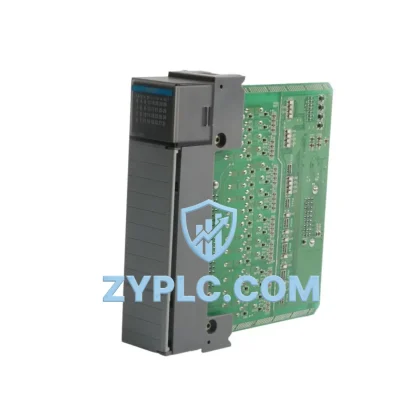
Allen-Bradley 1769-L30ERM Energy-Saving CompactLogix PLC: Precision Efficiency Control for Optimized Production Lines
The Allen-Bradley 1769-L30ERM is a high-performance CompactLogix 5370 L3 programmable logic controller engineered for energy-conscious industrial environments. Designed to reduce unnecessary power draw, minimize idle-state energy consumption, and deliver deterministic control across complex motion and process applications, the 1769-L30ERM serves as the intelligent core of modern energy-aware automation architectures. Whether deployed in automotive assembly, food and beverage processing, material handling, or discrete manufacturing, this controller enables facilities to achieve measurable reductions in energy cost per production cycle while maintaining the throughput and reliability that industrial operations demand.
Efficiency Performance Table
| Parameter |
Specification |
| Model / SKU |
Allen-Bradley 1769-L30ERM |
| Series |
CompactLogix 5370 L3 |
| Processor Memory |
1 MB User Memory |
| EtherNet/IP Nodes |
Up to 16 CIP Motion Axes |
| Power Consumption |
Optimized low-draw backplane architecture |
| Operating Efficiency |
Deterministic scan-cycle execution, minimizing CPU idle waste |
| Compatible Systems |
Studio 5000 Logix Designer, FactoryTalk View, EtherNet/IP, CIP Motion |
| Application Environment |
Discrete manufacturing, motion control, process automation, energy management |
| Energy Saving Value |
Reduces over-cycling via precise motion scheduling; supports load-based drive control |
| Origin |
United States |
| Warranty |
12-Month Warranty — tested and verified before shipment |
Energy-Aware Automation Architecture
The 1769-L30ERM is built to anchor a fully integrated, energy-aware control system. Its native EtherNet/IP port enables seamless communication with upstream and downstream components, allowing real-time energy data to flow across the entire automation layer without protocol conversion overhead.
In a typical energy-optimized cell, the 1769-L30ERM coordinates directly with Allen-Bradley PowerFlex 525 and PowerFlex 755 variable frequency drives to implement demand-based motor speed regulation. Rather than running motors at fixed full speed, the controller issues dynamic speed references based on actual production load — a strategy that can reduce motor energy consumption by 20–50% in variable-torque applications such as conveyor systems, pumps, and fans.
For servo-driven axes, the 1769-L30ERM integrates natively with Kinetix 5500 and Kinetix 5700 servo drives over the CIP Motion protocol. This tight coupling enables coordinated multi-axis motion profiles that eliminate unnecessary acceleration peaks, reducing both mechanical wear and instantaneous power demand on the supply rail. The shared DC bus architecture of the Kinetix 5700 further allows regenerative energy from decelerating axes to be redistributed to accelerating axes, cutting net energy draw at the cabinet level.
On the I/O side, the controller manages 1769 CompactLogix I/O modules — including digital input, digital output, and analog I/O — to monitor field-level signals from sensors, actuators, and energy metering devices. Analog input modules connected to current transformers or power transducers feed real-time consumption data back to the controller, enabling closed-loop energy management logic to be executed directly in the PLC program without relying on a separate energy management system.
The 1769-L30ERM also communicates with Allen-Bradley PowerMonitor 5000 power quality meters via EtherNet/IP, providing granular visibility into harmonic distortion, power factor, and demand peaks. This data is surfaced through FactoryTalk View SE HMI displays, giving operators and energy managers a unified view of both production throughput and energy consumption in real time.
For facilities running distributed control architectures, the 1769-L30ERM can act as a producer or consumer of tag data across a ControlLogix 5580 backbone, enabling plant-wide energy coordination strategies where individual machine controllers report consumption data to a supervisory controller that optimizes load scheduling across shifts.
Power Optimization in Real Production Lines
In practice, the energy savings delivered by the 1769-L30ERM are realized through several interconnected mechanisms that address the root causes of industrial energy waste.
Eliminating idle-state overconsumption: Many production lines run motors, conveyors, and actuators at full power even during product gaps, changeovers, or minor stoppages. The 1769-L30ERM enables programmable energy states — automatically ramping down drives and deactivating non-critical outputs during detected idle windows, then restoring full operation within milliseconds when production resumes. This alone can reduce standby energy consumption by 15–30% in lines with frequent micro-stops.
Optimizing production line takt time: By precisely controlling the timing and sequencing of servo axes and conveyor drives, the 1769-L30ERM eliminates the mechanical buffering and over-speed compensation that operators often introduce to mask timing uncertainty. Tighter takt control means motors run at their most efficient operating points for longer, reducing the energy cost per unit produced.
Predictive maintenance integration: The controller’s ability to log axis torque trends, drive thermal data, and I/O fault histories enables condition-based maintenance strategies. Catching a failing bearing before it causes a motor to draw 20% excess current — or preventing an unplanned stoppage that requires a full cold restart — delivers energy savings that are difficult to quantify but consistently significant in high-utilization facilities.
Reducing restart energy spikes: Unplanned downtime followed by simultaneous restart of multiple drives creates demand spikes that trigger peak demand charges on utility bills. The 1769-L30ERM supports sequenced restart logic that staggers drive start commands, flattening the inrush current profile and reducing peak demand penalties.
All units are sourced from verified supply channels, undergo full functional testing prior to shipment, and are covered by a 12-month warranty. Stock is maintained for prompt dispatch, supporting both planned procurement and urgent replacement scenarios.
Energy Optimization FAQ
Q: How does the 1769-L30ERM contribute to measurable energy savings on the production floor?
A: The 1769-L30ERM enables demand-based drive control through its native CIP Motion and EtherNet/IP integration. By dynamically adjusting motor speeds via connected PowerFlex drives and coordinating servo motion profiles through Kinetix drives, it eliminates the fixed-speed overconsumption common in legacy systems. Facilities typically report 15–40% reductions in motor-related energy costs after implementing load-adaptive control strategies with this controller.
Q: Is the 1769-L30ERM compatible with existing CompactLogix I/O and drive infrastructure?
A: Yes. The 1769-L30ERM is fully compatible with the 1769 CompactLogix I/O module family and communicates natively with PowerFlex 525, PowerFlex 755, Kinetix 5500, and Kinetix 5700 drives over EtherNet/IP and CIP Motion. It integrates with Studio 5000 Logix Designer for programming and FactoryTalk View for HMI, making it a drop-in upgrade path for existing CompactLogix 5370 installations.
Q: Can the 1769-L30ERM replace an older CompactLogix controller without a full system redesign?
A: In most cases, yes. The 1769-L30ERM is designed as a form-fit-function replacement within the CompactLogix 5370 L3 family. Existing I/O configurations, network topology, and Studio 5000 project files can typically be migrated with minimal modification. We recommend a pre-replacement compatibility review, which our technical team can support prior to order confirmation.
Q: What does the 12-month warranty cover, and what is the testing process before shipment?
A: Every 1769-L30ERM unit undergoes functional verification testing prior to dispatch, including power-on self-test, communication port validation, and I/O backplane integrity checks. The 12-month warranty covers hardware defects and operational failures under normal industrial use conditions. In the event of a warranty claim, replacement or repair is coordinated promptly to minimize production downtime.
© 2026 ZYPLC. All rights reserved.
Original Source: https://zyplc.com
Contact: +86 19859288691 | plc.sales@zyplc.com