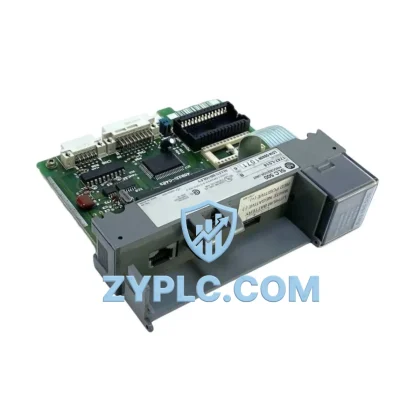
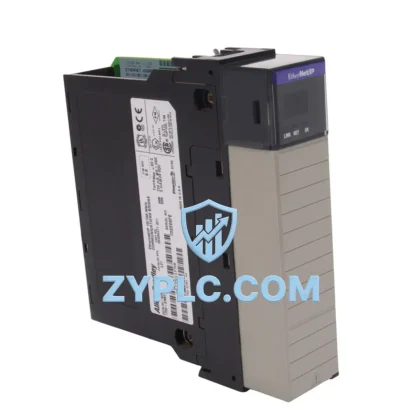
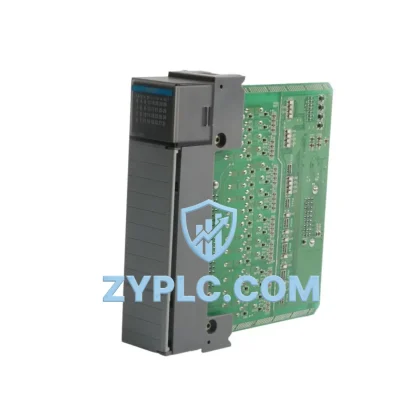
Allen-Bradley 1769-L33ER System-Ready CompactLogix Controller for L33 Control System Architecture
The Allen-Bradley 1769-L33ER CompactLogix Controller is a high-performance programmable logic controller engineered for seamless integration within layered industrial automation architectures. Designed by Rockwell Automation, this controller occupies the control layer of a complete system hierarchy, coordinating signal flow between field-level I/O modules, network communication gateways, power distribution components, human-machine interfaces, and downstream actuators and drives. Its role is not simply to execute logic — it is to serve as the architectural backbone that ensures system consistency, scalability, redundancy readiness, and long-term maintainability across the entire control platform.
In modern industrial environments, no controller operates in isolation. The 1769-L33ER is purpose-built to function within the CompactLogix 1769 backplane ecosystem, where it communicates natively with expansion I/O modules such as the 1769-IQ16 digital input module and the 1769-OB16 digital output module, enabling dense signal aggregation without sacrificing scan cycle performance. Analog process variables are handled through modules like the 1769-IF4 analog input module, which feeds real-time process data directly into the controller’s tag database for closed-loop regulation and alarm management.
At the network layer, the 1769-L33ER’s dual-port EtherNet/IP interface supports Device Level Ring (DLR) topology, providing inherent network redundancy without requiring additional switching hardware. This allows the controller to maintain uninterrupted communication with upstream SCADA systems, MES platforms, and peer controllers even in the event of a single cable or port failure. Integration with the 1783-ETAP EtherNet/IP tap or the 1783-BMS series managed switches further strengthens network resilience across large-scale distributed architectures.
Power integrity is foundational to system reliability. The 1769-L33ER operates within a CompactLogix chassis powered by the 1769-PA4 or 1769-PB4 power supply modules, which deliver regulated 24 VDC backplane power with sufficient current capacity to support fully populated I/O expansion banks. Proper power budgeting across the backplane ensures that all connected modules — including specialty modules such as the 1769-HSC high-speed counter or the 1769-SM2 motion module — receive stable operating voltage under all load conditions.
For human-machine interface integration, the 1769-L33ER communicates natively with PanelView Plus 7 terminals via EtherNet/IP, enabling real-time visualization of process states, alarm histories, and production metrics. This HMI-to-controller link is configured through Studio 5000 Logix Designer, Rockwell Automation’s unified engineering environment, which also manages motion coordination, safety logic, and network topology mapping from a single project file. The result is a tightly integrated engineering workflow that reduces commissioning time and minimizes configuration errors across complex multi-axis or multi-zone systems.
From an execution layer perspective, the 1769-L33ER supports coordinated control of variable frequency drives, servo amplifiers, and smart actuators through its EtherNet/IP and serial communication ports. Drive integration — whether with PowerFlex 525, PowerFlex 755, or third-party EtherNet/IP-compatible drives — is achieved through Add-On Profiles (AOPs) that standardize parameter mapping and diagnostic feedback within the Studio 5000 environment. This architecture-level integration eliminates the need for custom driver development and accelerates system validation during factory acceptance testing.
The 1769-L33ER also supports modular system expansion through the CompactLogix local expansion bus, allowing engineers to add I/O capacity incrementally as process requirements evolve. This scalability is critical in industries such as automotive assembly, food and beverage processing, pharmaceutical manufacturing, and water treatment, where production lines are frequently reconfigured or expanded without full system replacement. The controller’s task-based execution model — supporting periodic, event-driven, and continuous tasks — ensures that time-critical control loops are isolated from lower-priority background processes, maintaining deterministic performance even as system complexity grows.
Architecture Specification Table
| Parameter |
Specification |
| System Role |
Primary Control Layer CPU — CompactLogix 1769 Architecture |
| Processor Memory |
2 MB User Memory (Program + Data) |
| Communication Ports |
Dual-Port EtherNet/IP (DLR Capable), USB Programming Port |
| I/O Capacity |
Up to 16 Local 1769 Expansion Modules |
| Supported Tasks |
Periodic, Event-Driven, Continuous (up to 32 tasks) |
| Operating Voltage |
24 VDC (Backplane Powered via 1769-PA4 / 1769-PB4) |
| Operating Temperature |
0°C to 60°C (32°F to 140°F) |
| Relative Humidity |
5% to 95% Non-Condensing |
| Communication Protocol |
EtherNet/IP, CIP, USB |
| Programming Software |
Studio 5000 Logix Designer v21+ |
| Mounting |
DIN Rail or Panel Mount |
| Certifications |
UL, CE, RCM, cUL |
| Warranty |
12-Month Warranty — Tested, Verified, Ready to Deploy |
Coordinated Control System Design
The 1769-L33ER achieves its full architectural potential when deployed as part of a coordinated system rather than a standalone device. In a typical CompactLogix-based control cabinet, the controller shares the 1769 backplane with a combination of digital and analog I/O modules, specialty function modules, and communication interface cards. The 1769-IQ16 and 1769-OB16 handle discrete field signals from sensors, limit switches, and solenoid valves, while the 1769-IF4 and 1769-OF4 manage analog process variables such as pressure, temperature, and flow rate.
At the network level, the controller’s DLR-capable EtherNet/IP ports connect to 1783-BMS managed switches, forming a resilient ring topology that maintains communication continuity even during cable faults. For remote I/O expansion beyond the local chassis, the 1734 POINT I/O platform — connected via EtherNet/IP adapters such as the 1734-AENT — extends the controller’s reach to distributed field panels without requiring additional CPUs. This architecture is particularly effective in large-footprint facilities such as water treatment plants, mining conveyors, and chemical processing units where field devices are spread across significant distances.
Motion control integration is achieved through the 1769-SM2 Sercos motion module or direct EtherNet/IP connectivity to Kinetix 5500 or Kinetix 5700 servo drives, enabling synchronized multi-axis positioning within the same Studio 5000 project. For safety-critical applications, the 1769-L33ER can be paired with a 1791DS-IB12 GuardLogix safety I/O module, providing integrated safety logic execution without requiring a separate safety PLC. The 1769-PA4 power supply completes the local architecture by delivering stable backplane power across all installed modules, ensuring consistent performance under variable load conditions.
Application in Layered Automation Systems
The 1769-L33ER is deployed across a wide range of industrial sectors where layered automation architecture is essential for operational reliability and regulatory compliance. In municipal water treatment facilities, the controller manages pump sequencing, chemical dosing, and filtration cycles while communicating process data upstream to SCADA systems via EtherNet/IP. Its DLR network topology ensures that communication is maintained even during maintenance activities that require temporary cable disconnection.
In power generation and electrical substation automation, the 1769-L33ER coordinates protection relay inputs, transformer monitoring signals, and switchgear control outputs within a unified control architecture. Its deterministic scan cycle and event-driven task execution ensure that fault response times meet the stringent requirements of IEC 61850-compatible protection schemes. In petrochemical and refinery applications, the controller manages continuous process loops — including temperature, pressure, and flow regulation — while interfacing with distributed control system (DCS) historians via OPC-UA or EtherNet/IP gateways.
In discrete manufacturing environments such as automotive body assembly, packaging lines, and electronics production, the 1769-L33ER serves as the primary cell controller, coordinating robot interfaces, conveyor drives, vision system triggers, and quality inspection signals within a single execution environment. Its modular I/O expansion capability allows production engineers to add new process steps or quality checkpoints without redesigning the control architecture, significantly reducing the cost and downtime associated with line changeovers. In mining and metallurgical applications, the controller’s wide operating temperature range and robust electrical noise immunity make it suitable for deployment in harsh environments where conventional control hardware would require additional protective enclosures.
Architecture Engineering FAQ
Q1: Is the 1769-L33ER compatible with existing CompactLogix 1769 I/O modules and backplane configurations?
Yes. The 1769-L33ER is fully compatible with the CompactLogix 1769 local expansion bus and supports up to 16 expansion modules in a single local bank. It is compatible with the full range of 1769 digital, analog, and specialty I/O modules, including the 1769-IQ16, 1769-OB16, 1769-IF4, 1769-OF4, and 1769-HSC. Existing backplane configurations and I/O wiring can be retained when upgrading from earlier CompactLogix controllers, minimizing retrofit costs and commissioning time.
Q2: How does the dual-port EtherNet/IP interface support network redundancy in large-scale architectures?
The 1769-L33ER’s dual EtherNet/IP ports support Device Level Ring (DLR) topology, which provides automatic network failover in the event of a single cable break or port failure. In a DLR ring, the controller continuously monitors ring integrity and reroutes communication traffic within milliseconds of detecting a fault, ensuring uninterrupted data exchange with remote I/O adapters, HMI terminals, and SCADA systems. This eliminates the need for redundant managed switches in many applications, reducing hardware cost and cabinet space requirements.
Q3: What does the 12-Month Warranty cover, and how does ZYPLC support long-term maintenance requirements?
Every 1769-L33ER supplied by ZYPLC is covered by a 12-Month Warranty that includes functional testing, firmware verification, and pre-shipment burn-in validation. The warranty covers defects in hardware performance under normal operating conditions and includes technical support for installation, configuration, and Studio 5000 compatibility verification. For long-term maintenance planning, ZYPLC maintains inventory of both current and legacy CompactLogix components, enabling rapid replacement of failed modules without extended lead times. Customers requiring ongoing supply agreements or system-level spare parts kits are encouraged to contact our engineering team directly.
© 2026 ZYPLC. All rights reserved.
Original Source: https://zyplc.com
Contact: +86 19859288691 | plc.sales@zyplc.com