Allen-Bradley 1771-IA/C System-Ready AC Input for PLC-5 Architecture: Control System Architecture and Upstream-Downstream Coordination
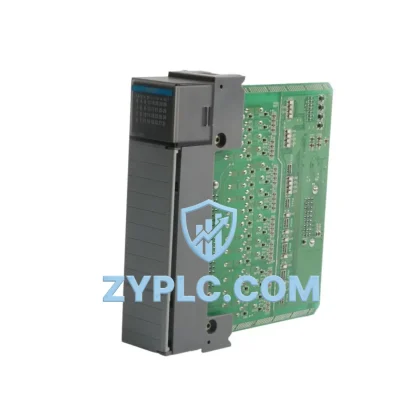
The Allen-Bradley 1771-IA/C is a 120V AC discrete input module engineered for seamless integration within the Allen-Bradley PLC-5 control platform. Rather than functioning as a standalone component, the 1771-IA/C is designed to occupy a defined role within a layered automation architecture — bridging field-level signal acquisition with the deterministic scan cycle of the PLC-5 processor. In distributed manufacturing, power generation, petrochemical processing, and water treatment environments, this module serves as the foundational input interface that enables the control system to respond accurately and reliably to process conditions.
Within a complete PLC-5 control system, the 1771-IA/C is installed into a 1771 I/O chassis — typically a 1771-A1B, 1771-A2B, 1771-A3B, or 1771-A4B backplane — and communicates directly with the PLC-5 processor via the 1771 I/O bus. The module accepts 16 discrete AC input signals from field devices such as limit switches, proximity sensors, pushbuttons, and relay contacts, converting them into logic-level signals that the processor can evaluate within its ladder logic program. This signal flow — from field device through the 1771-IA/C to the PLC-5 CPU — forms the core of the control layer’s input acquisition cycle.
Architecture Specification Table
| Parameter |
Specification |
| System Role |
Discrete AC Input Module — PLC-5 I/O Layer |
| Compatible Platform |
Allen-Bradley PLC-5 (1771 I/O System) |
| Input Voltage |
100–120V AC, 47–63 Hz |
| Number of Input Points |
16 discrete inputs |
| Input Current (per point) |
Approx. 10 mA at 120V AC |
| ON-State Voltage Range |
74–132V AC |
| OFF-State Voltage Range |
0–20V AC |
| Isolation |
Optical isolation between field and logic circuits |
| Communication Interface |
1771 Parallel I/O Backplane Bus |
| Compatible Chassis |
1771-A1B / A2B / A3B / A4B |
| Installation Environment |
Industrial control panels, DIN-rail enclosures, IEC 60068 rated environments |
| Operating Temperature |
0°C to 60°C (32°F to 140°F) |
| Contextual Integration |
Fully compatible with PLC-5 multi-rack and remote I/O configurations |
| Warranty |
12-Month Warranty — tested, verified, and ready to deploy |
Coordinated Control System Design
The 1771-IA/C does not operate in isolation. Its value is realized through its coordination with the broader PLC-5 control architecture. At the processor level, the Allen-Bradley PLC-5/20 or PLC-5/40 CPU manages the scan cycle that reads the input image table populated by the 1771-IA/C. The processor’s program logic evaluates these inputs and drives corresponding output modules — such as the 1771-OA (120V AC output module) or 1771-OB (24V DC output module) — to actuate field devices including motor starters, solenoid valves, and control relays.
At the power layer, the 1771-P4S or 1771-P7 power supply provides regulated DC bus voltage to the 1771 chassis backplane, ensuring stable operation of all installed modules including the 1771-IA/C. Proper power supply sizing is critical in multi-module chassis configurations where several I/O modules share the same backplane power budget.
For systems requiring network connectivity and remote monitoring, the 1771-KE or 1771-KF communication interface modules enable the PLC-5 system to participate in Data Highway Plus (DH+) or Remote I/O (RIO) networks. This allows the 1771-IA/C’s input data to be shared across supervisory SCADA systems or upstream MES platforms without additional hardware conversion. In larger distributed architectures, the 1756-DHRIO ControlLogix bridge module can serve as a gateway between legacy PLC-5 RIO networks and modern EtherNet/IP infrastructure.
At the human-machine interface layer, operator workstations running RSView32 or FactoryTalk View SE display real-time input status from the 1771-IA/C, enabling operators to monitor field device states, acknowledge alarms, and initiate manual overrides. The integration of the 1771-IA/C’s input data into the HMI tag database is straightforward, as the PLC-5 processor exposes all I/O image table data through standard DH+ or Ethernet communication drivers.
For redundancy-critical applications, the 1771-IA/C can be deployed in dual-chassis configurations where a primary and secondary PLC-5 system monitor the same field inputs through parallel wiring or input signal splitters. This architecture supports hot-standby control strategies commonly required in power generation, oil and gas, and water treatment facilities where unplanned downtime carries significant operational and safety consequences.
Application in Layered Automation Systems
The 1771-IA/C finds application across a wide range of industrial sectors where 120V AC field devices remain the standard for discrete signal wiring. In manufacturing and assembly lines, the module interfaces with machine guarding sensors, conveyor limit switches, and pneumatic valve position feedback signals, providing the PLC-5 processor with real-time machine state data. In power generation and electrical substations, the 1771-IA/C monitors breaker status, relay contact positions, and auxiliary contact feedback from high-voltage switching equipment, supporting both automatic control sequences and manual operator commands.
In petrochemical and refinery applications, the module is used to monitor pump run/stop status, valve open/close confirmation, and process interlock signals from field-mounted switches. Its optical isolation ensures that high-voltage transients common in industrial field wiring do not propagate into the PLC-5 logic circuits, protecting system integrity. In water and wastewater treatment facilities, the 1771-IA/C supports level switch monitoring, pump control feedback, and chemical dosing system interlocks, where reliable discrete input acquisition is essential for regulatory compliance and process safety.
In mining and metallurgical operations, the module is deployed in conveyor control systems, crusher interlock circuits, and ventilation control panels, where the rugged 1771 I/O platform has demonstrated decades of reliable service in harsh environments. For packaging and material handling lines, the 1771-IA/C interfaces with photoelectric sensors, inductive proximity switches, and mechanical limit switches to provide precise product position and machine state feedback to the PLC-5 control system.
Architecture Engineering FAQ
Q1: Is the 1771-IA/C compatible with all PLC-5 processor variants and chassis configurations?
The 1771-IA/C is compatible with all Allen-Bradley PLC-5 processor families — including the PLC-5/11, PLC-5/20, PLC-5/30, PLC-5/40, and PLC-5/60 — when installed in a 1771-series I/O chassis (1771-A1B through 1771-A4B). The module occupies a single slot and communicates via the standard 1771 parallel I/O backplane bus. It is also compatible with remote I/O adapter configurations using the 1771-ASB adapter module, enabling deployment in distributed rack architectures located away from the main processor chassis. All units supplied by ZYPLC are tested for backplane communication integrity prior to shipment and are covered by a 12-Month Warranty.
Q2: How does the 1771-IA/C support long-term maintenance and spare parts strategy in aging PLC-5 systems?
As PLC-5 systems approach end-of-life from the OEM perspective, maintaining a reliable inventory of tested 1771-IA/C modules is a critical element of any long-term maintenance strategy. ZYPLC maintains stock of verified 1771-IA/C units to support emergency replacement, planned maintenance shutdowns, and system expansion projects. Each module undergoes functional testing including input channel verification, optical isolation integrity checks, and backplane communication validation before dispatch. Customers operating large PLC-5 installations are encouraged to maintain a minimum buffer stock of 1771-IA/C modules to minimize mean time to repair (MTTR) during unplanned failures.
Q3: What commissioning steps are required when installing a replacement 1771-IA/C in an existing PLC-5 system?
Installing a replacement 1771-IA/C requires the following commissioning steps: (1) Power down the affected chassis or confirm that hot-insertion is supported by the system configuration. (2) Remove the existing module and install the replacement 1771-IA/C in the same chassis slot, ensuring the keying bands match the original module’s configuration. (3) Restore power and verify that the processor recognizes the module in the I/O configuration table — no software reconfiguration is required if the replacement module matches the original catalog number. (4) Using RSLogix 5 or RSLogix 500 online monitoring, verify that all 16 input channels are reading correctly against known field device states. (5) Document the replacement in the system maintenance log and confirm the 12-Month Warranty registration with ZYPLC for the replacement unit.
© 2026 ZYPLC. All rights reserved.
Original Source: https://zyplc.com
Contact: +86 19859288691 | plc.sales@zyplc.com