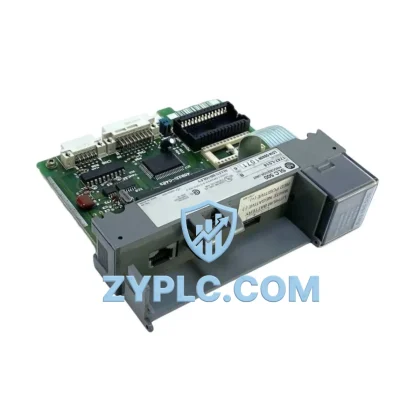
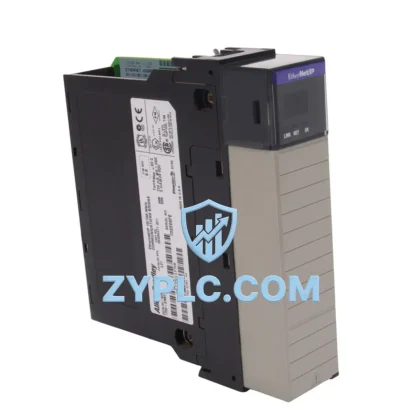
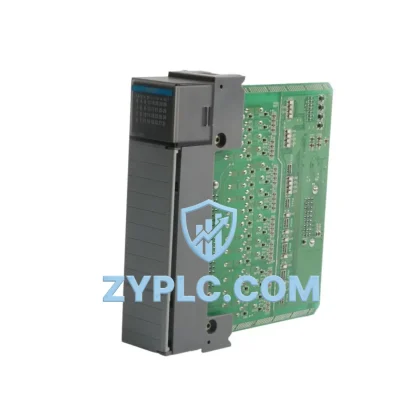
Allen-Bradley 1771-IVN/C System-Ready Isolated Input for PLC-5 Architecture
The Allen-Bradley 1771-IVN/C is a high-integrity isolated analog input module engineered for seamless integration within the PLC-5 control system architecture. Designed to operate within the 1771 I/O chassis, this module serves as a critical signal acquisition node at the I/O layer of a layered automation hierarchy, bridging field-level instrumentation with the PLC-5 processor’s control logic. Its galvanic isolation capability ensures that noise, ground loops, and transient voltages originating from field devices do not propagate into the control backplane — a fundamental requirement in high-reliability industrial environments such as power generation, petrochemical processing, and heavy manufacturing.
In a complete PLC-5 control system, the 1771-IVN/C does not operate in isolation. It functions as part of a coordinated architecture that spans the processor module, I/O chassis, power supply, communication network, and human-machine interface. Understanding its role within this broader system context is essential for engineers responsible for system design, commissioning, and long-term maintenance. The module slots directly into the 1771 I/O chassis backplane, communicating with the PLC-5 processor via the 1771 I/O bus, and its configuration is managed through RSLogix 5 or equivalent programming environments. Proper rack addressing, module keying, and I/O image table mapping are prerequisites for stable operation within the control architecture.
Signal integrity is the primary engineering value delivered by the 1771-IVN/C. By providing channel-to-channel and channel-to-backplane isolation, the module allows engineers to connect sensors from multiple independent field circuits — including thermocouples, RTDs, 4–20 mA transmitters, and voltage sources — without risking cross-contamination of signals or damage to the processor. This is particularly valuable in process industries where field wiring runs long distances through electrically noisy environments, such as motor control centers, variable frequency drive panels, and high-voltage switchgear rooms.
From a system architecture perspective, the 1771-IVN/C contributes to both redundancy design and modular scalability. In redundant PLC-5 configurations, paired processors and I/O chassis can be configured to share input data, and isolated input modules like the 1771-IVN/C reduce the risk of a single field fault cascading into a system-wide failure. Engineers designing for high-availability applications — such as continuous process plants or critical infrastructure — rely on the isolation characteristics of this module to maintain control system uptime even when individual field instruments experience faults or require maintenance.
All units supplied by ZYPLC are covered by a 12-Month Warranty and undergo functional verification prior to shipment. Our inventory is sourced from certified channels, and each module is inspected for physical integrity, connector condition, and label authenticity. We maintain stock availability to support both planned maintenance schedules and emergency replacement requirements, minimizing unplanned downtime for our customers.
Architecture Specification Table
| Parameter |
Specification |
| System Role |
Isolated Analog Input Module — I/O Layer |
| Compatible Platform |
Allen-Bradley PLC-5 / 1771 I/O System |
| Module Series |
1771 (1771-IVN/C) |
| Isolation Type |
Channel-to-Channel and Channel-to-Backplane Galvanic Isolation |
| Input Signal Types |
Voltage / Current Analog Inputs (field-configurable) |
| Backplane Interface |
1771 I/O Bus (single-slot) |
| Programming Environment |
RSLogix 5 / A.I. Series PLC-5 Processors |
| Installation Environment |
Industrial Control Panel / 1771 I/O Chassis |
| Operating Temperature |
0°C to 60°C (standard industrial range) |
| Communication Capability |
I/O Image Table Mapping via PLC-5 Processor |
| Contextual Integration |
Compatible with PLC-5 redundancy and multi-rack architectures |
| Warranty |
12-Month Warranty — All units verified before shipment |
| Origin |
United States (Allen-Bradley / Rockwell Automation) |
Coordinated Control System Design
The 1771-IVN/C achieves its full engineering value when deployed within a coordinated PLC-5 system architecture. At the processor layer, the Allen-Bradley PLC-5/20 or PLC-5/40 CPU manages the I/O image table and executes the ladder logic program that processes the isolated input signals. The processor communicates with the I/O chassis via the 1771 I/O bus, and the 1771-IVN/C module’s data is mapped into the processor’s input image file for real-time use in control logic.
Power integrity for the I/O chassis is provided by the 1771-P4S or 1771-P7 power supply modules, which deliver regulated DC power to the backplane and all installed I/O modules. Stable power supply operation is a prerequisite for accurate analog signal acquisition, as power rail noise directly affects the resolution and repeatability of isolated input readings.
At the network and communication layer, the 1771-KE or 1771-KF communication interface modules enable the PLC-5 system to participate in Data Highway Plus (DH+) or Remote I/O networks, allowing the isolated input data acquired by the 1771-IVN/C to be shared with supervisory systems, SCADA platforms, or remote operator stations. In distributed architectures, the 1771-ASB adapter module extends the I/O chassis to remote rack configurations, enabling the 1771-IVN/C to be installed closer to field instrumentation while maintaining communication with the central processor.
For human-machine interface integration, the Allen-Bradley PanelView 550 or PanelView 900 terminals connect to the PLC-5 system via DH+ or RS-232, displaying real-time process values derived from the isolated input signals. Operators can monitor analog trends, set alarm thresholds, and initiate control actions based on the data acquired through the 1771-IVN/C module.
At the output and execution layer, the isolated input signals processed by the PLC-5 CPU drive 1771-OFE analog output modules or 1771-OW relay output modules, which in turn command field actuators, control valves, motor starters, and variable frequency drives. The complete signal chain — from field sensor through the 1771-IVN/C, through the PLC-5 processor, to the output module and actuator — represents the fundamental control loop that the isolated input module anchors at the acquisition stage.
Terminal block assemblies and 1492-IFM interface modules are commonly used in conjunction with the 1771-IVN/C to provide organized, maintainable field wiring termination points within the control panel, reducing installation time and simplifying future troubleshooting and rewiring activities.
Application in Layered Automation Systems
The Allen-Bradley 1771-IVN/C finds application across a wide range of industrial sectors where signal isolation is a non-negotiable requirement for control system reliability.
In power generation and electrical utilities, the module is used to acquire isolated analog signals from current transformers, voltage transducers, and temperature sensors associated with generators, transformers, and switchgear. The galvanic isolation prevents high-voltage transients from reaching the PLC-5 backplane, protecting the control system from damage during switching events or fault conditions.
In petrochemical and refinery applications, the 1771-IVN/C is deployed in hazardous area control panels where field instruments are located in classified zones. The isolation barrier ensures that intrinsically safe circuit integrity is maintained between the field and the control room, supporting compliance with IEC 60079 and NEC Article 505 requirements for hazardous location installations.
In water and wastewater treatment facilities, the module acquires flow, pressure, level, and pH signals from distributed field instruments across large plant areas. The ability to isolate each input channel independently prevents ground loop interference — a common problem in water treatment plants where field instruments are grounded at multiple points across the facility.
In mining and mineral processing, the 1771-IVN/C is used in conveyor control systems, crusher monitoring applications, and flotation cell process control, where the electrical environment is characterized by high levels of electromagnetic interference from large motors, variable speed drives, and high-current switching equipment.
In packaging and discrete manufacturing lines, the module supports quality control applications where analog sensors — such as vision system outputs, load cells, and position transducers — must be acquired with high accuracy and without cross-channel interference, ensuring that product quality measurements are not corrupted by electrical noise from adjacent machine axes.
Architecture Engineering FAQ
Q1: Is the 1771-IVN/C compatible with both single-rack and multi-rack PLC-5 architectures?
Yes. The 1771-IVN/C installs in any slot of a 1771 I/O chassis and is compatible with both local and remote rack configurations. In remote rack applications, the chassis must be equipped with a 1771-ASB adapter module to communicate with the PLC-5 processor over the Remote I/O link. Rack addressing must be configured correctly in both the hardware and the RSLogix 5 I/O configuration to ensure proper data mapping. ZYPLC can provide technical guidance on rack addressing and module placement as part of our pre-sales support service, backed by our 12-Month Warranty on all supplied modules.
Q2: How does the 1771-IVN/C support long-term maintenance and spare parts management in aging PLC-5 systems?
As the PLC-5 platform approaches end-of-life support from the original manufacturer, maintaining a reliable supply of critical I/O modules such as the 1771-IVN/C becomes a strategic priority for plant engineers. ZYPLC maintains dedicated inventory of 1771 series modules to support both planned preventive maintenance programs and emergency replacement scenarios. Each module is functionally tested and covered by a 12-Month Warranty, providing assurance that replacement modules will perform to specification from the moment of installation. We recommend that facilities operating PLC-5 systems establish a minimum spare parts inventory of critical I/O modules to reduce the risk of extended downtime caused by module failure.
Q3: What commissioning steps are required when installing the 1771-IVN/C as a replacement module in an existing PLC-5 system?
When replacing a 1771-IVN/C in an existing system, engineers should verify that the replacement module’s revision level (in this case, revision C) matches or is compatible with the original module’s configuration as defined in the RSLogix 5 project file. Physical module keying must be checked to ensure the replacement module is keyed identically to the original. After installation, the PLC-5 processor should be placed in Program mode before the module is powered, and the I/O configuration should be verified in RSLogix 5 to confirm that the module is recognized at the correct rack and slot address. Analog scaling parameters, filter settings, and alarm limits configured in the ladder logic should be verified against the original engineering documentation before returning the system to Run mode. ZYPLC’s technical support team is available to assist with commissioning questions for modules supplied under our 12-Month Warranty program.
© 2026 ZYPLC. All rights reserved.
Original Source: https://zyplc.com
Contact: +86 19859288691 | [email protected]