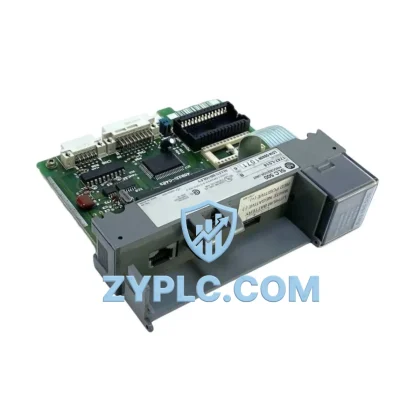
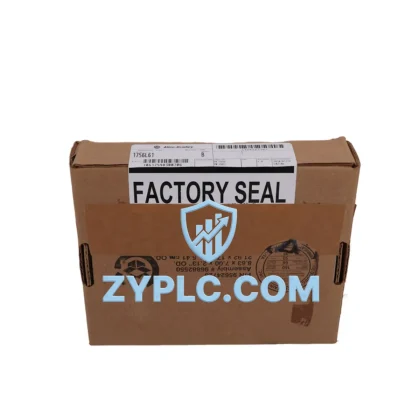
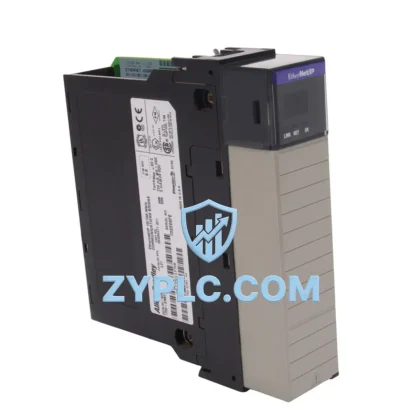
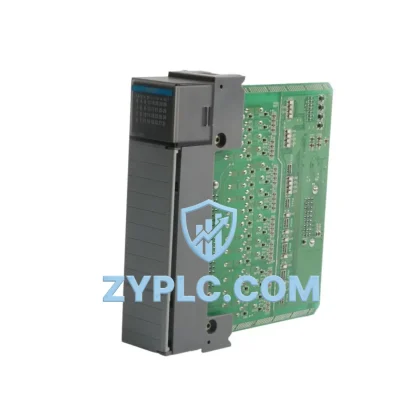
Allen-Bradley 1771-OAD System-Ready Digital Output for PLC-5 Architecture
The Allen-Bradley 1771-OAD Digital Output Module is a purpose-built discrete output component designed to operate within the full-depth control architecture of the Allen-Bradley PLC-5 platform. Rather than functioning as a standalone device, the 1771-OAD is engineered to serve as a critical output execution node within a layered automation hierarchy — bridging the gap between the CPU’s logic decisions and the physical actuators, contactors, solenoids, and motor starters that drive real-world industrial processes.
In a complete PLC-5 control system, the 1771-OAD occupies the I/O layer, receiving discrete output commands from the PLC-5 processor — such as the 1785-L40B or 1785-L80B — via the 1771 I/O chassis backplane. The module slots directly into the 1771-A4B or 1771-A2B I/O chassis, sharing the backplane with complementary modules including the 1771-IAD digital input module and the 1771-OFE analog output module. This modular architecture allows engineers to configure mixed I/O racks tailored precisely to the signal density and type requirements of each control zone.
At the network and communication layer, the PLC-5 processor communicates with supervisory systems and peer controllers via Data Highway Plus (DH+) or Remote I/O (RIO) links. The 1771-OAD participates in this architecture by responding to output image table updates driven by the processor’s scan cycle, ensuring deterministic and synchronized actuation across all output channels. In distributed control configurations, the module can be deployed in remote I/O drops managed through a 1771-SN scanner module, extending the control reach across large plant floor footprints without sacrificing signal integrity or scan time consistency.
From a power layer perspective, the 1771-OAD requires a compatible I/O chassis power supply — typically the 1771-P4S or 1771-P7 — to deliver regulated backplane voltage. Proper power budgeting across the chassis is essential when combining high-density output modules with analog and specialty modules, and the 1771-OAD’s well-defined power consumption profile simplifies this calculation for system designers.
At the human-machine interface layer, operator stations running RSView32 or FactoryTalk View SE communicate with the PLC-5 processor to provide real-time output status visualization. The 1771-OAD’s channel states are mapped directly into the processor’s output image table, making them immediately accessible for HMI display, alarm management, and historical data logging — supporting both operational transparency and regulatory compliance in process-intensive industries.
For redundancy-critical applications, the 1771-OAD can be deployed in architectures utilizing the 1785-CHBM chassis interconnect module for hot-standby CPU redundancy. While the output module itself operates in a single-chassis role, the overall system architecture ensures that a standby processor can assume control with minimal disruption, preserving output state continuity across the switchover event.
The 1771-OAD’s robust design supports long-term deployment in demanding industrial environments, including manufacturing assembly lines, electrical power distribution substations, petrochemical process units, water and wastewater treatment facilities, mining conveyor systems, metallurgical furnace controls, and high-speed packaging lines. Its compatibility with the broader 1771 I/O family means that system expansions — adding new I/O points, integrating additional control zones, or upgrading communication capabilities — can be accomplished without disrupting existing wiring or chassis configurations.
From an engineering and maintenance perspective, the 1771-OAD supports efficient commissioning workflows. Field wiring connects to the module’s removable terminal block, allowing the module to be replaced during maintenance windows without disturbing field wiring — a critical advantage in 24/7 production environments where downtime carries significant operational cost. Diagnostic LEDs on the module faceplate provide immediate visual confirmation of output channel states and module health, reducing troubleshooting time during both initial commissioning and ongoing preventive maintenance cycles.
All 1771-OAD units supplied by ZYPLC are sourced from verified inventory channels, functionally tested prior to shipment, and covered by a 12-Month Warranty. Our Contextual Integration support service ensures that each module is matched to the correct chassis, power supply, and processor configuration for your specific application — reducing the risk of compatibility issues and accelerating your project timeline.
Architecture Specification Table
| Parameter |
Specification |
| System Role |
Discrete Output Module — PLC-5 I/O Layer |
| Compatible Platform |
Allen-Bradley PLC-5 (1785 Series) |
| Compatible Chassis |
1771-A2B, 1771-A4B, 1771-A3B1 |
| Output Type |
AC Digital Output (Triac) |
| Number of Output Points |
16 Points |
| Output Voltage Range |
85–265V AC, 47–63 Hz |
| Output Current per Point |
0.5A continuous per output |
| Backplane Communication |
1771 I/O Chassis Backplane |
| Network Compatibility |
Data Highway Plus (DH+), Remote I/O (RIO) |
| Power Supply Compatibility |
1771-P4S, 1771-P7 |
| Operating Temperature |
0°C to 60°C (32°F to 140°F) |
| Relative Humidity |
5% to 95% non-condensing |
| Installation |
Single-slot, 1771 I/O chassis |
| Wiring |
Removable terminal block |
| Warranty |
12-Month Warranty (ZYPLC) |
| Contextual Integration |
Supported — chassis, power, and processor matching service |
Coordinated Control System Design
The 1771-OAD achieves its full operational value when integrated within a coordinated PLC-5 control system. A typical architecture begins with the 1785-L40B PLC-5/40 processor as the central logic engine, housed in a 1771-A4B four-slot chassis alongside the 1771-OAD and complementary I/O modules. The 1771-IAD digital input module occupies an adjacent slot, feeding discrete field signals — limit switches, proximity sensors, pushbuttons — into the processor’s input image table, while the 1771-OAD drives the corresponding output devices based on the processor’s ladder logic execution.
For analog process control loops, the 1771-OFE analog output module works in parallel with the 1771-OAD, providing 4–20mA or 0–10V signals to variable frequency drives and control valves, while the 1771-OAD handles the discrete on/off commands for auxiliary contactors and pilot lights. The 1771-IFE analog input module completes the analog I/O pair, feeding process variable signals back to the processor for closed-loop PID control.
At the communication layer, a 1785-KA5 DH+ communication adapter enables the PLC-5 processor to exchange data with peer controllers, SCADA systems, and programming terminals over the Data Highway Plus network. For remote I/O expansion, the 1771-SN scanner module extends the I/O chassis network to remote drops, allowing 1771-OAD modules to be deployed at distributed field locations while remaining under centralized processor control.
Power integrity across the system is maintained by the 1771-P4S chassis power supply, which delivers regulated 5V backplane power and 24V field power to all installed modules. Proper load calculation — accounting for the 1771-OAD’s output current draw alongside other modules — is essential during system design to ensure stable operation across the full operating temperature range.
Application in Layered Automation Systems
The 1771-OAD finds application across a broad spectrum of industrial automation environments. In manufacturing assembly lines, the module drives conveyor motor starters, pneumatic cylinder solenoids, and indicator light towers, providing the discrete output density required for high-throughput production control. In electrical power distribution substations, it controls circuit breaker trip coils, alarm annunciators, and auxiliary relay panels under the supervision of a PLC-5 processor executing protection and control logic.
In petrochemical process plants, the 1771-OAD operates in SIL-rated control architectures, driving emergency shutdown valve actuators and process isolation contactors in response to safety logic executed by the PLC-5 processor. Water and wastewater treatment facilities rely on the module to control pump motor starters, valve actuators, and chemical dosing systems across geographically distributed pump stations connected via Remote I/O links.
In mining and minerals processing operations, the 1771-OAD controls conveyor belt drives, crusher motor starters, and dust suppression systems in high-vibration, high-dust environments where its robust construction and removable terminal block wiring system simplify maintenance during scheduled shutdowns. Metallurgical and furnace control applications leverage the module’s AC output capability to drive high-current contactors controlling furnace heating elements and cooling system actuators.
For packaging and material handling lines, the 1771-OAD provides the output density and response speed required to synchronize conveyor drives, reject mechanisms, and labeling actuators within high-speed production sequences managed by the PLC-5 processor’s high-speed counter and interrupt routines.
Architecture Engineering FAQ
Q1: Is the 1771-OAD compatible with all PLC-5 processor models and chassis configurations?
The 1771-OAD is compatible with the full range of Allen-Bradley PLC-5 processors, including the 1785-L11B, 1785-L20B, 1785-L40B, and 1785-L80B, when installed in any standard 1771 I/O chassis (1771-A1B, 1771-A2B, 1771-A3B1, 1771-A4B). Chassis slot assignment follows standard 1771 I/O addressing rules, and the module’s I/O image size must be accounted for in the processor’s I/O configuration. ZYPLC’s Contextual Integration service verifies chassis compatibility, power budget, and processor I/O table configuration before shipment to eliminate commissioning surprises.
Q2: Can the 1771-OAD be used in a redundant PLC-5 architecture, and what are the key considerations?
Yes. In hot-standby redundancy configurations using the 1785-CHBM chassis interconnect module, the 1771-OAD operates in the primary chassis and its output states are maintained by the active processor. Upon a switchover event, the standby processor assumes control and resumes output image table management. Key considerations include ensuring that both primary and standby chassis are populated with identical I/O module configurations, that the 1771-OAD’s output channel wiring is routed to field devices without intermediate switching that could cause state discontinuity during switchover, and that the power supply capacity in both chassis is independently verified.
Q3: What does the 12-Month Warranty cover, and how does ZYPLC support long-term maintenance of the 1771-OAD?
ZYPLC’s 12-Month Warranty covers functional defects in the 1771-OAD module under normal operating conditions, including backplane communication failures, output channel malfunctions, and terminal block integrity issues. Beyond the warranty period, ZYPLC maintains ongoing inventory of 1771-OAD modules and compatible 1771 I/O family components to support long-term maintenance and emergency replacement requirements. Our technical team provides pre-shipment functional testing, configuration documentation, and post-installation support to ensure that replacement modules integrate seamlessly into existing PLC-5 architectures without requiring processor reprogramming or chassis reconfiguration.
© 2026 ZYPLC. All rights reserved.
Original Source: https://zyplc.com
Contact: +86 19859288691 | [email protected]