Allen-Bradley 1771-OW16 System-Ready Relay Output for 1771 Architecture: Control System Architecture and Upstream-Downstream Coordination
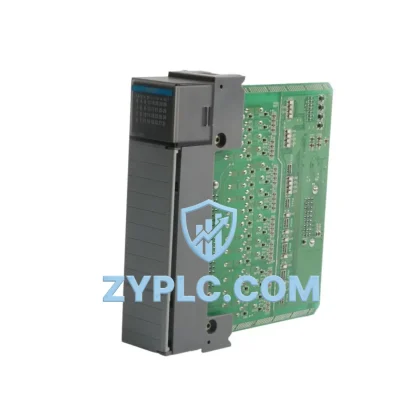
The Allen-Bradley 1771-OW16 is a 16-point relay output module engineered for seamless integration within the Allen-Bradley 1771 I/O chassis system, a foundational platform in the PLC-5 control architecture. Rather than functioning as a standalone component, the 1771-OW16 occupies a critical position within the discrete output layer of a layered automation system — bridging the command logic of the CPU with the physical actuation layer of motors, solenoids, contactors, and pilot devices. Understanding its role demands a system-level perspective that spans the control layer, I/O layer, power distribution layer, network layer, and human-machine interface layer simultaneously.
In a fully realized PLC-5 control architecture, the 1771-OW16 is installed into a 1771 I/O chassis — typically a 1771-A1B, 1771-A2B, 1771-A3B, or 1771-A4B backplane — which provides the physical and electrical backbone for all I/O modules in the rack. The backplane distributes both power and data across the I/O bus, allowing the 1771-OW16 to receive discrete output commands from the CPU module, such as the 1785-L40B or 1785-L80B PLC-5 processor, via the 1771 I/O bus protocol. This tight coupling between the processor and the output module ensures deterministic scan-cycle response, which is essential in time-sensitive manufacturing and process control environments.
On the power distribution side, the 1771-OW16 relies on the 1771-P4S or 1771-P7 power supply modules to deliver stable backplane voltage. Relay output modules are particularly sensitive to power quality because each relay coil requires consistent energization to maintain contact integrity over thousands of switching cycles. In redundant power architectures — common in water treatment, oil and gas, and chemical processing applications — dual power supplies are deployed with automatic switchover to ensure uninterrupted output module operation. The 1771-OW16’s isolated relay contacts further protect the control system from voltage transients originating in the field wiring, enhancing overall system resilience.
From a network and communications perspective, the 1771-OW16 operates within systems that are typically coordinated via Data Highway Plus (DH+) or ControlNet networks. A 1785-KA5 communication adapter or a 1771-KF2 DH+ interface module may be present in the same rack or adjacent racks to facilitate peer-to-peer messaging, remote I/O scanning, and SCADA integration. In larger distributed architectures, the PLC-5 processor communicates upstream to a supervisory system via an Ethernet/IP gateway or a 1761-NET-ENI interface, enabling plant-wide visibility of the relay output states controlled by the 1771-OW16.
At the human-machine interface layer, operators interact with the system through PanelView terminals or modern FactoryTalk View SE stations, which display the real-time status of each relay output point managed by the 1771-OW16. Alarm management, output forcing, and diagnostic screens are configured to reflect the module’s 16 output channels, giving maintenance engineers immediate visibility into field device states without requiring physical inspection of the control cabinet.
The 1771-OW16 also plays a role in system redundancy and maintainability strategies. In hot-standby redundancy configurations using the 1785-CHBM chassis monitor module, the output module’s state is continuously mirrored between primary and secondary racks, ensuring bumpless transfer during CPU failover events. This architecture is particularly valued in continuous process industries such as petrochemical refining, power generation, and pharmaceutical manufacturing, where unplanned output interruptions carry significant operational and safety consequences.
For long-term maintenance and inventory planning, the 1771-OW16 is supported by ZYPLC’s 12-Month Warranty program, which covers verified functional testing, contact resistance measurement, and coil integrity validation prior to shipment. Contextual Integration support ensures that replacement modules are pre-configured and documented to match the existing rack slot assignment, I/O address mapping, and field wiring termination scheme — reducing commissioning time and minimizing the risk of configuration errors during emergency replacements.
Architecture Specification Table
| Parameter |
Specification |
| System Role |
Discrete Relay Output Module — 1771 I/O Layer |
| Output Points |
16 relay output channels (isolated contacts) |
| Output Voltage Range |
5–265V AC / 5–125V DC per channel |
| Output Current Rating |
2A per point (resistive load) |
| Contact Type |
Form A (normally open) relay contacts |
| Backplane Compatibility |
1771-A1B, 1771-A2B, 1771-A3B, 1771-A4B chassis |
| Communication Protocol |
1771 I/O Bus (PLC-5 native) |
| Power Supply Compatibility |
1771-P4S, 1771-P7 backplane power supplies |
| Operating Temperature |
0°C to 60°C (32°F to 140°F) |
| Relative Humidity |
5% to 95% non-condensing |
| Installation Environment |
Panel-mount, 1771 I/O chassis slot |
| Warranty |
12-Month Warranty — functional tested, contact verified |
| Contextual Integration |
Slot-matched, address-mapped, field-wiring documented |
Coordinated Control System Design
The 1771-OW16 achieves its full operational value when deployed as part of a coordinated control system rather than as an isolated replacement component. In a typical PLC-5 rack assembly, the module shares the 1771-A3B or 1771-A4B chassis with a 1785-L40B or 1785-L80B processor module, a 1771-IFE analog input module for process variable acquisition, a 1771-OFE analog output module for valve positioner control, and a 1771-IBD DC input module for discrete field device status monitoring. Together, these modules form a complete I/O subsystem capable of handling both analog process control loops and discrete switching functions within a single rack.
In applications requiring expanded I/O capacity, the 1771-OW16 is deployed across multiple remote I/O racks connected to the PLC-5 processor via a 1771-ASB remote I/O adapter module. This configuration allows a single PLC-5 CPU to manage hundreds of I/O points distributed across a plant floor, with the 1771-OW16 providing relay switching capability at each remote rack location. The 1771-ASB adapter handles all communication handshaking with the processor, ensuring that relay output commands are delivered with the same determinism as local rack I/O.
For systems requiring network-level integration, a 1785-KA5 communication adapter installed in the same rack enables the PLC-5 processor to participate in a Data Highway Plus network alongside other PLC-5 and SLC 500 controllers. This peer-to-peer architecture allows coordinated relay output sequencing across multiple controllers — a common requirement in large-scale conveyor systems, automated assembly lines, and batch processing facilities. The 1771-OW16’s output states can be read and written by peer controllers via MSG instructions, enabling distributed control logic without centralized bottlenecks.
Terminal block wiring for the 1771-OW16 is typically managed through a 1492-IFM (interface module) or equivalent field wiring termination assembly, which provides a structured and labeled connection point for all 16 relay output circuits. This approach simplifies field wiring, reduces installation errors, and accelerates troubleshooting during commissioning and maintenance cycles.
Application in Layered Automation Systems
The 1771-OW16 finds application across a broad spectrum of industrial sectors where relay output switching is required within a PLC-5 or compatible control architecture. In discrete manufacturing environments — including automotive assembly, electronics production, and metal fabrication — the module controls motor starters, solenoid valves, indicator lamps, and audible alarms as part of machine-level control sequences managed by the PLC-5 processor. Its isolated relay contacts provide the electrical isolation necessary to protect the control system from inductive load switching transients generated by motor contactors and solenoid coils.
In the electric power sector, the 1771-OW16 is deployed in substation automation and switchgear control panels, where it provides the relay switching interface between the PLC-5 control system and high-voltage switching devices. The module’s wide output voltage range — supporting both AC and DC field devices — makes it suitable for mixed-voltage switchgear environments where both 120V AC control circuits and 24V DC signaling circuits coexist within the same control cabinet.
In water and wastewater treatment facilities, the 1771-OW16 controls pump motor starters, valve actuators, chemical dosing systems, and UV disinfection equipment as part of a SCADA-integrated PLC-5 control system. The module’s relay contacts provide the dry-contact switching interface required by many field devices in water treatment applications, where galvanic isolation between the control system and field equipment is a regulatory and safety requirement.
In petrochemical and refining applications, the 1771-OW16 operates within safety-instrumented system (SIS) adjacent architectures, controlling shutdown valves, depressurization systems, and emergency isolation devices under the command of the PLC-5 processor. While the 1771-OW16 itself is not a SIL-rated module, it is frequently deployed in the basic process control system (BPCS) layer alongside SIS architectures, providing the relay switching interface for non-safety-critical output functions.
In mining and mineral processing operations, the module controls conveyor drive starters, crusher motor contactors, and ore handling equipment as part of distributed PLC-5 control systems spanning large geographic areas. The 1771-OW16’s compatibility with remote I/O architectures via the 1771-ASB adapter makes it well-suited for these distributed applications, where control equipment is spread across multiple buildings and process areas.
Architecture Engineering FAQ
Q1: Is the 1771-OW16 compatible with all 1771 I/O chassis sizes, and can it be mixed with other 1771 I/O modules in the same rack?
A: Yes. The 1771-OW16 is compatible with all standard 1771 I/O chassis variants, including the 1771-A1B (4-slot), 1771-A2B (8-slot), 1771-A3B (12-slot), and 1771-A4B (16-slot) backplanes. It can be freely mixed with other 1771 I/O modules — including analog input/output modules, DC input modules, and communication adapters — within the same chassis, subject to the power supply capacity of the installed 1771-P4S or 1771-P7 power supply. Slot addressing is configured via the module’s keyswitch and the PLC-5 processor’s I/O configuration table.
Q2: What are the key considerations for replacing a 1771-OW16 in a live production system, and how does Contextual Integration support minimize downtime?
A: Replacing a 1771-OW16 in a live system requires careful attention to slot addressing, field wiring termination, and output forcing states. ZYPLC’s Contextual Integration service provides a pre-shipment documentation package that includes the module’s rack slot assignment, I/O address mapping, and field wiring termination diagram — allowing maintenance engineers to complete the physical replacement and recommission the module without requiring a controls engineer to be on-site. The 12-Month Warranty covers the replacement module for a full year from the date of shipment, providing confidence in long-term reliability.
Q3: How does the 1771-OW16 perform in high-cycle-rate applications, and what maintenance intervals are recommended for relay contact longevity?
A: The 1771-OW16’s relay contacts are rated for a mechanical life of approximately 10 million operations and an electrical life that varies with load type and switching frequency. In high-cycle-rate applications — such as conveyor indexing, packaging machinery, or rapid-sequence batch processing — relay contact wear is the primary maintenance concern. ZYPLC recommends periodic contact resistance measurement using a milliohm meter as part of a planned maintenance program, with contact replacement or module swap-out triggered when contact resistance exceeds 100 milliohms. Spare module inventory management is simplified by ZYPLC’s in-stock availability and 12-Month Warranty coverage on all replacement units.
© 2026 ZYPLC. All rights reserved.
Original Source: https://zyplc.com
Contact: +86 19859288691 | [email protected]