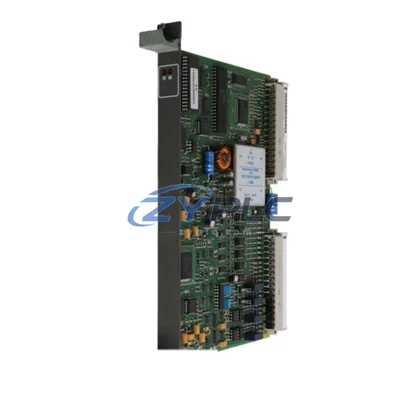
Allen-Bradley 1775-KA Communication Adapter for PLC-3 Automation
The Allen-Bradley 1775-KA is a high-performance communication adapter engineered for the PLC-3 platform, designed to reduce unnecessary data transmission overhead, streamline inter-device communication, and support energy-conscious industrial automation architectures. In modern manufacturing environments where every watt of consumed power and every millisecond of cycle time matters, the 1775-KA plays a critical role in connecting control systems, drives, and monitoring equipment with minimal latency and maximum reliability. All units are sourced from verified supply channels, fully tested prior to shipment, and backed by a warranty terms confirmed during quotation.
Product Specification Table
| Parameter |
Specification / Value |
| SKU |
1775-KA |
| Brand |
Allen-Bradley (Rockwell Automation) |
| Series |
PLC-3 |
| Product Type |
Communication Adapter |
| Communication Protocol |
DH+ (Data Highway Plus) |
| Power Consumption |
Low-overhead bus communication; reduces redundant polling cycles |
| Operating Efficiency |
Optimized for deterministic scan-cycle communication |
| Compatible Systems |
Allen-Bradley PLC-3, PLC-3/10, PLC-3/15, PLC-3/20 platforms |
| Application Environment |
Industrial automation, process control, discrete manufacturing |
| Maintenance Value |
Reduces CPU load on host PLC, lowers idle communication energy draw |
| Origin |
USA |
| Warranty |
warranty terms confirmed during quotation |
| Condition |
Tested & Verified, shipment arranged after confirmation |
System Compatibility and Application
The 1775-KA communication adapter is most effective when deployed as part of a tightly integrated automation architecture where energy efficiency is a system-level objective rather than an afterthought. In a typical PLC-3-based control cabinet, the 1775-KA interfaces directly with the processor backplane, enabling the host controller to offload communication management tasks and focus its scan cycle on real-time control logic. This division of responsibility directly reduces the processor’s active duty cycle, which translates into measurable reductions in heat generation and power draw during steady-state operation.
When paired with Allen-Bradley 1771 I/O modules — including digital input/output cards and analog signal conditioners — the 1775-KA enables the PLC-3 to receive high-resolution process data from field sensors without burdening the main CPU with raw data parsing. This architecture supports faster response to energy anomalies detected at the field level, such as overcurrent conditions or motor thermal events, allowing the control system to take corrective action before unplanned downtime escalates into equipment damage.
In drive-intensive applications, the 1775-KA facilitates communication between the PLC-3 and Allen-Bradley 1336 PLUS or 1336 IMPACT AC drive systems. These variable frequency drives (VFDs) rely on accurate, low-latency command signals to implement speed ramping, torque limiting, and regenerative braking — all of which are operational-efficiency strategies that depend on the communication adapter delivering setpoint data without delay or packet loss. A degraded or incompatible communication adapter in this chain can cause drives to default to fixed-speed operation, eliminating the operational stability that VFD control is designed to deliver.
For facilities running distributed control across multiple production zones, the 1775-KA supports Data Highway Plus (DH+) network topology, allowing the PLC-3 to exchange data with remote I/O racks, operator interface panels such as the Allen-Bradley PanelView 550 or PanelView 900, and peer controllers without requiring a dedicated communication processor for each node. This reduces the total number of active hardware components on the network, which directly lowers the aggregate standby power consumption of the control infrastructure.
Power monitoring integration is another key benefit of a properly functioning 1775-KA. When connected to energy metering devices or power quality analyzers via the DH+ network, the PLC-3 can log real-time kWh consumption data, track power factor trends, and trigger demand-response actions during peak tariff periods. The Allen-Bradley 1420 PowerMonitor or compatible third-party power transducers can feed this data into the PLC-3’s data table, enabling closed-loop maintenance planning without requiring a separate SCADA layer.
In systems where the 1775-KA supports communication with remote terminal units or gateway devices bridging to Ethernet/IP or ControlNet networks, it enables the PLC-3 to participate in plant-wide energy dashboards managed by platforms such as Rockwell’s FactoryTalk Energy Metrics. This integration allows production managers to correlate operating load data with production output in real time, identifying inefficient operating windows and scheduling high-energy processes during off-peak hours.
Maintenance and Replacement Notes
On the production floor, the impact of a reliable 1775-KA communication adapter is most visible in three areas: cycle time consistency, unplanned downtime reduction, and drive system efficiency.
Cycle time consistency is directly tied to communication determinism. When the 1775-KA maintains stable, low-jitter data exchange between the PLC-3 and downstream devices, the controller can execute motion sequences and process transitions at their designed scan rates. Inconsistent communication — caused by a failing or incompatible adapter — introduces scan cycle overruns that force the PLC to extend its cycle time, slowing production throughput and increasing the energy consumed per unit of output. Replacing a degraded adapter with a tested 1775-KA restores designed cycle performance and eliminates this hidden energy penalty.
Unplanned downtime is one of the largest sources of unplanned downtime in industrial facilities. When a line stops unexpectedly, heating systems, compressed air networks, conveyor drives, and auxiliary equipment continue to consume power while producing nothing. The 1775-KA’s role in maintaining reliable communication between the PLC-3 and field devices — including proximity sensors, photoelectric detectors, and servo drive feedback channels — reduces the frequency of nuisance faults and communication timeouts that trigger unplanned stops. Predictive maintenance strategies that rely on continuous data collection from the field are only possible when the communication layer is functioning correctly.
Drive system efficiency is the third major area of impact. Allen-Bradley 1336 PLUS II and similar VFD platforms implement operational-efficiency algorithms — including sleep mode, flux optimization, and dynamic braking — that are activated and managed through PLC commands delivered via the communication network. If the 1775-KA is unable to deliver these commands reliably, the drive reverts to conservative default settings that prioritize stability over efficiency. A properly functioning 1775-KA ensures that every operational-efficiency feature of the connected drive system is fully accessible to the PLC-3 control program.
Maintenance cost reduction is an additional benefit. By enabling the PLC-3 to monitor drive fault registers, motor thermal models, and I/O diagnostic data in real time, the 1775-KA supports condition-based maintenance scheduling. Technicians can address developing faults during planned maintenance windows rather than responding to emergency breakdowns, reducing both labor costs and the unplanned downtime associated with emergency restart procedures.
Product Sourcing FAQ
Q1: How does the 1775-KA contribute to operational stability in a PLC-3 system?
The 1775-KA reduces the communication overhead on the PLC-3 processor, allowing the CPU to complete its scan cycle faster and with lower active power draw. It also enables reliable command delivery to variable frequency drives, ensuring that speed control, torque optimization, and regenerative braking functions operate as designed rather than defaulting to fixed-speed, high-energy modes.
Q2: Is the 1775-KA compatible with current Allen-Bradley drive and I/O systems?
The 1775-KA is designed for the PLC-3 platform and communicates via the DH+ protocol. It is compatible with Allen-Bradley 1771 I/O systems, 1336-series AC drives, PanelView operator terminals, and other DH+-capable devices. For integration with newer ControlLogix or CompactLogix platforms, a protocol gateway or migration plan should be evaluated.
Q3: What is the recommended replacement or upgrade path if the 1775-KA is no longer sufficient?
For facilities planning a control system modernization, the PLC-3 platform can be migrated to the Allen-Bradley ControlLogix 1756 series, which supports EtherNet/IP, ControlNet, and DeviceNet natively. However, for sites where the PLC-3 remains the primary controller, a tested and warranted 1775-KA replacement is the most cost-effective path to restoring full communication performance without a full system retrofit.
Q4: What testing and warranty coverage is included with this unit?
Every 1775-KA unit shipped by ZYPLC undergoes functional testing to verify communication initialization, data throughput, and protocol handshake performance before dispatch. All units are covered by a warranty terms confirmed during quotation against defects in materials and workmanship. Availability is confirmed via RFQ for same-week shipment to minimize production downtime.