Allen-Bradley 1775-LX System-Ready Communication Adapter for PLC-3 Architecture: Contextual Integration Across Control System Layers
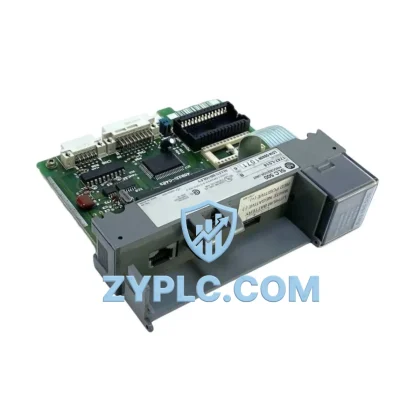
The Allen-Bradley 1775-LX is a dedicated communication adapter module engineered for deployment within the PLC-3 control platform — one of Rockwell Automation’s most enduring and field-proven programmable controller families. Rather than functioning as a standalone component, the 1775-LX is designed to serve as a critical communication bridge within a layered industrial automation architecture, enabling the PLC-3 processor to interface with remote I/O networks, peer controllers, and supervisory systems. Understanding the 1775-LX in the context of the full control system — from the processor backplane to the field device level — is essential for engineers responsible for system integration, expansion, and long-term maintenance.
In a complete PLC-3 control architecture, the 1775-LX occupies the communication layer, sitting between the central processing unit and the broader network infrastructure. It enables the PLC-3 processor — such as the 1775-P — to communicate across Allen-Bradley’s Remote I/O (RIO) network, facilitating deterministic, high-reliability data exchange with distributed I/O racks, remote adapter modules, and field instrumentation. This communication capability is foundational to any distributed control topology where the processor must manage I/O points located beyond the local chassis.
The PLC-3 platform is built around a modular chassis architecture. The 1775-A1 and 1775-A2 chassis provide the physical backplane into which the 1775-P processor, the 1775-LX communication adapter, and supplementary I/O modules are installed. The backplane facilitates high-speed data transfer between modules, and the 1775-LX leverages this infrastructure to route communication signals between the processor and the remote network. Engineers integrating the 1775-LX must ensure chassis slot compatibility and backplane keying alignment to maintain system integrity.
On the power supply side, the 1775-P2 and 1775-P3 power supply modules provide regulated DC power to the chassis, ensuring that the 1775-LX and co-resident modules operate within specified voltage and current tolerances. Stable power delivery is particularly critical for communication modules, as voltage fluctuations can introduce latency, packet loss, or adapter faults that propagate across the entire remote I/O network. Proper power budgeting across the chassis is a prerequisite for reliable 1775-LX operation.
At the remote I/O level, the 1775-LX communicates with remote adapter modules such as the 1771-ASB, which serves as the adapter for 1771 I/O chassis located at remote drops. These remote chassis house discrete and analog I/O modules — including 1771-IB input modules and 1771-OB output modules — that interface directly with field devices such as sensors, actuators, solenoid valves, and motor starters. The 1775-LX manages the polling cycle for each remote drop, ensuring that I/O data is refreshed at the scan rate required by the application.
For applications requiring human-machine interface integration, the PLC-3 platform supports connectivity to Allen-Bradley PanelView terminals via Data Highway Plus (DH+) or Remote I/O links. The 1775-LX can be configured to support supervisory data access, enabling operators to monitor process variables, acknowledge alarms, and issue control commands from HMI stations without disrupting the primary control scan. This integration is particularly valuable in process industries where continuous visibility into system status is a safety and operational requirement.
In redundant control architectures, the 1775-LX plays a role in maintaining communication continuity during processor switchover events. When paired with redundancy modules and a hot-standby processor configuration, the communication adapter must maintain network presence and I/O polling continuity to prevent process upsets during failover. Engineers designing redundant PLC-3 systems should account for the 1775-LX’s role in the switchover sequence and verify that network addressing and polling parameters are mirrored correctly across primary and standby controllers.
From a maintenance and lifecycle perspective, the 1775-LX is a field-replaceable module that can be swapped without requiring chassis replacement or processor reprogramming, provided that the replacement unit is configured with identical network parameters. Maintaining a spare 1775-LX in inventory is a best practice for facilities operating PLC-3 systems in critical applications, where unplanned downtime carries significant operational or safety consequences. All units supplied by ZYPLC are tested prior to shipment and covered by a 12-Month Warranty, providing assurance of functional integrity for the duration of the warranty period.
Architecture Specification Table
| Parameter |
Specification |
| System Role |
Remote I/O Communication Adapter for PLC-3 Processor |
| Compatible Platform |
Allen-Bradley PLC-3 (1775 Series) |
| Communication Protocol |
Allen-Bradley Remote I/O (RIO) |
| Network Function |
Scanner / Adapter Interface for Distributed I/O |
| Chassis Compatibility |
1775-A1, 1775-A2 PLC-3 Chassis |
| Backplane Interface |
PLC-3 Parallel Backplane |
| Power Requirement |
Supplied via chassis backplane (1775-P2 / 1775-P3) |
| Installation Environment |
Industrial Control Panel, DIN Rail or Rack-Mount Chassis |
| Operating Temperature |
0°C to 60°C (32°F to 140°F) |
| Manufacturer |
Allen-Bradley / Rockwell Automation |
| Country of Origin |
United States |
| Warranty |
12-Month Warranty (ZYPLC) |
| Contextual Integration |
Supported — PLC-3 RIO Network Architecture |
Coordinated Control System Design
A fully coordinated PLC-3 control system built around the 1775-LX communication adapter typically incorporates the following components working in concert. The 1775-P processor serves as the central execution engine, running the ladder logic program and managing the I/O scan cycle. The 1775-A2 chassis provides the physical housing and backplane for the processor and adapter modules. Power is delivered by the 1775-P3 power supply, which must be sized to accommodate the combined current draw of all installed modules.
At the remote I/O level, the 1771-ASB remote adapter module connects 1771-series I/O chassis to the RIO network managed by the 1775-LX. Within these remote chassis, 1771-IB discrete input modules and 1771-OW relay output modules interface with field devices. For analog process control, 1771-IF analog input modules provide 4–20 mA signal conditioning for transmitters measuring pressure, temperature, flow, and level.
Network communication between the PLC-3 and supervisory systems is facilitated by the 1785-KA communication adapter, which bridges the RIO network to Data Highway Plus for integration with SCADA platforms and Allen-Bradley PanelView 1000 HMI terminals. In applications requiring inter-controller communication, the 1775-SR serial communication module provides RS-232/RS-422 connectivity for peer-to-peer data exchange with third-party devices or legacy systems.
Together, these components form a coherent, layered control architecture in which the 1775-LX serves as the communication backbone — ensuring that process data flows reliably from field devices through the I/O network to the processor, and that control outputs are delivered to actuators with the determinism required by industrial applications.
Application in Layered Automation Systems
The Allen-Bradley 1775-LX communication adapter finds application across a broad range of industrial sectors where the PLC-3 platform has been deployed for process and discrete control.
In power generation and electrical distribution facilities, PLC-3 systems equipped with the 1775-LX manage switchgear control, transformer monitoring, and load shedding sequences. The adapter’s reliable RIO communication ensures that protection relay status and breaker position feedback are delivered to the processor with minimal latency, supporting fast fault response and system recovery.
In petrochemical and refinery applications, the 1775-LX supports distributed control of pump stations, compressor packages, and heat exchanger networks. The ability to manage multiple remote I/O drops from a single processor reduces panel wiring complexity and simplifies system commissioning in hazardous area installations.
In water and wastewater treatment plants, PLC-3 systems with 1775-LX adapters control aeration blowers, chemical dosing pumps, and clarifier drives across geographically distributed treatment stages. The RIO network’s deterministic communication characteristics support the timed sequencing required for biological treatment processes.
In mining and mineral processing operations, the 1775-LX enables centralized control of conveyor systems, crusher drives, and flotation cell agitators from a single control room, reducing the need for distributed local control panels and simplifying operator training.
In packaging and material handling lines, the adapter supports high-speed discrete I/O scanning for product detection, reject actuation, and conveyor speed control, where consistent scan cycle performance is essential for maintaining line throughput and product quality.
Architecture Engineering FAQ
Q1: Is the 1775-LX compatible with both 1775-A1 and 1775-A2 chassis configurations, and are there any slot restrictions?
The 1775-LX is designed for installation in PLC-3 series chassis, including the 1775-A1 and 1775-A2 backplane configurations. Slot placement should follow the system configuration guidelines specified in the Allen-Bradley PLC-3 installation manual, as certain slots are reserved for the processor module. Engineers should verify backplane keying and module catalog compatibility before installation to ensure correct electrical and logical interfacing.
Q2: Can the 1775-LX be used in a redundant PLC-3 architecture, and what configuration steps are required?
Yes, the 1775-LX can be incorporated into redundant PLC-3 control architectures. In a hot-standby configuration, both the primary and standby processors require independently configured communication adapters with mirrored network addressing parameters. During switchover, the standby processor assumes control of the RIO network, and the 1775-LX in the standby chassis must be pre-configured to resume polling without network re-initialization delays. Thorough commissioning testing of the switchover sequence is recommended before placing the system in service.
Q3: What does the 12-Month Warranty cover, and how does ZYPLC support long-term maintenance for legacy PLC-3 systems?
All 1775-LX units supplied by ZYPLC are functionally tested prior to shipment and covered by a 12-Month Warranty against manufacturing defects and operational failures under normal operating conditions. ZYPLC maintains inventory of PLC-3 series components to support facilities operating legacy Allen-Bradley systems, providing a reliable source for replacement modules that may no longer be available through standard distribution channels. For long-term maintenance planning, ZYPLC can assist with spare parts identification, system audits, and sourcing of compatible components across the 1775 and 1771 product families. Contact our technical team at [email protected] or +86 19859288691 for system-specific support.
© 2026 ZYPLC. All rights reserved.
Original Source: https://zyplc.com
Contact: +86 19859288691 | [email protected]