Allen-Bradley 1784-KTX System-Ready KT Serial Interface for 1784 Architecture: Control System Architecture and Upstream-Downstream Coordination
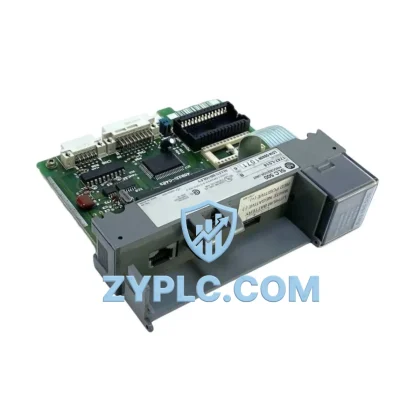
The Allen-Bradley 1784-KTX is a KT Serial Interface module engineered to serve as a critical communication bridge within Rockwell Automation’s 1784 architecture. Rather than functioning as a standalone peripheral, the 1784-KTX occupies a defined role within the layered control hierarchy — connecting host workstations and programming terminals to PLC-5, SLC 500, and ControlLogix platforms via the Data Highway Plus (DH+) and RS-232 serial networks. In complex industrial environments where system consistency, deterministic communication, and long-term maintainability are non-negotiable, the 1784-KTX delivers the contextual integration that modern automation engineers demand.
Understanding the 1784-KTX requires viewing it not as an isolated component, but as a node within a multi-layer control architecture. From the control layer down through the I/O layer, network layer, power layer, HMI layer, and into the execution layer, every module must communicate reliably and predictably. The 1784-KTX fulfills this requirement by providing a stable, low-latency serial interface that allows RSLogix 5 and RSLogix 500 programming environments to maintain live connections with the controller backplane — enabling real-time diagnostics, program uploads and downloads, and online monitoring without disrupting active process control.
Architecture Specification Table
| Parameter |
Specification |
| System Role |
KT Serial Interface — Host-to-Controller Communication Bridge |
| Compatible Platforms |
PLC-5, SLC 500, ControlLogix (via DH+ gateway) |
| Network Protocol |
Data Highway Plus (DH+), RS-232 Serial |
| Interface Type |
ISA Bus Card (PC-based programming terminal) |
| Communication Speed |
57.6 Kbps (DH+ configurable) |
| Electrical Standard |
RS-232C / DH+ differential signaling |
| Operating Voltage |
5 VDC (ISA bus supplied) |
| Operating Temperature |
0°C to 60°C |
| Installation Environment |
Control room workstation / engineering terminal |
| Series |
Allen-Bradley 1784 Series |
| Brand |
Allen-Bradley / Rockwell Automation |
| Warranty |
12-Month Warranty |
Coordinated Control System Design
The 1784-KTX does not operate in isolation — its value is realized through its integration with a coordinated suite of Rockwell Automation hardware and software components. In a typical PLC-5 based control architecture, the 1784-KTX installed in an engineering workstation communicates directly with the Allen-Bradley PLC-5/20 or PLC-5/40 processor over the DH+ network. The processor, mounted in a 1771 I/O chassis with a 1771-P4S power supply, manages discrete and analog I/O modules such as the 1771-OBD output module and 1771-IFE analog input module.
For systems that have migrated or are in the process of migrating toward ControlLogix, the 1784-KTX continues to serve as a legacy interface, working alongside the 1756-DHRIO Data Highway Plus/Remote I/O Communication Module to bridge DH+ segments with the ControlLogix backplane. This allows engineers to maintain programming access to both legacy PLC-5 nodes and modern 1756-L71 or 1756-L73 ControlLogix processors within the same network topology — a critical capability during phased migration projects.
At the HMI layer, operator interface terminals such as the PanelView 550 or PanelView Plus 6 communicate over the same DH+ segment, with the 1784-KTX enabling the engineering workstation to monitor and update HMI configurations without requiring a separate dedicated communication path. This reduces wiring complexity and simplifies cabinet layout in control panels where space is at a premium.
For redundancy-critical applications, the 1784-KTX supports diagnostic access to redundant controller pairs, allowing maintenance engineers to verify synchronization status and perform controlled switchover testing without interrupting production. When paired with the 1756-RM2 redundancy module in a ControlLogix redundancy chassis, the 1784-KTX provides the communication pathway for offline diagnostics and firmware management — tasks that are essential for maintaining system availability in continuous process environments.
Power integrity across the DH+ segment is maintained through proper grounding and shielding practices, with the 1784-KTX’s RS-232 interface providing electrical isolation between the workstation and the industrial network. This isolation is particularly important in environments where ground loops or electrical noise from variable frequency drives (VFDs) and motor starters could otherwise corrupt communication frames and cause intermittent faults.
Application in Layered Automation Systems
Manufacturing and Assembly Lines: In automotive and discrete manufacturing environments, the 1784-KTX enables engineering teams to perform live program edits and force I/O points during commissioning and troubleshooting without requiring physical access to the controller rack. This capability significantly reduces mean time to repair (MTTR) and supports lean maintenance strategies.
Power Generation and Utilities: In power plant auxiliary systems and substation automation, where PLC-5 platforms have historically been deployed for turbine control, boiler management, and switchgear sequencing, the 1784-KTX provides the communication interface necessary for ongoing program maintenance and regulatory compliance testing. Its compatibility with legacy DH+ infrastructure means that existing network investments are preserved even as control systems age.
Petrochemical and Refinery Process Control: In hazardous area applications, the engineering workstation equipped with a 1784-KTX is typically located in a safe area control room, communicating with field-mounted controllers via DH+ over shielded twisted-pair cabling. This architecture maintains the required separation between the safe area and the classified hazardous zone while still providing full programming and diagnostic access.
Water and Wastewater Treatment: Municipal water treatment facilities operating PLC-5 based SCADA systems rely on the 1784-KTX for periodic program updates, setpoint adjustments, and alarm configuration changes. The module’s stable DH+ communication ensures that SCADA polling cycles are not disrupted during engineering workstation activities.
Mining and Metals Processing: In conveyor control, crusher management, and flotation cell automation systems, the 1784-KTX supports the long-term maintainability of PLC-5 installations that may have operational lifespans exceeding 20 years. Availability of replacement modules with a 12-Month Warranty ensures that spare parts strategies can be maintained without compromising system reliability.
Architecture Engineering FAQ
Q1: Is the Allen-Bradley 1784-KTX compatible with both PLC-5 and ControlLogix systems in the same DH+ network?
Yes. The 1784-KTX communicates over Data Highway Plus (DH+), which is supported natively by PLC-5 processors and accessible from ControlLogix systems via the 1756-DHRIO communication module. In a mixed-platform network, the 1784-KTX allows a single engineering workstation to address both PLC-5 nodes and ControlLogix processors that are bridged onto the DH+ segment, making it an effective tool for phased migration projects and hybrid control architectures.
Q2: What installation and configuration steps are required to integrate the 1784-KTX into an existing control system?
The 1784-KTX is installed as an ISA bus card in a compatible PC-based engineering workstation. After physical installation, the RSLinx Classic driver must be configured to recognize the card and assign it a node address on the DH+ network. The DH+ baud rate must match the network configuration of the connected controllers (typically 57.6 Kbps). No additional hardware configuration is required on the controller side, as the 1784-KTX appears as a standard DH+ node. Commissioning typically requires less than one hour for an experienced controls engineer.
Q3: What does the 12-Month Warranty cover, and how does it support long-term maintenance planning?
The 12-Month Warranty covers manufacturing defects and functional failures under normal operating conditions. For maintenance engineers managing aging PLC-5 infrastructure, this warranty provides assurance that replacement modules sourced through ZYPLC meet functional specifications and will perform reliably in the field. The warranty supports long-term spare parts strategies by reducing the risk associated with procuring modules for legacy systems, and it ensures that any defective units will be replaced or repaired without additional cost during the warranty period. For critical applications, we recommend maintaining at least one spare 1784-KTX in inventory to minimize potential downtime.
© 2026 ZYPLC. All rights reserved.
Original Source: https://zyplc.com
Contact: +86 19859288691 | [email protected]