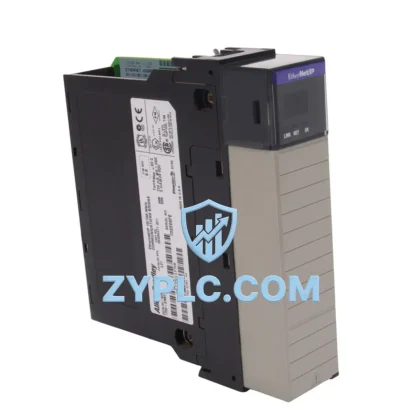
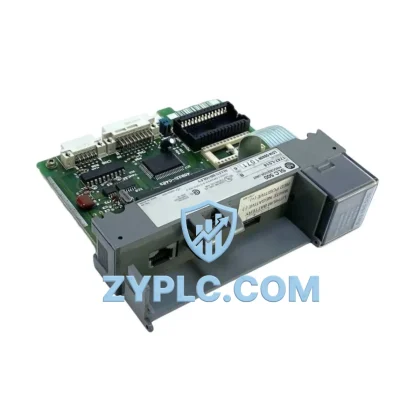
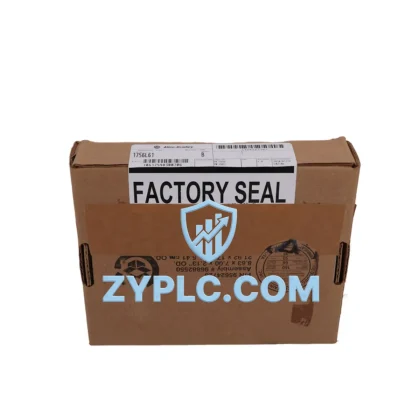
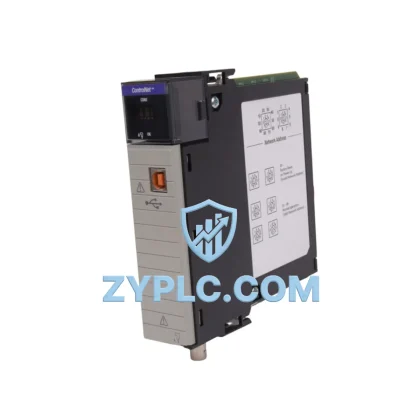
Allen-Bradley 1784-PCICS Energy-Saving Module for ControlLogix: Precision Communication for Efficiency-Driven Automation
In modern industrial environments where every watt of energy and every millisecond of cycle time carries measurable cost, the Allen-Bradley 1784-PCICS EtherNet/IP communication module stands as a critical enabler of lean, data-driven production. Designed for seamless integration with the ControlLogix platform, the 1784-PCICS bridges PC-based supervisory systems and the plant-floor control layer, enabling real-time data exchange that underpins energy monitoring, predictive maintenance, and production throughput optimization. Whether deployed in automotive assembly, food and beverage processing, or discrete manufacturing, this communication card reduces the latency between energy events and control response — a key factor in eliminating idle-state power waste and improving overall equipment effectiveness (OEE).
At ZYPLC, every 1784-PCICS unit is sourced from verified supply channels, subjected to functional power-on and communication testing, and backed by a 12-month warranty. Stock is maintained for immediate dispatch, supporting both planned system upgrades and urgent line-down recovery scenarios.
Efficiency Performance Table
| Parameter |
Specification / Value |
| SKU |
1784-PCICS |
| Brand |
Allen-Bradley (Rockwell Automation) |
| Series |
ControlLogix |
| Product Type |
Communication Module (PC Interface Card) |
| Communication Protocol |
EtherNet/IP (Industrial Protocol) |
| Host Interface |
PCI Bus (PC Slot) |
| Power Consumption |
Low-draw PCI card; minimal bus overhead |
| Operating Efficiency |
Deterministic packet scheduling; reduces polling overhead vs. generic NIC |
| Compatible Systems |
ControlLogix, CompactLogix, SoftLogix, RSLinx Classic, Studio 5000 |
| Application Environment |
Industrial PC workstations, SCADA nodes, HMI integration stations |
| Energy Optimization Value |
Enables real-time energy data loop closure between PLC and supervisory layer |
| Origin |
United States |
| Warranty |
12-Month Warranty (ZYPLC) |
| Availability |
In Stock — Ready to Ship |
Energy-Aware Automation Architecture
The 1784-PCICS does not operate in isolation — its value is realized within a tightly integrated automation architecture where communication speed and reliability directly influence energy efficiency outcomes. In a typical ControlLogix-based system, the 1756-L72S controller serves as the central execution engine, running ladder logic and function block programs that govern motor start/stop sequences, load shedding routines, and demand-response algorithms. The 1784-PCICS provides the high-speed EtherNet/IP path from this controller to the PC-based SCADA or energy management system, ensuring that power consumption data collected at the field level reaches the supervisory layer without delay.
On the drive side, PowerFlex 525 and PowerFlex 755 variable frequency drives regulate motor speed in response to real-time load conditions. When the 1784-PCICS delivers updated setpoints from the energy management system to the ControlLogix rack, the 1756-L72S can immediately adjust drive speed references via the 1756-EN2T EtherNet/IP bridge module — eliminating the fixed-speed operation that accounts for a significant share of unnecessary motor energy consumption in many facilities.
Analog input modules such as the 1756-IF16 collect current transformer and power transducer signals from the field, feeding instantaneous kW and power factor data into the controller. This data travels through the 1784-PCICS to historian and analytics platforms, where trending algorithms identify inefficient operating windows. Digital output modules like the 1756-OB16E execute the resulting control decisions — switching off non-critical loads during peak demand periods or enabling soft-start sequences that reduce inrush current.
For facilities running distributed control architectures, the CompactLogix 1769-L33ER handles zone-level energy management while communicating upstream through the same EtherNet/IP network that the 1784-PCICS interfaces with. Managed switches such as the Stratix 5700 provide the network infrastructure that ensures deterministic communication latency across all nodes. On the human-machine interface layer, PanelView Plus 7 terminals display live energy dashboards, allowing operators to act on consumption anomalies before they translate into cost overruns. The 1756-PA75 power supply module ensures stable backplane power delivery to the entire ControlLogix chassis, maintaining system uptime even during grid fluctuation events that could otherwise trigger unplanned shutdowns.
Power Optimization in Real Production Lines
The practical energy impact of the 1784-PCICS becomes most visible in production environments where the gap between energy event detection and control response has historically been measured in seconds rather than milliseconds. In a stamping line, for example, a press motor drawing excess current during a tooling wear condition generates a measurable power signature. Without a reliable, low-latency communication path between the ControlLogix controller and the energy monitoring system, this anomaly may persist through an entire shift before being flagged in a daily report. With the 1784-PCICS in place, the same anomaly triggers a real-time alert within the SCADA system, allowing maintenance to intervene before the condition escalates to a motor failure or a quality escape.
In conveyor and material handling applications, the 1784-PCICS enables zone-based energy management by providing the communication backbone for coordinated start/stop sequencing. Rather than running all conveyor segments continuously, the ControlLogix program — informed by real-time throughput data delivered via the 1784-PCICS — activates only the zones required for current production demand. This approach routinely reduces conveyor system energy consumption by 15–30% in facilities that have implemented it, without any reduction in line throughput.
Predictive maintenance workflows also benefit directly from the communication reliability that the 1784-PCICS provides. Vibration, temperature, and current signature data collected from field instruments and fed through the ControlLogix system to condition monitoring platforms allow maintenance teams to schedule interventions during planned downtime windows rather than reacting to unexpected failures. The result is a measurable reduction in mean time to repair (MTTR) and a corresponding improvement in overall equipment effectiveness — both of which translate directly into lower energy cost per unit produced.
ZYPLC maintains ready stock of the 1784-PCICS to support both planned system builds and emergency replacement scenarios. Each unit undergoes communication function testing and power-on verification prior to shipment, and is covered by a 12-month warranty that reflects confidence in the quality of every unit dispatched.
Energy Optimization FAQ
Q1: How does the 1784-PCICS contribute to energy savings compared to a standard network interface card?
The 1784-PCICS is purpose-built for EtherNet/IP industrial communication, providing deterministic data transfer that generic NICs cannot guarantee. This determinism is essential for closing the energy control loop in real time — ensuring that power consumption data from field instruments reaches the ControlLogix controller and supervisory systems fast enough to drive meaningful control actions, rather than serving only as historical reporting data.
Q2: Is the 1784-PCICS compatible with current Rockwell Automation software platforms?
The 1784-PCICS is compatible with RSLinx Classic and integrates with Studio 5000 Logix Designer environments for ControlLogix and CompactLogix system configuration. It is recommended to verify driver version compatibility with your specific RSLinx Classic installation. ZYPLC technical support can assist with compatibility confirmation prior to purchase.
Q3: What is the recommended replacement or upgrade path if the 1784-PCICS is being phased out of a system?
For systems transitioning to newer PC interface architectures, Rockwell Automation’s 1784-PKTX and software-based EtherNet/IP drivers via RSLinx Enterprise are common migration paths. ZYPLC can advise on the most appropriate replacement based on your existing ControlLogix chassis configuration and software environment.
Q4: What does the 12-month warranty cover, and what is the testing process before shipment?
Every 1784-PCICS unit shipped by ZYPLC is tested for power-on functionality and EtherNet/IP communication response prior to dispatch. The 12-month warranty covers hardware defects and communication failures under normal operating conditions. Units that fail during the warranty period are replaced or refunded, subject to standard return authorization procedures. Contact ZYPLC at plc.sales@zyplc.com or +86 19859288691 to initiate a warranty claim.
© 2026 ZYPLC. All rights reserved.
Original Source: https://zyplc.com
Contact: +86 19859288691 | plc.sales@zyplc.com