Allen-Bradley 1786-CP System-Ready ControlNet Cable for ControlLogix Architecture
In a layered industrial automation system, the integrity of the communication backbone determines the reliability of every layer above it. The Allen-Bradley 1786-CP ControlNet coaxial cable is engineered to serve as that backbone — a system-ready physical medium that connects the control layer, I/O layer, network layer, and HMI layer into a coherent, deterministic architecture. Whether deployed in a greenfield ControlLogix installation or integrated into an existing PLC-5 network, the 1786-CP delivers the signal consistency and mechanical durability that industrial environments demand.
ControlNet is a deterministic, repeatable network protocol designed for time-critical I/O data and peer-to-peer messaging. Unlike Ethernet-based topologies that rely on managed switches and traffic prioritization, ControlNet guarantees scheduled data delivery within defined update intervals — a critical requirement for motion control, process interlocks, and safety-rated sequences. The 1786-CP coaxial cable is the physical foundation of this determinism. Its impedance-matched construction, double-shielded braid, and robust outer jacket ensure that signal attenuation, reflection, and electromagnetic interference remain within the tight tolerances that ControlNet demands across segment lengths up to 1,000 meters.
Architecture Specification Table
| Parameter |
Specification |
| System Role |
ControlNet Physical Layer — Trunk / Drop Cable |
| Compatible Networks |
ControlNet (IEEE 802.4 coaxial) |
| Impedance |
75 Ω (RG-6 type coaxial) |
| Max Segment Length |
Up to 1,000 m (trunk, without repeaters) |
| Compatible Platforms |
ControlLogix, CompactLogix, PLC-5, SLC 500 (via bridge) |
| Communication Protocol |
ControlNet — deterministic, scheduled & unscheduled messaging |
| Connector Compatibility |
BNC (1786-BNC), F-connector tap (1786-BNCP) |
| Installation Environment |
Industrial — panel, conduit, cable tray; rated for EMI-dense environments |
| Shielding |
Double-shielded coaxial braid for high-noise immunity |
| Warranty |
12-Month Warranty — tested, verified, ready to deploy |
Coordinated Control System Design
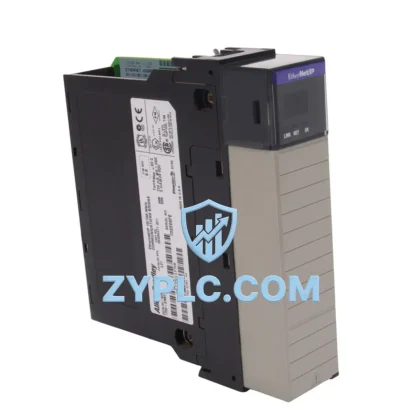
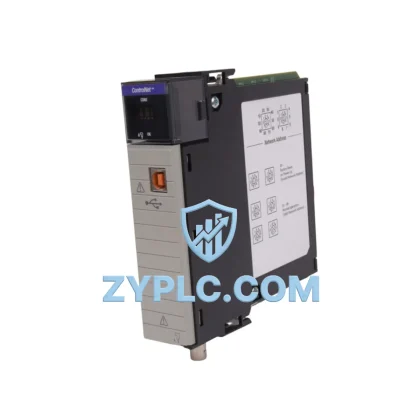
The 1786-CP does not operate in isolation — it is the connective tissue of a complete ControlNet architecture. At the control layer, a 1756-L73 ControlLogix CPU or 1756-L63 processor module manages program execution and coordinates all network traffic. These processors communicate over ControlNet via a 1756-CNB ControlNet Bridge module installed in the same 1756 chassis, which schedules both I/O updates and peer messaging across the 1786-CP trunk cable.
Downstream from the controller, remote I/O chassis populated with 1756-IB16 digital input and 1756-OB16 digital output modules receive their scheduled updates over the same coaxial segment. The 1786-CP trunk connects each remote rack through 1786-BNCP BNC tap connectors, maintaining the network’s characteristic impedance and preventing signal reflections that would otherwise corrupt time-critical data. For installations requiring extended reach, 1786-RPFRL ControlNet fiber repeaters can bridge coaxial segments, with the 1786-CP serving as the copper segment on either side.
At the HMI layer, a PanelView Plus 7 terminal connected via a 1756-ENBT EtherNet/IP bridge provides operator visualization, while the ControlNet backbone handles the deterministic I/O traffic that Ethernet alone cannot guarantee. For legacy integration, a 1785-L80E PLC-5 controller with a 1785-CHBM ControlNet interface can participate on the same 1786-CP network segment, enabling phased migration without disrupting production. Power to remote I/O racks is supplied by 1756-PA72 or 1756-PB72 power supply modules, completing the architecture from control to execution.
Application in Layered Automation Systems
The 1786-CP finds its most critical applications in industries where deterministic communication is non-negotiable. In automotive manufacturing, body-in-white welding lines use ControlNet to synchronize robot controllers, servo drives, and safety PLCs across a single coaxial backbone — the 1786-CP trunk cable carries the scheduled I/O updates that keep weld timers and clamp sequences in lockstep. In power generation and substation automation, ControlNet connects protection relay panels, motor control centers, and SCADA gateways with the sub-millisecond update rates required for grid-tied equipment.
In petrochemical and refinery applications, the 1786-CP’s double-shielded construction provides immunity against the high-frequency interference generated by variable frequency drives and high-voltage switching equipment. Water treatment facilities rely on ControlNet to link remote pump stations and valve actuators back to a central ControlLogix controller, with the 1786-CP trunk spanning distances that Ethernet segments cannot cover without managed infrastructure. In mining and mineral processing, the cable’s robust jacket withstands the mechanical stress of cable trays in high-vibration environments, maintaining network continuity across conveyor drives, crusher controls, and flotation cell automation.
For packaging and palletizing lines, ControlNet’s deterministic scheduling ensures that pick-and-place robots, label applicators, and case sealers receive their motion commands within guaranteed update windows — a requirement that the 1786-CP physical layer fulfills by maintaining signal integrity across multi-drop trunk topologies. In each of these environments, the 1786-CP is not simply a cable; it is the architectural commitment to deterministic control.
Architecture Engineering FAQ
Q1: Is the 1786-CP compatible with both ControlLogix and legacy PLC-5 ControlNet systems?
Yes. The 1786-CP is the standard coaxial cable for all Rockwell Automation ControlNet installations, including ControlLogix (1756 platform), CompactLogix (1769 platform with CNB bridge), and legacy PLC-5 systems equipped with a 1785-CHBM ControlNet interface. All platforms share the same physical layer standard, so a single 1786-CP trunk can support mixed-generation architectures during phased migration projects.
Q2: How do I ensure long-term network stability and simplify maintenance on a ControlNet segment?
Network stability on a ControlNet segment depends on consistent impedance matching, proper termination at both ends of the trunk, and secure BNC tap connections at each node. Use 1786-BNCP taps and ensure terminator resistors (75 Ω) are installed at both trunk ends. For long-term maintenance, document the network map including segment lengths and node addresses, and keep spare 1786-CP cable lengths on hand. Our stock is pre-tested and ships with a 12-Month Warranty, ensuring that replacement cable meets the same electrical specifications as the original installation.
Q3: What is covered under the 12-Month Warranty, and how is the product tested before shipment?
Every 1786-CP unit in our inventory undergoes pre-shipment inspection covering physical integrity, connector compatibility, and impedance verification. The 12-Month Warranty covers manufacturing defects and electrical performance failures under normal industrial operating conditions. If a unit fails to perform within specification during the warranty period, we provide replacement or full credit. Our global logistics network supports DHL and FedEx express delivery, ensuring that replacement stock reaches your facility with minimal downtime impact.
© 2026 ZYPLC. All rights reserved.
Original Source: https://zyplc.com
Contact: +86 19859288691 | [email protected]