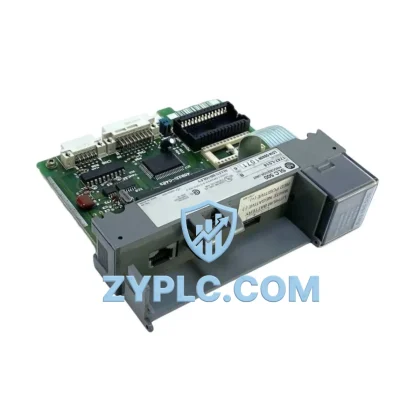
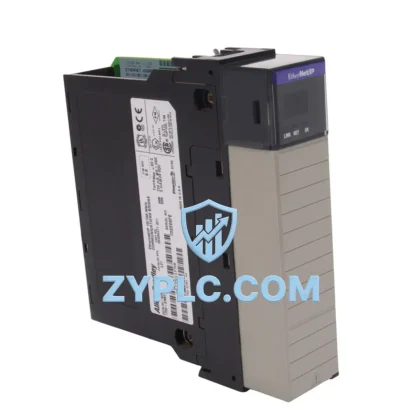
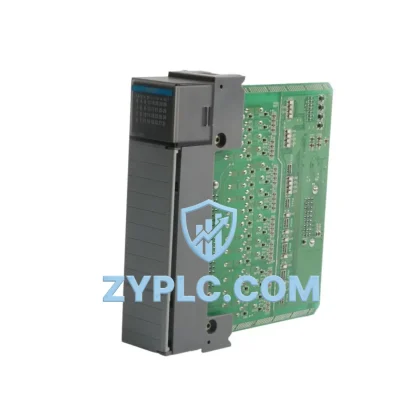
Allen-Bradley 1786-RPFM System-Ready Repeater Filter for ControlNet Architecture
The Allen-Bradley 1786-RPFM is a ControlNet Repeater Filter Module engineered to extend, condition, and stabilize ControlNet trunk segments within large-scale industrial control architectures. In modern distributed automation environments — spanning manufacturing cells, power distribution substations, petrochemical process units, and water treatment facilities — the integrity of the ControlNet backbone is foundational to deterministic communication between controllers, I/O modules, and intelligent field devices. The 1786-RPFM is not simply a passive network component; it is a system-level asset that directly influences the reliability, scalability, and long-term maintainability of the entire control platform.
Deployed within Rockwell Automation’s 1756 ControlLogix ecosystem, the 1786-RPFM operates at the network layer of the automation hierarchy, bridging ControlNet trunk segments while filtering electrical noise and regenerating signal integrity across extended cable runs. Its role becomes especially critical in architectures where multiple 1756-L7x or 1756-L8x ControlLogix CPUs are interconnected across geographically distributed control panels, requiring consistent, low-latency communication for coordinated process execution and redundancy switchover.
Architecture Specification Table
| Parameter |
Specification |
| System Role |
ControlNet Trunk Repeater & Signal Filter |
| Compatible Platform |
Allen-Bradley 1756 ControlLogix, 1756 GuardLogix |
| Network Protocol |
ControlNet (IEC 61158) |
| Segment Extension |
Up to 1000 m per segment (coax); extended via repeater |
| Max Nodes per Segment |
Up to 48 nodes |
| Signal Filtering |
Active noise filtering on ControlNet trunk |
| Power Supply |
Powered via ControlNet trunk (no external supply required) |
| Operating Temperature |
0°C to 60°C (32°F to 140°F) |
| Relative Humidity |
5% to 95% non-condensing |
| Mounting |
DIN rail or panel mount |
| Communication Capability |
Transparent repeating; supports scheduled & unscheduled traffic |
| Certifications |
UL, CE, cUL |
| Warranty |
12-Month Warranty (ZYPLC) |
Coordinated Control System Design
The 1786-RPFM achieves its full value when understood within the context of a complete ControlLogix control system architecture. At the controller layer, one or more 1756-L74 or 1756-L85E ControlLogix CPUs serve as the primary processing nodes, executing ladder logic, function block diagrams, and structured text programs that govern process sequences. These CPUs communicate with distributed I/O racks and peer controllers via the ControlNet backbone — a backbone whose physical integrity the 1786-RPFM is specifically designed to protect and extend.
At the I/O layer, 1756-IB16 digital input modules and 1756-OB16E digital output modules mounted in remote 1756 chassis receive and transmit field signals. These remote racks connect to the ControlNet trunk via 1756-CNB or 1756-CNBR ControlNet bridge modules, which schedule I/O data transfers with deterministic timing. When the physical distance between the main control cabinet and remote I/O panels exceeds the standard ControlNet segment length, the 1786-RPFM is inserted into the trunk to regenerate the signal and filter accumulated electrical noise — ensuring that the 1756-CNB modules at each end of the segment receive clean, correctly timed data frames.
For redundant controller architectures, the 1756-RM2 redundancy module coordinates primary-to-secondary switchover between paired ControlLogix chassis. In these configurations, ControlNet communication continuity is non-negotiable: a degraded trunk segment can delay redundancy synchronization or trigger false switchover events. The 1786-RPFM eliminates this risk by maintaining signal quality across the full trunk length, even in electrically noisy environments such as variable frequency drive (VFD) panels or high-current motor control centers.
At the power layer, 1756-PA75 or 1756-PB75 power supply modules provide stable DC power to each ControlLogix chassis. Proper power architecture — combined with the 1786-RPFM’s noise filtering capability — ensures that switching transients from power supplies do not propagate onto the ControlNet trunk and corrupt scheduled communication windows. At the human-machine interface layer, PanelView Plus 7 terminals connected via EtherNet/IP to the ControlLogix CPU display real-time process data, alarm states, and trend histories. While HMI communication typically runs on a separate EtherNet/IP network, the overall system stability depends on the ControlNet layer performing without interruption — a dependency the 1786-RPFM directly supports.
In applications requiring analog process control, 1756-IF16 analog input modules and 1756-OF8 analog output modules transmit 4–20 mA signals from field transmitters and to control valves. The deterministic scheduling of ControlNet ensures these analog values are updated at consistent intervals, enabling tight PID loop control. The 1786-RPFM preserves this scheduling integrity across extended trunk segments, preventing the jitter and packet loss that would otherwise degrade loop performance.
Application in Layered Automation Systems
In manufacturing and assembly line automation, the 1786-RPFM enables ControlNet architectures to span large factory floors where control cabinets may be separated by hundreds of meters. Automotive body shops, stamping lines, and robotic welding cells frequently require ControlNet trunks that exceed single-segment limits, making the 1786-RPFM an essential infrastructure component for maintaining production continuity.
In power generation and electrical substation control, ControlLogix systems manage protection relays, circuit breaker control, and SCADA integration. The 1786-RPFM’s active noise filtering is particularly valuable in these environments, where high-voltage switching events generate significant electromagnetic interference that can corrupt unfiltered ControlNet signals. Its use ensures that protection logic executes without communication-induced delays.
In petrochemical and refinery process control, distributed control architectures span large process units with multiple remote I/O panels. The 1786-RPFM allows a single ControlNet network to serve multiple process areas without requiring additional controller nodes, reducing system complexity and licensing costs while maintaining deterministic communication performance.
In water and wastewater treatment facilities, ControlLogix systems control pumping stations, chemical dosing systems, and filtration processes across geographically dispersed sites. The 1786-RPFM extends ControlNet reach to remote pump stations while maintaining the signal quality required for reliable remote I/O operation and alarm management.
In mining and mineral processing, conveyor systems, crushers, and flotation cells are controlled by distributed ControlLogix architectures. The harsh electrical environment — characterized by large motor starts, ground faults, and cable runs through metallic conduit — makes the 1786-RPFM’s filtering capability essential for maintaining communication reliability and minimizing unplanned downtime.
Architecture Engineering FAQ
Q1: How many 1786-RPFM modules can be cascaded on a single ControlNet trunk, and does cascading affect scheduled communication timing?
A: Rockwell Automation supports up to three 1786-RPFM repeaters in series on a single ControlNet trunk, allowing the total network span to be extended significantly beyond the base 1000 m coaxial segment limit. Each repeater introduces a small, fixed propagation delay, but this delay is deterministic and is automatically accounted for by the ControlNet Network Update Time (NUT) scheduling algorithm in RSNetWorx for ControlNet. Provided the NUT is configured appropriately for the extended topology, cascaded repeaters do not degrade scheduled I/O communication performance.
Q2: Is the 1786-RPFM compatible with both coaxial and fiber ControlNet media, and can it be used in a mixed-media architecture?
A: The 1786-RPFM is designed for coaxial ControlNet trunk segments (RG-6 or equivalent). For fiber optic ControlNet segments, Rockwell Automation provides separate fiber media converters and repeaters. In mixed-media architectures — where coaxial and fiber segments are combined — the 1786-RPFM handles the coaxial segment conditioning, while fiber media converters manage the coax-to-fiber transition. This combination allows architects to design long-distance ControlNet networks that leverage the noise immunity of fiber for inter-building runs while using coaxial media within control rooms and local panels.
Q3: What does the 12-Month Warranty cover, and what support is available for integration and commissioning?
A: ZYPLC’s 12-Month Warranty covers the 1786-RPFM against manufacturing defects and functional failures under normal operating conditions. During the warranty period, defective units are replaced or repaired at no additional cost. Beyond the warranty, ZYPLC provides pre-sales technical consultation to assist with ControlNet topology design, segment length calculations, and repeater placement planning. Post-sales support includes commissioning guidance for RSNetWorx for ControlNet configuration, NUT optimization, and integration verification within existing 1756 ControlLogix architectures. Contact our technical team at plc.sales@zyplc.com or +86 19859288691 for architecture-specific support.
© 2026 ZYPLC. All rights reserved.
Original Source: https://zyplc.com
Contact: +86 19859288691 | plc.sales@zyplc.com