Allen-Bradley 1791-OB32 System-Ready Output Module: Control Architecture Synchronization and Downstream Execution
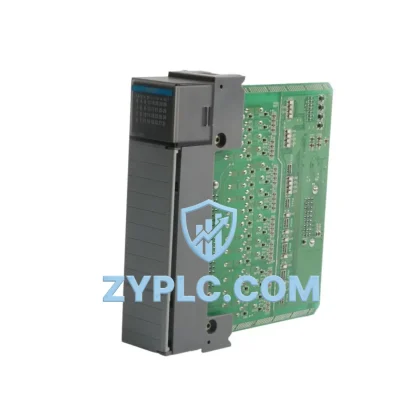
The Allen-Bradley 1791-OB32 is a 32-point 24VDC sourcing Block I/O output module engineered for seamless integration within Rockwell Automation’s distributed control architecture. Rather than functioning as a standalone component, the 1791-OB32 occupies a critical position in the execution layer of a layered automation system — translating CPU-level logic decisions into precise, high-density field-level switching actions. Its design philosophy centers on system coherence: every electrical parameter, communication timing, and mechanical form factor has been optimized to align with the broader PLC-5 and SLC 500 control platforms, ensuring that engineers can deploy, expand, and maintain their control infrastructure with minimal architectural friction.
In a complete industrial control system, the 1791-OB32 does not operate in isolation. It is the downstream terminus of a signal chain that originates at the CPU module — such as the Allen-Bradley PLC-5/20, PLC-5/40, or PLC-5/80 — passes through the backplane or remote I/O network, and ultimately reaches the field devices: solenoid valves, motor starters, indicator lamps, and relay coils. The module’s 32 discrete output channels provide the density required for high-channel-count applications without multiplying cabinet footprint, making it a preferred choice for panel builders and system integrators working within constrained enclosure dimensions.
From a system architecture perspective, the 1791-OB32 is designed to coexist with complementary modules across all control layers. At the I/O layer, it pairs naturally with the Allen-Bradley 1791-IB32 32-point input module, enabling symmetric I/O expansion within the same Block I/O family. At the communication layer, the module interfaces with the 1771 Remote I/O adapter or the 1747-SN SLC Remote I/O Scanner, allowing the output block to be distributed across the plant floor while maintaining deterministic scan-cycle communication with the host controller. This distributed topology reduces home-run wiring costs and improves signal integrity in electrically noisy industrial environments.
Power architecture integration is equally important. The 1791-OB32 requires a stable 24VDC field power supply — typically sourced from a dedicated 1606-XLP or equivalent DIN-rail power supply — isolated from the logic supply to prevent cross-contamination of transient noise between the control and field circuits. Proper power zoning, combined with the module’s built-in output short-circuit protection, ensures that a field-side fault does not propagate upstream to the CPU or communication network, preserving system availability during fault conditions.
For redundancy-conscious applications, the 1791-OB32 can be incorporated into architectures that utilize the Allen-Bradley 1715 Redundant I/O System or Hot Standby CPU configurations based on the PLC-5R platform. In these designs, dual output modules are mapped to the same logical address space, with the redundancy controller managing switchover in the event of a module failure. This approach is particularly relevant in continuous process industries — such as petrochemical refining, power generation, and water treatment — where unplanned output loss can trigger costly process upsets or safety system activations.
At the human-machine interface layer, operator visibility into the 1791-OB32’s output states is typically provided through a PanelView Plus 7 or FactoryTalk View SE SCADA system, which reads output status tags from the PLC-5 data table and displays them on process mimic screens. This closed-loop visibility — from CPU logic, through the 1791-OB32, to field device actuation, and back to the HMI — forms the foundation of effective process monitoring and alarm management.
Engineering teams responsible for long-term maintenance will appreciate the 1791-OB32’s compatibility with the existing installed base of PLC-5 and SLC 500 systems, many of which remain in active service across manufacturing, utilities, and infrastructure sectors. Stocking the 1791-OB32 as a critical spare — alongside the 1771-OBD 16-point output module and the 1746-OB32 SLC 500 output module — provides a comprehensive output module inventory strategy that covers both legacy and transitional control platforms. All units supplied through ZYPLC are covered by a 12-Month Warranty, with pre-shipment functional testing and documentation of key electrical parameters to support incoming inspection and commissioning workflows.
Architecture Specification Table
| Parameter |
Specification |
| System Role |
Distributed Execution Layer — 32-Point Discrete Output |
| SKU / Part Number |
1791-OB32 |
| Brand / Manufacturer |
Allen-Bradley (Rockwell Automation) |
| Compatible Platforms |
PLC-5, SLC 500, Remote I/O Network |
| Output Points |
32 Sourcing (PNP) Discrete Outputs |
| Output Voltage |
24VDC Field Power |
| Output Current per Point |
0.5A (typical) |
| Communication Interface |
Allen-Bradley Remote I/O (1771 RIO) |
| Module Series |
1791 Block I/O Series |
| Installation Environment |
DIN Rail / Panel Mount; IP20 Enclosure Rating |
| Operating Temperature |
0°C to 60°C (32°F to 140°F) |
| Contextual Integration |
Compatible with PLC-5/20, PLC-5/40, PLC-5/80, SLC 5/04, SLC 5/05 |
| Warranty |
12-Month Warranty — Functional Testing Included |
| Supply Condition |
New / Refurbished; In-Stock for Immediate Dispatch |
Coordinated Control System Design
The 1791-OB32 achieves its full architectural value when deployed as part of a coordinated control system rather than as an isolated output device. In a typical PLC-5-based architecture, the control layer is anchored by a PLC-5/40 or PLC-5/80 CPU, which manages the scan cycle, executes ladder logic, and communicates with remote I/O drops via the 1771-ASB Remote I/O Adapter. The 1791-OB32 resides at one of these remote drops, receiving output commands from the CPU’s output image table and driving field devices with 24VDC sourcing signals.
At the I/O layer, the 1791-OB32 is commonly paired with the 1791-IB32 input module to form a complete discrete I/O node, providing 32 inputs and 32 outputs within a compact Block I/O housing. For analog process variables, the 1771-OFE2 analog output module or the 1746-NIO4I combination analog module may be integrated into the same control cabinet, handling PID loop outputs to variable frequency drives or control valves while the 1791-OB32 manages discrete switching functions.
Network layer integrity is maintained through the 1747-SN SLC Remote I/O Scanner or the 1771-ASB adapter, which manages token-passing communication on the Remote I/O highway. For systems requiring higher-bandwidth communication, the 1756-DHRIO ControlLogix communication module can serve as a bridge between legacy Remote I/O networks and modern EtherNet/IP infrastructure, enabling the 1791-OB32 to participate in hybrid architectures during platform migration projects.
At the power layer, the 1791-OB32’s field power circuit is typically fed from a 1606-XLP72E or equivalent 24VDC power supply, with a 1492-SP circuit breaker providing branch circuit protection for each output group. Terminal modules such as the 1492-CABLE series wiring systems or Phoenix Contact PTFIX distribution blocks are used to fan out field power to multiple output modules within the same panel section, maintaining clean power distribution architecture.
For human-machine interface integration, output states from the 1791-OB32 are surfaced through FactoryTalk View SE or a PanelView Plus 7 terminal, providing operators with real-time output status, fault annunciation, and manual override capability. This complete signal chain — from CPU logic through Remote I/O communication, through the 1791-OB32, to field device actuation, and back to the HMI — represents the full contextual integration that defines a well-engineered automation system.
Application in Layered Automation Systems
The 1791-OB32 finds application across a broad spectrum of industrial sectors where high-density discrete output control is required within an established Rockwell Automation architecture.
In manufacturing and assembly automation, the module controls pneumatic solenoid valves, conveyor drive contactors, and part-present indicator lamps across multi-station assembly lines. Its 32-point density allows a single module to manage an entire workstation’s output requirements, reducing the number of remote I/O drops and simplifying network topology.
In power generation and electrical utilities, the 1791-OB32 is used to control switchgear auxiliary contacts, breaker trip/close coils, and annunciator panel lamps within substation automation and plant auxiliary systems. Its compatibility with PLC-5-based protection and control systems — which remain widely deployed in power infrastructure — makes it a critical spare component for maintenance teams responsible for system availability.
In petrochemical and refining applications, the module drives shutdown valve solenoids, pump motor starters, and flare system controls within Safety Instrumented System (SIS) support architectures. When integrated with redundant PLC-5R Hot Standby configurations, the 1791-OB32 contributes to the high-availability output infrastructure required for continuous process operations.
In water and wastewater treatment, the module controls pump station outputs, valve actuators, and chemical dosing system contactors across distributed Remote I/O networks spanning multiple lift stations and treatment process areas. Its ability to operate reliably in electrically noisy environments — common in pump station applications — makes it well-suited for these demanding field conditions.
In mining and metals processing, the 1791-OB32 manages conveyor belt drive contactors, crusher control outputs, and ventilation fan starters within PLC-5-based SCADA-integrated control systems. The module’s robust output protection and wide operating temperature range support reliable operation in the harsh thermal and electrical environments typical of underground and surface mining facilities.
Architecture Engineering FAQ
Q1: Is the 1791-OB32 directly compatible with both PLC-5 and SLC 500 control platforms, and what communication hardware is required for each?
Yes. For PLC-5 systems, the 1791-OB32 connects to the Remote I/O network via a 1771-ASB Remote I/O Adapter, which interfaces the Block I/O module to the PLC-5’s Remote I/O scanner port. For SLC 500 systems, the 1747-SN SLC Remote I/O Scanner serves the equivalent function, allowing the 1791-OB32 to be addressed as a standard 1/2-slot or full-slot I/O rack within the SLC 500’s I/O configuration. In both cases, the module occupies a defined rack/group/slot address on the Remote I/O highway, and its output image is mapped directly into the controller’s output data table for ladder logic control.
Q2: Can the 1791-OB32 be used in a redundant output architecture, and what system components are required to implement output redundancy?
The 1791-OB32 can participate in redundant output architectures when paired with a PLC-5R Hot Standby CPU system. In this configuration, two 1791-OB32 modules are wired in parallel to the same field devices, with each module connected to a separate Remote I/O drop managed by the primary and secondary CPUs respectively. The Hot Standby system’s redundancy controller manages bumpless switchover between the primary and secondary output paths in the event of a CPU or communication failure. For applications requiring IEC 61508-compliant safety output redundancy, a dedicated Safety PLC platform such as the Allen-Bradley GuardLogix should be evaluated as the primary safety output controller, with the 1791-OB32 retained for standard control output functions.
Q3: What does the 12-Month Warranty cover, and how does ZYPLC support long-term maintenance and spare parts availability for the 1791-OB32?
All 1791-OB32 units supplied by ZYPLC are covered by a 12-Month Warranty from the date of shipment, covering manufacturing defects, functional failures under normal operating conditions, and electrical parameter deviations from published specifications. Prior to shipment, each unit undergoes functional testing to verify output switching performance, field power circuit integrity, and communication interface operation. For long-term maintenance planning, ZYPLC maintains in-stock inventory of the 1791-OB32 and related Block I/O family components to support both planned maintenance schedules and emergency replacement requirements. Our technical team can assist with cross-referencing compatible replacement modules, advising on migration pathways to current-generation Rockwell Automation platforms, and providing documentation support for incoming inspection and commissioning workflows. Contact us at +86 19859288691 or [email protected] for availability and lead time confirmation.
© 2026 ZYPLC. All rights reserved.
Original Source: https://zyplc.com
Contact: +86 19859288691 | [email protected]