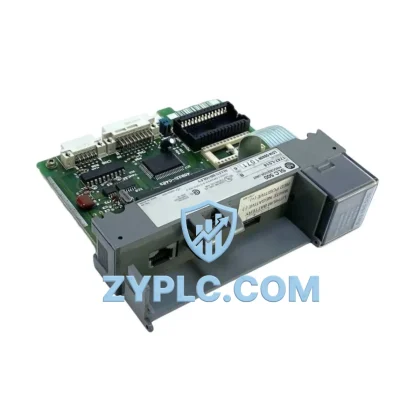
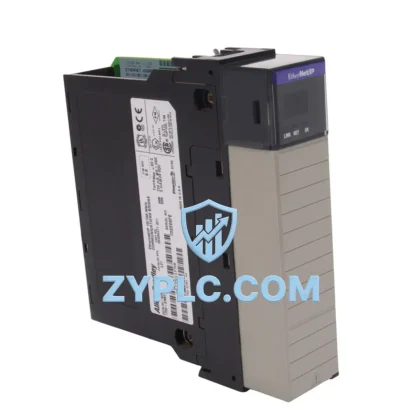
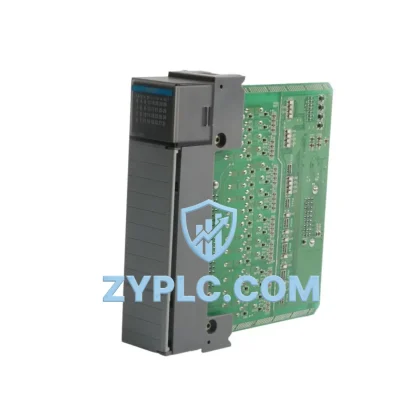
Allen-Bradley 1791DS-IB12 System-Ready Safety Input for Guard I/O Architecture
The Allen-Bradley 1791DS-IB12 is a 12-point safety digital input module engineered for seamless integration within Rockwell Automation’s Guard I/O distributed safety architecture. Rather than functioning as a standalone device, the 1791DS-IB12 is designed to operate as a coordinated node within a layered control system — connecting safety field devices at the I/O layer to the safety logic controller at the control layer, while communicating across the network layer via DeviceNet Safety protocol. Its role in the overall system architecture makes it a critical component for achieving SIL 2 (IEC 61508) and PLd (ISO 13849) safety integrity levels across industrial automation platforms.
In modern industrial control architectures, safety and standard automation functions must coexist within a unified system framework. The 1791DS-IB12 addresses this requirement by enabling safety-rated digital inputs — such as emergency stop buttons, light curtains, safety gate switches, and two-hand control devices — to be monitored and processed within the same DeviceNet Safety network that governs broader machine control. This Contextual Integration capability eliminates the need for separate hardwired safety relay circuits, reducing panel complexity, wiring costs, and long-term maintenance burden across the control cabinet.
Architecture Specification Table
| Parameter |
Specification |
| System Role |
Distributed Safety Input Node — Guard I/O I/O Layer |
| Input Points |
12 x Safety Digital Inputs (single or dual-channel) |
| Safety Rating |
SIL 2 (IEC 61508), PLd (ISO 13849-1), Cat. 3 / Cat. 4 |
| Communication Protocol |
DeviceNet Safety (CIP Safety) |
| Input Voltage |
24V DC (IEC Type 1 / Type 3) |
| Input Current |
≤ 6 mA per point |
| Power Supply |
24V DC system bus (via Guard I/O power tap or dedicated supply) |
| Housing / Mounting |
IP67 rated, DIN rail or panel mount, compact block format |
| Operating Temperature |
0°C to +55°C (32°F to 131°F) |
| Communication Distance |
Up to 500 m (DeviceNet trunk, speed-dependent) |
| Diagnostic Capability |
Short-circuit detection, cross-fault detection, input discrepancy monitoring |
| Warranty |
12-Month Warranty — covers manufacturing defects and functional failure under normal operating conditions |
Coordinated Control System Design
The 1791DS-IB12 achieves its full value when deployed as part of a coordinated Rockwell Automation safety control architecture. At the control layer, a GuardLogix 5570 or GuardLogix 5580 safety PLC (such as the 1756-L71S or 1756-L83ES) serves as the safety logic controller, executing the safety program and managing safety task execution in accordance with SIL 2 requirements. The GuardLogix platform supports dual-processor redundancy through a paired 1756-L7SP Safety Partner module, ensuring that the safety CPU remains operational even in the event of a primary processor fault.
At the network layer, a 1756-DNB DeviceNet Scanner or 1788-DN2DN DeviceNet-to-DeviceNet linking device manages the DeviceNet Safety network segment on which the 1791DS-IB12 resides. Multiple Guard I/O nodes — including output modules such as the 1791DS-OB8 8-point safety output module and combination I/O modules like the 1791DS-IB8XOBV4 — can be distributed across the same DeviceNet Safety trunk, enabling a fully distributed safety I/O topology without centralizing all safety wiring at the control panel.
At the power layer, the Guard I/O system relies on a stable 24V DC supply. A 1606-XLP power supply or equivalent Rockwell-compatible DIN rail power supply provides the regulated DC bus required for both the DeviceNet network and the 1791DS-IB12 module’s internal logic. Proper power segmentation — separating safety I/O power from standard I/O power — is a recommended practice to prevent common-cause failures and maintain safety system integrity.
At the human-machine interface layer, a PanelView Plus 7 HMI terminal connected via EtherNet/IP to the GuardLogix controller provides operators with real-time visibility into safety input states, fault diagnostics, and system status. Safety input channel states from the 1791DS-IB12 can be mapped to HMI tags, enabling maintenance personnel to identify tripped safety devices without requiring direct field inspection. This integration significantly reduces mean time to repair (MTTR) during unplanned safety shutdowns.
At the execution layer, safety outputs derived from the 1791DS-IB12’s input signals may drive MSR127RP safety relays, PowerFlex 525 or PowerFlex 755 variable frequency drives with integrated safety options, or SMC-50 smart motor controllers — all of which support safe torque-off (STO) or safe stop functions when integrated with the GuardLogix safety program. This end-to-end architecture — from field device through safety input module, safety network, safety PLC, and safe output execution — constitutes a complete, validated safety function loop.
Application in Layered Automation Systems
The 1791DS-IB12 is widely deployed across industries where machine safety and process continuity must be balanced within a unified control architecture. In automotive manufacturing and general assembly lines, the module monitors safety gates, perimeter guarding, and two-hand control stations on robotic work cells, enabling zone-based safety without interrupting adjacent production areas. Its IP67 enclosure rating makes it suitable for installation close to the machine, reducing field wiring runs and improving signal integrity.
In packaging and material handling applications, the 1791DS-IB12 integrates with conveyor safety systems, monitoring emergency stop pull cords, area scanners, and safety mats. The module’s dual-channel input capability supports Category 3 and Category 4 safety functions, meeting the requirements of EN ISO 13849-1 for high-demand safety applications. In power generation and utilities, the module is used to monitor safety interlocks on switchgear, turbine control panels, and high-voltage isolation systems, where reliable input diagnostics and cross-fault detection are essential for personnel protection.
In oil and gas, petrochemical, and water treatment facilities, the 1791DS-IB12 supports SIL 2-rated safety instrumented functions (SIFs) as part of a broader Safety Instrumented System (SIS). Its compatibility with the GuardLogix platform — which supports both standard and safety tasks within a single controller — allows process safety functions to be managed alongside regulatory control logic, simplifying system architecture and reducing the total number of controllers required in the control room. In mining and metallurgy, the module’s robust construction and wide operating temperature range support deployment in harsh environments where vibration, dust, and temperature extremes are common.
Architecture Engineering FAQ
Q1: Is the 1791DS-IB12 compatible with both GuardLogix and standard Logix controllers on the same DeviceNet network?
The 1791DS-IB12 communicates exclusively over DeviceNet Safety (CIP Safety protocol) and requires a safety-capable scanner and a GuardLogix or equivalent CIP Safety controller to process its safety data. Standard ControlLogix or CompactLogix controllers without safety task capability cannot consume the safety connection from the 1791DS-IB12. However, standard DeviceNet devices and the 1791DS-IB12 can coexist on the same physical DeviceNet trunk, provided the scanner is safety-capable and the network is configured correctly in RSNetWorx for DeviceNet.
Q2: What are the key commissioning steps when integrating the 1791DS-IB12 into an existing Guard I/O architecture?
Commissioning the 1791DS-IB12 involves assigning a unique DeviceNet node address (0–63), configuring the module’s safety connection parameters in RSNetWorx for DeviceNet, and mapping the safety input data to the GuardLogix safety task in Studio 5000 Logix Designer. Each dual-channel input pair must be configured for the appropriate discrepancy time window based on the field device characteristics. After configuration, a functional safety validation test — verifying that each safety input correctly triggers the intended safety function — must be performed and documented in accordance with IEC 62061 or ISO 13849 validation requirements before the system is placed into service.
Q3: What does the 12-Month Warranty cover for the 1791DS-IB12, and what support is available during the warranty period?
The 12-Month Warranty covers manufacturing defects and functional failures occurring under normal operating conditions within twelve months of the shipment date. It includes replacement or repair of the module at no additional cost. During the warranty period, technical support for installation, configuration, and system integration questions is available through our engineering team. Warranty claims require the original purchase documentation and a description of the fault condition. Damage resulting from incorrect wiring, overvoltage, unauthorized modification, or operation outside the specified environmental conditions is excluded from warranty coverage.
© 2026 ZYPLC. All rights reserved.
Original Source: https://zyplc.com
Contact: +86 19859288691 | plc.sales@zyplc.com