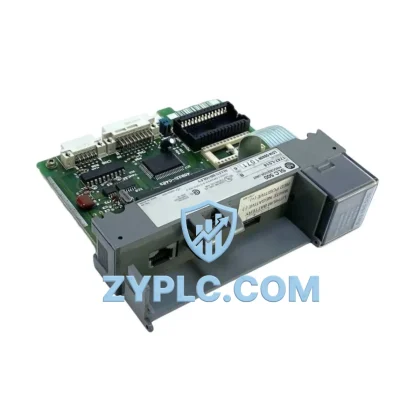
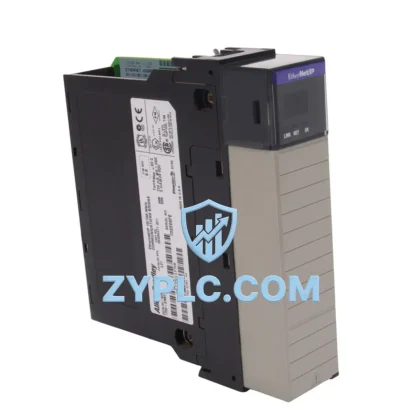
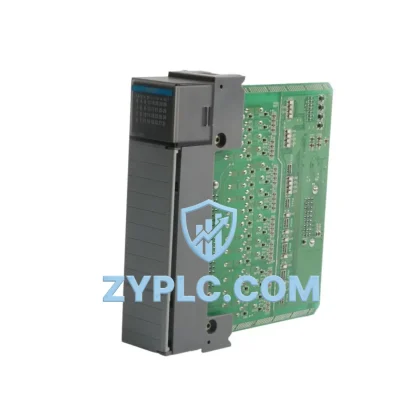
Allen-Bradley 1794-AENT System-Ready EtherNet/IP Adapter for Flex I/O Architecture
The Allen-Bradley 1794-AENT is a high-performance EtherNet/IP communication adapter designed for the Flex I/O platform, engineered to serve as the critical communication bridge between distributed I/O nodes and the upper control layer in modern industrial automation architectures. Rather than functioning as a standalone component, the 1794-AENT is purpose-built to operate within a layered control system — connecting field-level signals upward through the network layer to the CPU, while maintaining deterministic data exchange, system-wide diagnostics, and seamless contextual integration across every tier of the automation hierarchy.
In a fully realized control architecture, the 1794-AENT occupies the I/O communication layer, interfacing directly with Flex I/O terminal base assemblies and I/O modules mounted on the 1794-TB3 or 1794-TB3S terminal bases. Its upstream EtherNet/IP port connects to managed industrial switches — such as those in the Stratix 5700 series — which route real-time I/O data to the primary controller. Whether the host controller is a 1756-L85E ControlLogix CPU, a 1769-L33ER CompactLogix processor, or a redundant 1756-L8SP SIL 2 controller, the 1794-AENT delivers consistent, low-latency cyclic data exchange that sustains the integrity of the entire control loop.
Architecture Specification Table
| System Role |
Distributed I/O EtherNet/IP Communication Adapter — Flex I/O Platform |
| Full SKU |
1794-AENT |
| Brand / Series |
Allen-Bradley / Flex I/O |
| Communication Protocol |
EtherNet/IP (CIP over TCP/IP), supports explicit and implicit messaging |
| Network Port |
1 × RJ-45, 10/100 Mbps, auto-negotiate, full/half duplex |
| I/O Module Capacity |
Up to 8 Flex I/O modules per adapter node |
| Electrical Supply |
24V DC, supplied via Flex I/O power supply (e.g. 1794-PS13) |
| Backplane Communication |
Flex I/O proprietary backplane bus |
| IP Address Assignment |
DHCP, BOOTP, or manual static configuration via RSLinx / Studio 5000 |
| Diagnostic Capability |
Module status LED, network status LED, I/O status per module, CIP identity object |
| Operating Temperature |
0°C to 60°C (32°F to 140°F) |
| Mounting |
DIN rail or panel mount via Flex I/O adapter bracket |
| Enclosure Rating |
IP20 (requires installation in rated enclosure for harsh environments) |
| Certifications |
UL, CE, cUL, C-Tick |
| Warranty |
12-Month Warranty — all units tested prior to shipment |
| Contextual Integration |
Full Contextual Integration support with Studio 5000 Logix Designer and FactoryTalk View |
Coordinated Control System Design
The 1794-AENT achieves its full value when integrated within a coordinated, multi-layer control system. At the control layer, a 1756-L85E ControlLogix CPU or 1769-L33ER CompactLogix processor acts as the EtherNet/IP scanner, issuing cyclic connection requests to the 1794-AENT adapter at configurable RPI (Requested Packet Interval) rates — typically 5 to 20 ms for process-critical loops. The controller’s I/O tree in Studio 5000 Logix Designer maps each Flex I/O module’s data directly into the controller tag database, enabling seamless program logic referencing without manual address translation.
At the power layer, the 1794-PS13 or 1794-PS3 Flex I/O power supply provides regulated 24V DC to the adapter and all downstream I/O modules on the same backplane segment. For applications requiring extended I/O counts, the 1794-CE1 cable extender allows multi-segment Flex I/O banks to be distributed across a panel while maintaining a single EtherNet/IP node address — reducing network node consumption and simplifying controller I/O configuration.
At the I/O module layer, the 1794-AENT supports the full range of Flex I/O modules: digital input modules such as the 1794-IB16, digital output modules such as the 1794-OB16, analog input modules such as the 1794-IE8, and analog output modules such as the 1794-OE4. Specialty modules including the 1794-IT8 thermocouple input and 1794-IR8 RTD input modules are equally supported, enabling temperature-critical process control applications to share the same EtherNet/IP node as discrete I/O.
At the network layer, the 1794-AENT connects to Stratix 5700 or Stratix 2000 managed industrial Ethernet switches, which provide IGMP snooping, QoS prioritization, and VLAN segmentation to protect real-time I/O traffic from general IT network interference. For redundant network topologies, the 1794-AENT /C revision supports Device Level Ring (DLR) — a single-fault-tolerant ring topology that eliminates the need for redundant switches at the device level, reducing infrastructure cost while maintaining sub-3ms recovery time.
At the human-machine interface layer, FactoryTalk View SE or FactoryTalk View ME panels — such as the 2711P-T10C21D8S PanelView Plus 7 — access real-time I/O data from the 1794-AENT indirectly through the controller tag server, providing operators with live process visualization, alarm management, and trend logging without adding additional network load to the I/O adapter itself.
Application in Layered Automation Systems
The 1794-AENT is deployed across a wide range of industrial sectors where distributed I/O, network reliability, and long-term maintainability are non-negotiable requirements.
In manufacturing and assembly lines, the 1794-AENT enables distributed I/O nodes to be positioned close to machine actuators and sensors — reducing field wiring runs, lowering installation costs, and improving signal integrity. Automotive body-in-white welding lines, conveyor systems, and robotic cell integration all benefit from the adapter’s ability to deliver deterministic I/O data to the ControlLogix controller at the cell level.
In power generation and electrical distribution facilities, the 1794-AENT supports substation automation and switchgear control applications where EtherNet/IP connectivity must coexist with high-voltage environments. Its compatibility with DLR ring topology ensures that a single cable fault does not interrupt I/O communication — a critical requirement for continuous power plant operations.
In oil, gas, and petrochemical processing plants, the 1794-AENT is used in distributed control cabinets for wellhead monitoring, pipeline pressure regulation, and compressor station automation. Its wide operating temperature range and compatibility with SIL-rated ControlLogix controllers make it suitable for safety-instrumented system (SIS) adjacent architectures where process integrity is paramount.
In water and wastewater treatment facilities, the 1794-AENT supports remote pump station I/O, chemical dosing control, and SCADA integration. Its DHCP-compatible network configuration simplifies commissioning across geographically distributed sites managed by a central ControlLogix or CompactLogix controller over a fiber-optic EtherNet/IP backbone.
In mining, metals, and minerals processing, the 1794-AENT withstands the vibration, dust, and temperature extremes of underground and surface mining environments when installed in appropriately rated enclosures. Conveyor drive control, crusher monitoring, and ore processing automation systems rely on the adapter’s robust backplane communication and EtherNet/IP diagnostics to minimize unplanned downtime.
Architecture Engineering FAQ
Q1: Is the 1794-AENT compatible with both ControlLogix and CompactLogix controllers, and what configuration is required?
Yes. The 1794-AENT is fully compatible with any EtherNet/IP scanner-capable controller, including the 1756-L85E ControlLogix, 1769-L33ER CompactLogix, and GuardLogix safety controllers. Configuration is performed in Studio 5000 Logix Designer by adding the 1794-AENT as a generic EtherNet/IP module or using the Rockwell-supplied AOP (Add-On Profile). The engineer must define the correct connection parameters — RPI, input/output assembly instance numbers, and data sizes — matching the specific Flex I/O module configuration installed on the adapter’s backplane.
Q2: Can the 1794-AENT support Device Level Ring (DLR) for network redundancy, and what hardware revision is required?
DLR support is available on the 1794-AENT Series C (firmware 4.x and above). In a DLR topology, the adapter participates as a ring node between two Ethernet ports on the upstream Stratix switch or between adjacent DLR-capable devices. The ring supervisor function is typically assigned to the ControlLogix controller’s EtherNet/IP bridge module (e.g., 1756-EN2TR). DLR provides sub-3ms fault recovery, making it suitable for motion-critical and process-critical applications where network redundancy is required without the cost of fully redundant switch infrastructure.
Q3: What does the 12-Month Warranty cover, and how is long-term spare parts availability managed for the 1794-AENT?
All 1794-AENT units supplied by ZYPLC are covered by a 12-Month Warranty against manufacturing defects and functional failures under normal operating conditions. Each unit undergoes functional testing prior to shipment, including EtherNet/IP communication verification, backplane interface testing, and LED diagnostic confirmation. For long-term maintenance planning, ZYPLC maintains stock of the 1794-AENT and compatible Flex I/O components — including power supplies, terminal bases, and I/O modules — to support multi-year spare parts programs for facilities with extended planned maintenance intervals. Contact our engineering team to discuss consignment stock arrangements or scheduled replenishment programs tailored to your plant’s maintenance strategy.
© 2026 ZYPLC. All rights reserved.
Original Source: https://zyplc.com
Contact: +86 19859288691 | [email protected]