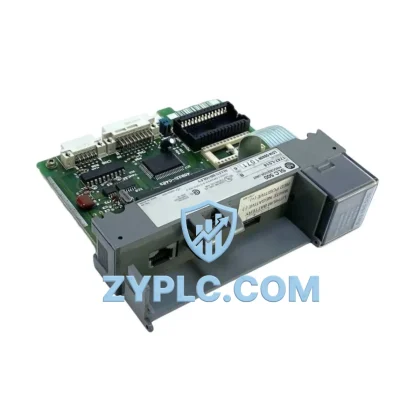
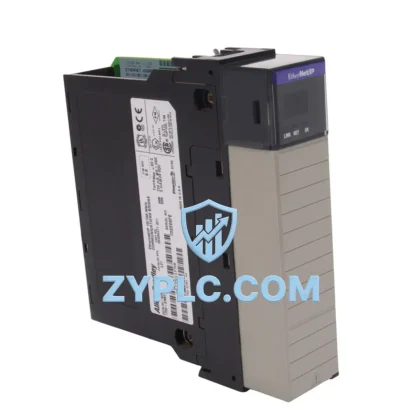
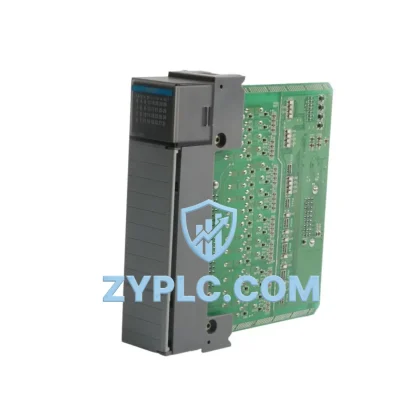
Allen-Bradley 1794-OE12 System-Ready Analog Output for Flex I/O Architecture
The Allen-Bradley 1794-OE12 is a 12-channel analog output module engineered for deployment within Rockwell Automation’s Flex I/O platform. In modern industrial control architectures, where signal integrity, modular scalability, and cross-layer communication are non-negotiable, the 1794-OE12 occupies a critical position at the I/O layer — bridging the control logic of a ControlLogix or CompactLogix CPU with the physical execution layer of field-mounted actuators, control valves, variable frequency drives, and proportional solenoids. Its role is not simply to convert digital commands into analog signals; it is to sustain the precision and repeatability that layered automation systems demand across long operational cycles.
In a fully integrated Flex I/O architecture, the 1794-OE12 is mounted on a 1794-TB3 or 1794-TB3S terminal base, which provides both the electrical backplane connection and the field-side wiring interface. The terminal base selection directly affects signal isolation, grounding topology, and maintenance accessibility — all of which are engineering decisions that must be made at the system design stage rather than during commissioning. The module communicates upstream through a 1794-AENT or 1794-ACNR15 adapter, which translates the backplane data into EtherNet/IP or ControlNet packets destined for the CPU. This communication path must be engineered with deterministic scan time requirements in mind, particularly in process control applications where analog output latency directly affects loop stability.
At the control layer, a 1756-L85E ControlLogix CPU or a 1769-L36ERM CompactLogix controller manages the output values written to the 1794-OE12 through the I/O tree. The controller’s task period, output update rate, and RPI (Requested Packet Interval) configured in Studio 5000 Logix Designer must be aligned with the response characteristics of the downstream actuators. For cascade control loops or ratio control strategies common in petrochemical and water treatment applications, this alignment is essential to prevent integral windup and output oscillation.
Architecture Specification Table
| Parameter |
Specification |
| System Role |
Analog Output Module – I/O Layer (Flex I/O Platform) |
| SKU / Catalog Number |
1794-OE12 |
| Brand / Manufacturer |
Allen-Bradley (Rockwell Automation) |
| Series |
Flex I/O (1794 Series) |
| Number of Output Channels |
12 Analog Output Channels |
| Output Signal Range |
0–20 mA / 4–20 mA / 0–10 VDC (configurable per channel) |
| Resolution |
12-bit (0–4095 counts) |
| Output Update Rate |
Configurable via RPI in Studio 5000 Logix Designer |
| Communication Interface |
Flex I/O backplane (via 1794-AENT / 1794-ACNR15 adapter) |
| Compatible Protocols |
EtherNet/IP, ControlNet (adapter-dependent) |
| Terminal Base Compatibility |
1794-TB3, 1794-TB3S, 1794-TB3G |
| Power Supply Requirement |
24 VDC (supplied via terminal base / backplane) |
| Operating Temperature |
0°C to 60°C (32°F to 140°F) |
| Relative Humidity |
5% to 95% non-condensing |
| Mounting |
DIN rail or panel mount via terminal base |
| Electrical Isolation |
Channel-to-backplane isolation (refer to datasheet) |
| Product Origin |
United States |
| Warranty |
12-Month Warranty (ZYPLC) |
| Contextual Integration |
Fully supported within ControlLogix, CompactLogix, and Flex I/O architectures |
Coordinated Control System Design
The 1794-OE12 achieves its full value only when considered as part of a coordinated system architecture. In a typical distributed control cabinet for a continuous process plant, the module operates alongside a 1794-IE12 analog input module on the same Flex I/O backplane, creating a balanced I/O node that handles both measurement acquisition and control output within a single compact assembly. The 1794-AENT EtherNet/IP adapter connects this node to the plant’s control network, where a 1756-EN2T communication module in the ControlLogix chassis manages the Ethernet backbone traffic.
Power distribution to the Flex I/O node is typically sourced from a 1794-PS13 power supply or an equivalent 24 VDC rail-mounted power supply with adequate current capacity for all modules on the backplane. In redundant power architectures — common in critical process applications — dual power feeds with diode ORing modules ensure that a single power supply failure does not interrupt analog output continuity. This is particularly important for applications where a loss of analog output signal defaults a control valve to a fail-safe position, potentially triggering a process shutdown.
For applications requiring higher channel density or mixed I/O in a single enclosure, the 1794-OE12 can be deployed alongside 1794-OB16 digital output modules and 1794-IB16 digital input modules on the same backplane, managed by a single adapter. This mixed I/O configuration reduces cabinet footprint, simplifies cable management, and lowers the total installed cost compared to deploying separate I/O racks for analog and digital signals.
In architectures where the Flex I/O node is located remotely from the main control panel — such as in field junction boxes or local control stations — the 1794-ACNR15 ControlNet adapter provides a deterministic, noise-immune communication link back to the main ControlLogix chassis. ControlNet’s scheduled messaging capability ensures that analog output updates arrive at the 1794-OE12 within a guaranteed time window, which is critical for tight loop control in applications such as boiler feedwater control, compressor surge control, or distillation column reflux ratio management.
At the human-machine interface layer, a PanelView Plus 7 terminal connected via EtherNet/IP provides operators with real-time visibility into the analog output values written to the 1794-OE12, along with alarm management and trend displays. The integration between the HMI, the ControlLogix CPU, and the Flex I/O analog output module is configured entirely within the Rockwell Automation software environment, ensuring consistent tag naming, data type compatibility, and alarm threshold management across all system layers.
Application in Layered Automation Systems
The 1794-OE12 is deployed across a wide range of industrial sectors where precise analog output control is a fundamental requirement of the process. In oil and gas processing, the module drives control valve positioners on separator vessels, where maintaining precise liquid level and pressure requires stable, drift-free 4–20 mA output signals over extended periods without manual recalibration. The 12-channel capacity allows a single module to manage an entire skid’s worth of control loops, reducing the number of I/O nodes required and simplifying the network topology.
In water and wastewater treatment facilities, the 1794-OE12 controls variable frequency drives on pump stations, dosing pump speed references, and UV disinfection intensity setpoints. The module’s compatibility with both current and voltage output modes allows it to interface with a wide variety of field instruments without requiring signal converters, which reduces installation cost and eliminates potential signal degradation points in the loop.
In metallurgical and mining operations, the module is used to control hydraulic proportional valves on ore processing equipment, where the relationship between the analog output signal and the physical valve position must be precisely characterized and maintained. The 12-bit resolution of the 1794-OE12 provides sufficient granularity for proportional control applications where coarse output steps would cause unacceptable process variability.
In pharmaceutical and food processing environments, the 1794-OE12 supports temperature control loops on jacketed reactors and pasteurization systems, where the analog output drives steam control valves or chilled water valves. The module’s stable output characteristics and compatibility with the ControlLogix validation framework support the documentation requirements of regulated manufacturing environments.
In power generation and substation automation, the module provides setpoint signals to automatic voltage regulators, governor controllers, and reactive power compensation systems, where the accuracy and repeatability of the analog output directly affect grid stability and equipment protection.
Architecture Engineering FAQ
Q1: Is the 1794-OE12 compatible with both ControlLogix and CompactLogix controllers, and what adapter is required for EtherNet/IP communication?
Yes. The 1794-OE12 is compatible with any Rockwell Automation controller that supports EtherNet/IP I/O, including the ControlLogix (1756 series) and CompactLogix (1769 series) platforms. For EtherNet/IP communication, the 1794-AENT adapter is required and must be mounted at the left end of the Flex I/O backplane. The adapter is configured in Studio 5000 Logix Designer by adding the 1794-AENT to the I/O tree and then adding the 1794-OE12 as a child module under the adapter. The RPI for the analog output module should be set based on the control loop requirements — typically 10–50 ms for most process control applications.
Q2: Can the 1794-OE12 be used in a redundant I/O architecture, and what are the system design considerations?
The 1794-OE12 itself does not support hardware redundancy at the module level in the same manner as the 1756 ControlLogix I/O modules with redundancy adapters. For applications requiring redundant analog output capability, the recommended approach is to deploy two independent Flex I/O nodes — each with its own 1794-OE12 and adapter — connected to redundant ControlLogix controllers via a redundant EtherNet/IP network. The control program manages output synchronization between the primary and secondary nodes. Alternatively, for critical single-loop applications, a dedicated safety-rated analog output module on a separate safety network may be more appropriate. Our engineering team can assist with redundancy architecture design as part of the 12-Month Warranty support package.
Q3: What is covered under the 12-Month Warranty, and how does ZYPLC support long-term maintenance and spare parts availability?
The 12-Month Warranty covers the 1794-OE12 module against manufacturing defects and functional failures under normal operating conditions. If the module fails within the warranty period, ZYPLC will provide a replacement unit or repair service at no additional cost. Beyond the warranty period, ZYPLC maintains stock of the 1794-OE12 and compatible Flex I/O components — including terminal bases, adapters, and power supplies — to support long-term maintenance programs. We also provide pre-shipment functional testing and configuration verification services to ensure that replacement modules are ready for installation without requiring extensive on-site commissioning. For planned maintenance programs and bulk spare parts procurement, contact our technical sales team directly.
© 2026 ZYPLC. All rights reserved.
Original Source: https://zyplc.com
Contact: +86 19859288691 | plc.sales@zyplc.com