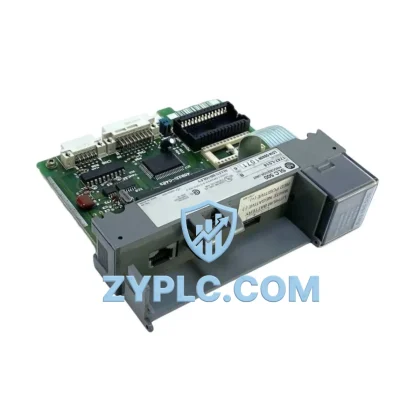
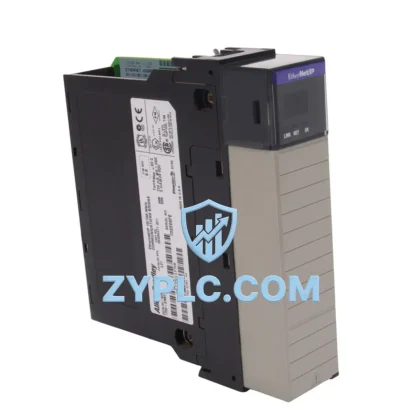
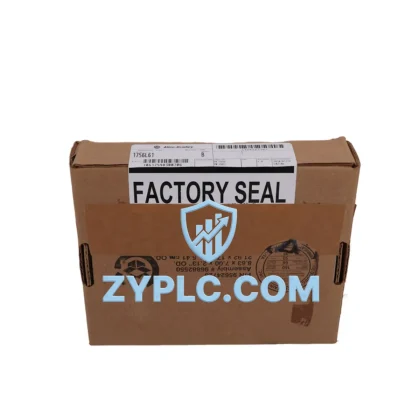
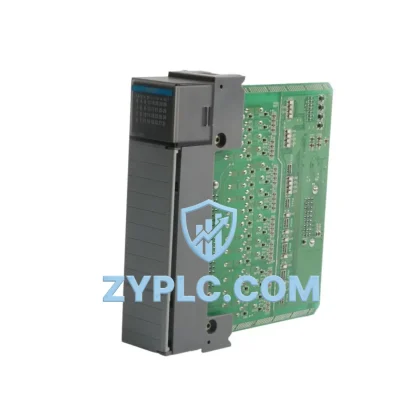
Allen-Bradley 1794-PS13 System-Ready Power Supply for FLEX I/O Architecture
The Allen-Bradley 1794-PS13 is a 24VDC power supply module purpose-built for the FLEX I/O distributed I/O platform, one of Rockwell Automation’s most widely deployed modular I/O systems in industrial control environments. Rather than functioning as a standalone component, the 1794-PS13 occupies a critical position within the layered automation architecture — serving as the electrical foundation upon which the entire FLEX I/O node depends. In distributed control topologies where field devices are spread across large plant floors, substations, or process units, the reliability of the power supply module directly determines the availability of every I/O point connected downstream.
In a complete control system architecture, the 1794-PS13 interfaces directly with the 1794-TB3 or 1794-TB3S terminal base, providing regulated 24VDC power to the I/O adapter and all associated I/O modules mounted on the same backplane segment. The power supply is designed to support up to eight I/O modules per segment, making it suitable for medium-density I/O nodes in both discrete and process control applications. Its compact DIN-rail-compatible form factor allows integration into standard control cabinets alongside other FLEX I/O components, reducing panel space requirements while maintaining full electrical isolation between the field-side and logic-side circuits.
From a system architecture perspective, the 1794-PS13 works in close coordination with the I/O adapter layer — typically the 1794-AENT Ethernet/IP adapter or the 1794-ADN DeviceNet adapter — which handles all upstream communication to the controller. The power supply itself does not participate in the communication protocol, but its stable output is a prerequisite for the adapter’s reliable operation. Any voltage fluctuation or power interruption at the 1794-PS13 level will cascade immediately to the adapter and all downstream I/O modules, making proper sizing and installation of this module a fundamental engineering requirement rather than an afterthought.
At the controller layer, the 1794-PS13-powered FLEX I/O nodes are typically managed by a ControlLogix 1756-L series processor or a CompactLogix 1769-L series controller, both of which communicate with the FLEX I/O adapter over EtherNet/IP or DeviceNet. The controller’s I/O tree treats each FLEX I/O node as a logical device, scanning input data and writing output data on every program scan cycle. The integrity of this scan cycle depends entirely on the continuous, stable power delivery provided by the 1794-PS13 to the local I/O node. In redundant controller architectures using the 1756-SB or 1756-RM2 redundancy modules, the FLEX I/O nodes powered by 1794-PS13 modules can be configured as non-redundant remote I/O drops, with the redundancy managed at the controller chassis level.
In the I/O layer itself, the 1794-PS13 supports a wide range of FLEX I/O modules, including the 1794-IB16 16-point 24VDC digital input module, the 1794-OB16 16-point 24VDC digital output module, the 1794-IE8 8-channel analog input module, and the 1794-OE4 4-channel analog output module. Mixed configurations combining digital and analog modules on the same power supply segment are fully supported, provided the total current draw does not exceed the 1794-PS13’s rated output capacity. Engineers designing FLEX I/O nodes must calculate the aggregate current consumption of all installed modules and verify compatibility with the power supply’s specifications before commissioning.
The network layer in a FLEX I/O system typically relies on EtherNet/IP as the primary communication backbone, with the 1794-AENT adapter providing the physical and logical interface between the FLEX I/O node and the plant network. The 1794-PS13 supports this architecture by ensuring that the adapter receives clean, uninterrupted power regardless of field-side load variations. In installations where DeviceNet is the preferred fieldbus, the 1794-ADN adapter serves the same role, and the power supply requirements remain identical. For installations requiring PROFIBUS DP connectivity, the 1794-APB adapter can be used, again relying on the 1794-PS13 for local power distribution.
From a maintenance and long-term reliability standpoint, the 1794-PS13 is designed for straightforward field replacement without requiring special tools or reconfiguration of the I/O node. The module’s status indicators provide immediate visual feedback on power supply health, allowing maintenance technicians to identify power-related faults quickly during routine inspections or troubleshooting activities. This ease of maintenance is particularly valuable in 24/7 production environments where minimizing mean time to repair (MTTR) is a key operational objective. All units supplied by ZYPLC are covered by a 12-Month Warranty, ensuring that replacement modules meet original factory specifications and perform reliably from the moment of installation.
In terms of system scalability, the 1794-PS13 supports the modular expansion philosophy of the FLEX I/O platform. As production requirements grow and additional I/O points are needed, new FLEX I/O nodes — each with their own 1794-PS13 power supply — can be added to the network without disrupting existing nodes. This distributed power architecture eliminates the single-point-of-failure risk associated with centralized power distribution schemes and allows engineers to design systems with inherent fault isolation between I/O segments.
For applications in demanding industrial environments — including automotive assembly lines, chemical processing plants, water treatment facilities, mining operations, metallurgical plants, and oil and gas installations — the 1794-PS13 provides the electrical stability required to maintain continuous I/O availability under conditions of electrical noise, temperature variation, and mechanical vibration. Its design compliance with IEC and UL standards ensures compatibility with international installation requirements and simplifies the certification process for end-user facilities operating under strict regulatory frameworks.
Architecture Specification Table
| Parameter |
Specification |
| System Role |
FLEX I/O Node Power Supply — I/O Layer |
| SKU / Catalog Number |
1794-PS13 |
| Brand / Manufacturer |
Allen-Bradley (Rockwell Automation) |
| Series |
FLEX I/O 1794 Series |
| Input Voltage |
24VDC (Nominal) |
| Output Voltage |
5VDC (Logic Bus) / 24VDC (Field Bus) |
| Supported I/O Modules per Segment |
Up to 8 modules |
| Compatible Terminal Base |
1794-TB3, 1794-TB3S |
| Compatible Adapters |
1794-AENT (EtherNet/IP), 1794-ADN (DeviceNet), 1794-APB (PROFIBUS) |
| Communication Protocol |
EtherNet/IP, DeviceNet, PROFIBUS DP (via adapter) |
| Mounting |
DIN Rail / Panel Mount via Terminal Base |
| Operating Temperature |
0°C to 55°C (32°F to 131°F) |
| Enclosure Rating |
Open Type (IP20 equivalent) |
| Standards Compliance |
UL, CE, IEC 61131-2 |
| Warranty |
12-Month Warranty (ZYPLC) |
| Product Condition |
New / Tested Surplus / Refurbished (as specified at order) |
Coordinated Control System Design
The 1794-PS13 achieves its full value when considered as part of a coordinated control system rather than as an isolated component. In a typical FLEX I/O node, the power supply works in direct coordination with the 1794-AENT EtherNet/IP adapter, which manages all upstream communication to the plant network and the controller. The adapter draws its operating power from the 1794-PS13’s logic bus, making the power supply the first critical dependency in the node’s operational chain.
At the I/O module level, the 1794-PS13 simultaneously powers multiple modules such as the 1794-IB16 digital input module and the 1794-OB16 digital output module, which handle discrete field signals from sensors, pushbuttons, solenoids, and motor starters. For process control applications requiring analog signal handling, the 1794-IE8 analog input module and 1794-OE4 analog output module are commonly installed on the same power supply segment, with the 1794-PS13 providing the stable power baseline required for accurate signal conversion.
At the controller layer, the FLEX I/O node powered by the 1794-PS13 is typically managed by a 1756-L73 ControlLogix processor housed in a 1756-A7 or 1756-A13 chassis, communicating over EtherNet/IP through a 1756-EN2T EtherNet/IP communication module. In smaller applications, a 1769-L33ER CompactLogix controller may serve as the primary processor, with the FLEX I/O node connected as a remote I/O drop. The power supply’s role in maintaining node availability is directly reflected in the controller’s I/O fault diagnostics — a power supply failure at the 1794-PS13 level will generate an I/O module fault in the controller’s fault log, enabling rapid identification and response by the maintenance team.
For installations requiring power conditioning upstream of the 1794-PS13, a 1606-XLP power supply from the Allen-Bradley PULS series is commonly used to provide regulated 24VDC from the incoming AC supply, ensuring that the FLEX I/O node receives clean, stable input power even in environments with significant electrical noise or voltage fluctuation. This upstream power conditioning, combined with the 1794-PS13’s internal regulation, creates a two-stage power architecture that significantly improves overall node reliability.
Application in Layered Automation Systems
The 1794-PS13 is deployed across a broad spectrum of industrial automation applications where distributed I/O architecture is preferred over centralized I/O wiring. In automotive manufacturing, FLEX I/O nodes powered by 1794-PS13 modules are installed at assembly stations, welding cells, and paint line conveyors, where the distributed architecture reduces cable runs and simplifies troubleshooting. In chemical and petrochemical processing, the power supply supports FLEX I/O nodes installed in field junction boxes, providing local I/O capability for pressure transmitters, flow meters, and control valves without requiring long signal cable runs back to the central control room.
In water and wastewater treatment facilities, the 1794-PS13 powers FLEX I/O nodes installed at pump stations, filtration units, and chemical dosing systems, where the distributed I/O architecture allows a single ControlLogix or CompactLogix controller to manage multiple geographically separated process units over a single EtherNet/IP network. In mining and metallurgical applications, the power supply’s robust design supports operation in environments with elevated levels of electrical noise from variable frequency drives, large motor starters, and high-current switching equipment. In packaging and material handling systems, FLEX I/O nodes powered by 1794-PS13 modules provide the I/O density and flexibility required to manage complex conveyor systems, robotic pick-and-place stations, and vision inspection systems within a unified control architecture.
Architecture Engineering FAQ
Q1: How many I/O modules can the 1794-PS13 support on a single FLEX I/O node, and what are the current budget considerations?
The 1794-PS13 supports up to eight I/O modules per power supply segment. However, the actual number of modules that can be installed depends on the aggregate current consumption of all modules in the node. Engineers must calculate the total current draw from both the logic bus (5VDC) and the field bus (24VDC) for all installed modules and verify that the combined load does not exceed the 1794-PS13’s rated output capacity. If the required I/O count exceeds the power supply’s capacity, an additional 1794-PS13 module can be added to extend the node with a second power supply segment.
Q2: Is the 1794-PS13 compatible with both EtherNet/IP and DeviceNet FLEX I/O adapters, and does the choice of adapter affect power supply selection?
Yes, the 1794-PS13 is compatible with all standard FLEX I/O adapters, including the 1794-AENT (EtherNet/IP), 1794-ADN (DeviceNet), and 1794-APB (PROFIBUS DP). The choice of communication adapter does not affect the power supply selection, as the 1794-PS13 provides power to the adapter and I/O modules regardless of the communication protocol in use. The adapter is selected based on the plant network architecture and controller communication capabilities, while the power supply is selected based on the I/O module count and current budget requirements.
Q3: What does the 12-Month Warranty cover for the 1794-PS13, and what is the recommended maintenance practice for long-term system reliability?
All 1794-PS13 modules supplied by ZYPLC are covered by a 12-Month Warranty against defects in materials and workmanship. This warranty ensures that replacement modules meet original factory specifications and perform reliably from the moment of installation. For long-term system reliability, it is recommended to maintain a spare 1794-PS13 module on-site, particularly in critical applications where unplanned downtime carries significant operational or safety consequences. Routine maintenance should include periodic inspection of the power supply’s status indicators, verification of input voltage levels, and thermal inspection of the module and surrounding cabinet environment to ensure operating conditions remain within specification.
© 2026 ZYPLC. All rights reserved.
Original Source: https://zyplc.com
Contact: +86 19859288691 | plc.sales@zyplc.com