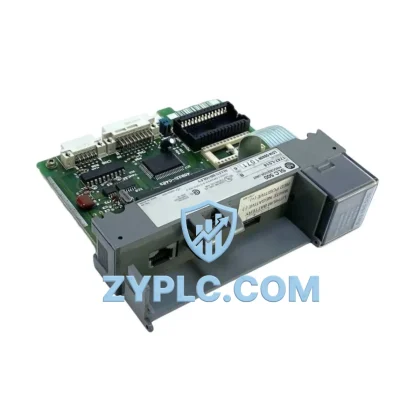
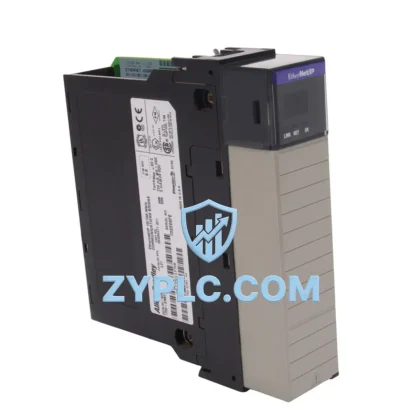
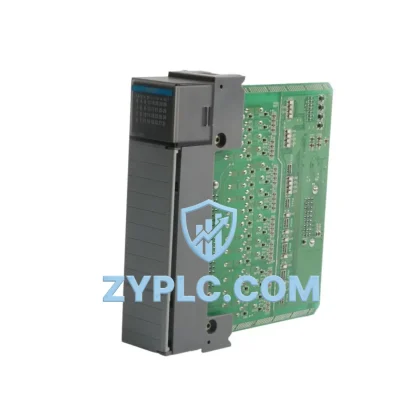
Allen-Bradley 2711P-RP7 System-Ready HMI Logic for PanelView Plus Architecture
The Allen-Bradley 2711P-RP7 is a replacement logic module engineered for the PanelView Plus 700 to 1500 terminal family, occupying a critical position within the human-machine interface (HMI) layer of a Rockwell Automation control system architecture. Rather than functioning as a standalone component, the 2711P-RP7 serves as the computational core of the operator interface node — the point at which the control layer communicates process status, alarm conditions, and command inputs to plant personnel. Understanding its role requires examining how it interacts with every adjacent layer of a modern industrial automation system.
In a layered automation architecture, the 2711P-RP7 sits at the intersection of the control layer and the human-machine interface layer. Below it, a ControlLogix or CompactLogix controller — such as the 1756-L73 or 1769-L33ER — executes the ladder logic or function block programs that govern process behavior. The 2711P-RP7 communicates with these controllers over EtherNet/IP, retrieving tag data in real time and presenting it through the PanelView Plus display. This communication path depends on a stable network infrastructure: managed switches, properly configured IP addressing, and consistent EtherNet/IP traffic prioritization all contribute to the responsiveness that operators rely on during critical process events.
At the I/O layer, the 2711P-RP7 does not directly interface with field devices, but its health directly affects how accurately operators can monitor and respond to I/O-driven alarms. When a 1756-IB16 digital input module detects a fault condition or a 1756-OF8 analog output module reports an out-of-range value, that information travels through the controller and arrives at the PanelView Plus terminal via the 2711P-RP7’s logic processing. A degraded or failed logic module introduces latency or display errors that can mask real process anomalies — making the integrity of this component essential to overall system reliability.
The power layer also plays a direct role in 2711P-RP7 performance. The PanelView Plus terminal requires a stable 24 VDC supply, typically sourced from a dedicated panel power supply such as the 1606-XLP95E or equivalent. Voltage fluctuations or inadequate current capacity can cause the logic module to reset unexpectedly, corrupting active display projects or triggering nuisance alarms. In high-availability installations, redundant power feeds with automatic switchover are recommended to protect the HMI layer from single-point power failures.
Within the network layer, the 2711P-RP7 supports EtherNet/IP as its primary communication protocol, enabling seamless integration with Rockwell’s Studio 5000 Logix Designer environment and FactoryTalk View Site Edition server. This connectivity allows centralized alarm management, historical trending, and remote diagnostics — capabilities that are increasingly important in facilities transitioning toward IIoT-enabled operations. The module’s network interface also supports remote firmware updates and project downloads, reducing the need for on-site engineering visits during routine maintenance cycles.
For system architects designing redundant HMI configurations, the 2711P-RP7 can be deployed alongside a secondary PanelView Plus terminal connected to the same controller tag database. In the event of a primary terminal failure, operators can switch to the backup display without interrupting process control — a design pattern commonly used in power generation, water treatment, and continuous chemical processing facilities where unplanned downtime carries significant operational cost.
From a maintenance and lifecycle perspective, stocking a spare 2711P-RP7 logic module is a recognized best practice in facilities running PanelView Plus terminals beyond their original warranty period. The module is field-replaceable without specialized tooling, and a trained technician can complete a swap and project reload within a standard maintenance window. All units supplied by ZYPLC carry a 12-Month Warranty and have been tested for functional integrity prior to shipment, supporting both planned replacement programs and emergency breakdown response.
Architecture Specification Table
| Parameter |
Specification |
| System Role |
HMI Logic Module — PanelView Plus 700 to 1500 Series |
| Compatible Terminals |
2711P-T7Cxx, 2711P-T10Cxx, 2711P-T12Wxx, 2711P-T15Cxx |
| Communication Protocol |
EtherNet/IP (primary), DH-485, DF1 (via adapter) |
| Controller Compatibility |
ControlLogix, CompactLogix, MicroLogix (via gateway) |
| Power Supply Requirement |
24 VDC nominal, supplied via terminal backplane |
| Operating Temperature |
0°C to 55°C (32°F to 131°F) |
| Storage Temperature |
-40°C to 85°C (-40°F to 185°F) |
| Relative Humidity |
5% to 95% non-condensing |
| Enclosure Rating |
NEMA 4/4X, 12, 13 (panel front face) |
| Project Software |
FactoryTalk View ME (Machine Edition) |
| Firmware Upgrade |
Supported via EtherNet/IP remote download |
| Contextual Integration |
Full tag-based integration with Studio 5000 controller projects |
| Warranty |
12-Month Warranty — all units tested prior to shipment |
| Origin |
United States |
Coordinated Control System Design
The 2711P-RP7 achieves its full value when deployed as part of a coordinated Rockwell Automation control system rather than as an isolated replacement part. In a typical mid-scale manufacturing cell, the architecture begins with a 1756-L73 ControlLogix CPU housed in a 1756-A10 chassis with a 1756-PA75 power supply providing stable backplane power. Digital and analog I/O is handled by modules such as the 1756-IB16 (16-point 24 VDC digital input) and 1756-OF8 (8-channel analog output), with field signals wired through 1492-CABLE series wiring systems to terminal blocks mounted in the control cabinet.
Network connectivity between the ControlLogix system and the PanelView Plus terminal running the 2711P-RP7 is established through a Stratix 5700 managed Ethernet switch, which provides VLAN segmentation and QoS prioritization for EtherNet/IP traffic. In installations where legacy DeviceNet or ControlNet devices remain in service, a 1788-EN2DN EtherNet/IP-to-DeviceNet linking device bridges the protocol gap, allowing the controller — and by extension the HMI — to present unified process data across mixed-protocol architectures.
For drive integration, variable frequency drives such as the PowerFlex 525 communicate over EtherNet/IP directly to the ControlLogix controller, with speed references, fault codes, and run status all available as controller tags that the 2711P-RP7 can display on operator faceplates. This tight integration between the drive layer and the HMI layer eliminates the need for separate drive keypads on the panel face, reducing cabinet complexity and improving operator situational awareness.
In safety-critical applications, the architecture may also include a 1756-L7S GuardLogix safety controller operating in the same chassis, with safety I/O modules such as the 1791DS-IB12 CompactBlock Guard I/O handling emergency stop circuits and light curtain inputs. The 2711P-RP7-equipped PanelView Plus terminal can display safety system status — including SIL-rated interlock states — providing operators with a consolidated view of both standard and safety control layers without requiring a separate safety HMI panel.
Application in Layered Automation Systems
The 2711P-RP7 logic module finds application across a broad range of industrial sectors where PanelView Plus terminals have been deployed as the standard operator interface platform.
In discrete manufacturing environments — automotive assembly, electronics production, and packaging lines — PanelView Plus terminals equipped with the 2711P-RP7 serve as the primary operator touchpoint for machine mode selection, recipe management, and production count display. The module’s ability to handle complex FactoryTalk View ME projects with multiple display pages, alarm banners, and trend objects makes it suitable for high-interaction operator stations where screen responsiveness directly affects line throughput.
In power generation and electrical distribution facilities, the 2711P-RP7 supports substation automation applications where operators monitor breaker status, transformer loading, and bus voltage from a centralized HMI panel. The module’s EtherNet/IP connectivity allows it to retrieve data from protection relays and power meters integrated into the ControlLogix system via communication modules, presenting a unified electrical single-line diagram on the PanelView Plus display.
In water and wastewater treatment plants, the 2711P-RP7 is commonly deployed at local pump station panels, where operators need to view flow rates, tank levels, and pump run hours without accessing the central SCADA workstation. The module’s ability to operate as a standalone FactoryTalk View ME terminal — without a continuous server connection — makes it well-suited for remote lift stations and distributed treatment facilities where network connectivity may be intermittent.
In oil, gas, and petrochemical processing, the 2711P-RP7 supports operator interface requirements in classified areas when installed in appropriately rated enclosures. Process variables such as pressure, temperature, and flow — measured by field instruments and processed by the ControlLogix controller — are presented on the PanelView Plus display in engineering units, with configurable alarm limits and trend history stored locally on the logic module’s internal memory.
In mining and metals processing, the module supports conveyor control panels, crusher monitoring stations, and mill drive interface panels, where the combination of high ambient temperature, vibration, and dust requires a robust HMI platform. The 2711P-RP7’s NEMA 4/4X-rated installation environment and wide operating temperature range make it appropriate for these demanding conditions.
Architecture Engineering FAQ
Q1: Is the 2711P-RP7 compatible with all PanelView Plus terminal sizes, and does it require firmware matching with the host terminal?
The 2711P-RP7 logic module is designed for use with PanelView Plus terminals in the 700 to 1500 display size range (2711P-T7C, T10C, T12W, T15C series). Firmware compatibility between the logic module and the display module is required — mismatched firmware versions can prevent the terminal from completing its boot sequence. Before installation, verify the existing terminal firmware version using FactoryTalk View ME Studio and update the replacement logic module to match. ZYPLC supplies units with current firmware and can advise on version compatibility for specific terminal configurations. All units are covered by a 12-Month Warranty.
Q2: Can the 2711P-RP7 be used in a redundant HMI architecture, and how is failover managed?
Redundant HMI configurations using PanelView Plus terminals are achieved at the system level rather than within a single terminal. Two independent PanelView Plus terminals — each equipped with a 2711P-RP7 logic module — are connected to the same ControlLogix controller tag database via EtherNet/IP. Both terminals run identical FactoryTalk View ME projects and display the same process data simultaneously. In the event of a primary terminal failure, operators switch to the secondary terminal manually or via a selector switch on the panel face. This architecture is commonly used in continuous process industries where HMI availability is a reliability requirement. The 12-Month Warranty on each supplied module supports the business case for maintaining a hot-standby spare.
Q3: What is the recommended procedure for replacing a 2711P-RP7 in a live production environment, and how long does the process take?
Replacing the 2711P-RP7 in a production environment requires a planned maintenance window, as the PanelView Plus terminal must be powered down during the module swap. The procedure involves: (1) backing up the existing FactoryTalk View ME project from the terminal or from the engineering workstation; (2) powering down the terminal and removing the logic module by releasing the retention clips; (3) installing the replacement 2711P-RP7 and securing it in the terminal housing; (4) powering up the terminal and downloading the backed-up project via EtherNet/IP or USB; (5) verifying controller communication and alarm functionality before returning the terminal to service. An experienced technician familiar with FactoryTalk View ME can complete this process in 30 to 60 minutes. Contextual Integration with the existing controller project eliminates the need to reconfigure tag bindings, provided the replacement module runs compatible firmware. ZYPLC’s 12-Month Warranty covers the replacement module for the full post-installation period.
© 2026 ZYPLC. All rights reserved.
Original Source: https://zyplc.com
Contact: +86 19859288691 | [email protected]