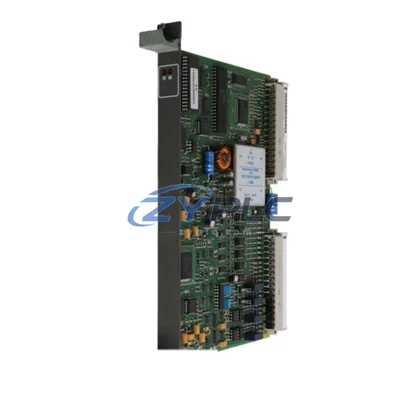
The Allen-Bradley 917-0050 is a high-performance welding control module from the MEDWELD 3005 series, engineered to deliver precise weld maintenance planning in demanding industrial environments. Designed for resistance welding applications, this module enables manufacturers to reduce unplanned downtime risk, tighten weld cycle timing, and maintain consistent output quality — all critical factors in modern maintenance-focused production lines.
In today’s industrial landscape, uncontrolled weld energy is one of the most overlooked sources of operational inefficiency. The 917-0050 addresses this directly by providing closed-loop weld current regulation, ensuring that each weld cycle consumes only the energy required — no more, no less. This translates to measurable reductions in peak power demand, lower heat stress on tooling, and extended electrode life, all of which contribute to a lower total cost of ownership over the equipment lifecycle.
Product Specification Table
| Parameter |
Specification / Value |
| SKU / Part Number |
917-0050 |
| Series |
MEDWELD 3005 |
| Product Type |
Welding Control Module |
| Brand |
Allen-Bradley |
| Power Consumption |
Optimized closed-loop weld energy regulation |
| Operating Efficiency |
Precision current control minimizes unplanned downtime per weld cycle |
| Compatible Systems |
MEDWELD 3005 welding controllers, Allen-Bradley PLC platforms, Rockwell Automation control networks |
| Application Environment |
Automotive body assembly, metal fabrication, resistance spot welding lines |
| Energy Saving Value |
Reduces peak power demand; extends electrode and transformer service life |
| Origin |
USA |
| Warranty |
warranty terms confirmed during quotation — tested and verified before shipment |
System Compatibility and Application
The 917-0050 does not operate in isolation — it is most effective when integrated into a broader industrial automation system. In a typical resistance welding cell, the module interfaces directly with the MEDWELD 3005 weld controller, which governs weld schedule selection, current setpoints, and cycle sequencing. Upstream, a Allen-Bradley ControlLogix L7x series PLC or CompactLogix 5380 controller manages the production sequence, issuing weld initiation signals and receiving completion feedback to maintain line throughput.
For condition monitoring at the cell level, the 917-0050 can be paired with a PowerMonitor 5000 unit, which captures real-time power consumption data and feeds it back to the control system via EtherNet/IP. This allows plant engineers to track weld energy trends, identify anomalies indicative of electrode wear or transformer degradation, and schedule maintenance before unplanned downtime occurs.
On the I/O side, Allen-Bradley 1734 POINT I/O modules handle discrete signals between the weld controller and peripheral devices such as clamp actuators, coolant flow switches, and part-present sensors. Reliable I/O communication ensures that the 917-0050 only initiates a weld cycle when all safety and process conditions are confirmed — eliminating wasted energy from aborted or incomplete welds.
For facilities running mixed welding and motion control operations, the 917-0050 architecture integrates cleanly alongside Kinetix 5700 servo drives managing electrode positioning axes. Coordinated motion and weld timing — orchestrated through the ControlLogix backplane — allows for tighter cycle synchronization, reducing idle time between weld events and improving overall equipment effectiveness (OEE).
Communication across the welding cell is handled via EtherNet/IP and, in legacy installations, DeviceNet — both natively supported within the Rockwell Automation ecosystem. The Allen-Bradley 1756-EN2T EtherNet/IP communication module provides the network bridge between the weld controller, the PLC, and plant-level SCADA or MES systems, enabling centralized energy data aggregation without additional protocol conversion hardware.
Where operator visibility is required at the cell level, a PanelView Plus 7 HMI can display live weld energy readings, cycle counts, and alarm states sourced directly from the MEDWELD 3005 and the 917-0050 module. Operators can adjust weld schedules, review operating load per part, and acknowledge faults without leaving the workstation — reducing response time and keeping the line running efficiently.
Maintenance and Replacement Notes
In automotive body-in-white (BIW) assembly lines, resistance spot welding accounts for a significant share of total facility operating load. A single robotic welding cell may execute thousands of weld cycles per shift, and even marginal inefficiencies in weld energy delivery — such as overcurrent conditions, extended weld times, or unnecessary heat input — accumulate into substantial unplanned downtime over time.
The Allen-Bradley 917-0050 addresses this at the source. By regulating weld current with high precision, the module ensures that each weld receives exactly the energy specified in the weld schedule — no excess, no shortfall. This consistency not only reduces operating load but also improves weld quality repeatability, reducing the frequency of rework and scrap that further drain production resources.
From a maintenance perspective, the 917-0050’s closed-loop control reduces thermal stress on the welding transformer and secondary circuit components. Lower operating temperatures translate directly to longer service intervals, fewer unplanned stoppages, and reduced spare parts consumption. When integrated with predictive maintenance workflows — using energy trend data from the PowerMonitor 5000 — maintenance teams can identify degrading components before they cause line stoppages, shifting from reactive to proactive maintenance strategies.
Line throughput also benefits from the module’s fast cycle response. The MEDWELD 3005 platform is designed for high-speed weld sequencing, and the 917-0050 supports rapid schedule switching between weld programs — enabling the same cell to handle multiple part variants without manual reconfiguration. This flexibility improves equipment utilization rates and reduces changeover-related downtime, both of which directly impact production efficiency and energy cost per unit produced.
All units supplied by ZYPLC are fully tested prior to shipment, with functional verification of weld control outputs, communication interfaces, and module diagnostics. Stock is maintained for prompt dispatch, supporting both planned maintenance replacements and urgent breakdown scenarios. Each 917-0050 is covered by a warranty terms confirmed during quotation, providing assurance of performance reliability from the moment of installation.
Product Sourcing FAQ
Q1: How does the Allen-Bradley 917-0050 contribute to operational stability in a welding production line?
The 917-0050 uses closed-loop weld current regulation to deliver precisely the energy specified in each weld schedule. This eliminates overcurrent conditions and unnecessary heat input, reducing per-weld operating load and lowering peak power demand on the facility’s electrical infrastructure. Over a full production shift, these savings accumulate significantly across high-cycle welding operations.
Q2: Is the 917-0050 compatible with current Allen-Bradley PLC and control platforms?
Yes. The 917-0050 is designed for the MEDWELD 3005 weld controller platform, which integrates with Allen-Bradley ControlLogix and CompactLogix PLC families via EtherNet/IP and DeviceNet. It operates within the standard Rockwell Automation Studio 5000 programming environment, making it compatible with existing control infrastructure in most Allen-Bradley-based facilities.
Q3: Can the 917-0050 replace an existing MEDWELD 3005 module directly, and what is the recommended replacement process?
The 917-0050 is a direct replacement module for compatible MEDWELD 3005 systems. The recommended process involves powering down the weld controller, removing the existing module, installing the 917-0050, and restoring the saved weld schedule configuration from the controller’s memory or backup file. No firmware changes are typically required. ZYPLC recommends verifying weld schedule parameters after installation and performing a test weld sequence before returning the cell to full production.
Q4: What does the warranty terms confirmed during quotation cover, and how is the module tested before shipment?
Every Allen-Bradley 917-0050 supplied by ZYPLC undergoes functional testing prior to dispatch, including verification of weld control outputs, module communication interfaces, and internal diagnostics. The warranty terms confirmed during quotation covers defects in materials and workmanship under normal operating conditions. In the event of a warranty claim, ZYPLC provides replacement or repair support to minimize production disruption.