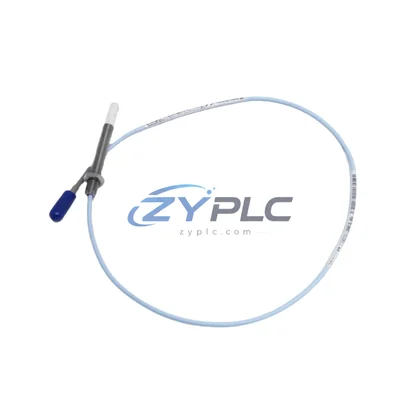
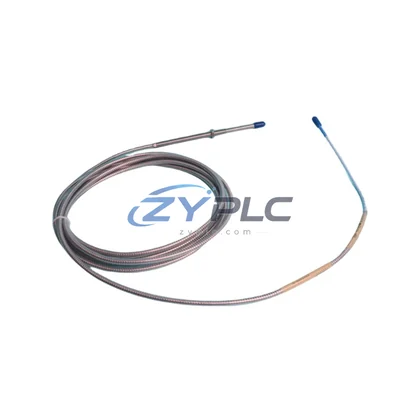
Bently Nevada 1701/10 Industrial Network Interface for 1701 Series Systems: Powering the Smart Factory Data Chain
The Bently Nevada 1701/10 is a dedicated power supply module engineered for the 1701 Series vibration monitoring platform — a cornerstone of industrial condition monitoring in rotating machinery environments. In modern smart factory deployments, the 1701/10 does far more than deliver regulated power: it anchors the data acquisition chain that connects field-level vibration sensors, proximity probes, and accelerometers to PLC controllers, SCADA systems, and enterprise-level asset management platforms. Its role in the industrial network begins at the sensor interface and extends through every layer of the automation pyramid.
Within a typical 1701 Series rack, the 1701/10 works in close coordination with signal conditioning modules such as the 1701/20 and 1701/15, ensuring that each channel receives stable, noise-free power for accurate vibration amplitude and phase measurement. Unstable power at this stage introduces measurement drift that propagates through the entire data pipeline — corrupting trend data in historian databases and triggering false alarms in SCADA dashboards. The 1701/10 eliminates this risk by providing tightly regulated DC output with built-in protection against overvoltage and short-circuit conditions.
Compatibility & Integration Notes
| Parameter |
Specification |
| SKU |
1701/10 |
| Brand |
Bently Nevada |
| Series |
1701 Series Vibration Monitoring |
| Product Type |
Vibration Monitor Power Supply |
| Protocol Support |
Compatible with Modbus RTU/TCP, OPC-UA via gateway integration |
| Interface Type |
Rack-mount backplane power interface |
| Communication Gateway |
Supports integration with 3500 Series gateway modules and SCADA/DCS bridges |
| Network Compatibility |
Industrial Ethernet, Fieldbus-ready via upstream gateway |
| System Application |
Rotating machinery protection, turbine monitoring, compressor health, SCADA integration |
| Origin |
United States |
| Warranty |
12 Months |
Connected Automation Data Flow
The industrial data flow enabled by the Bently Nevada 1701/10 begins at the physical layer, where proximity probes and velocity sensors mounted on turbines, compressors, and pumps generate continuous analog vibration signals. These signals feed into the 1701 Series rack, where the 1701/10 power supply ensures every module — including the 1701/20 two-channel vibration monitor and the 1701/15 keyphasor interface — operates within its specified voltage window. Signal integrity at this stage is non-negotiable: even minor power fluctuations can shift the baseline of a 4–20 mA output, causing the downstream PLC to misinterpret machine health data.
From the 1701 Series rack, conditioned vibration data travels via hardwired I/O or serial communication links to a Bently Nevada 3500/22M transient data interface or a 3500/25 keyphasor module, which aggregate multi-channel readings into a coherent machine health picture. These modules interface directly with the 3500/15 power supply within the 3500 Series rack, mirroring the power architecture philosophy of the 1701/10 — stable, redundant, and diagnostics-ready. The 3500 Series rack then communicates upstream via Modbus TCP or OPC-UA to a plant-level SCADA system, where operators monitor vibration trends, set alarm thresholds, and initiate remote diagnostics without leaving the control room.
For facilities running mixed-protocol environments — common in brownfield plants where legacy Fieldbus devices coexist with modern Industrial Ethernet infrastructure — the 1701/10-powered monitoring rack connects through a Bently Nevada TK-3e communication interface or a third-party Modbus-to-OPC gateway. This protocol conversion layer is critical: it allows vibration data from the 1701 Series to appear as standard OPC-UA tags in a GE iFIX or Wonderware System Platform SCADA environment, enabling unified alarming and historian logging alongside data from Allen-Bradley ControlLogix PLCs, Siemens S7-400 controllers, and remote I/O nodes distributed across the plant floor.
At the edge, the data chain extends further: vibration amplitude, phase, and gap voltage readings from the 1701 Series are forwarded to an edge gateway running condition monitoring analytics. Here, the Bently Nevada 3300 XL 8mm proximity transducer system and 1900/65A general-purpose equipment monitor contribute complementary vibration and temperature data streams, feeding machine learning models that predict bearing wear, rotor imbalance, and seal degradation weeks before a failure event. The 1701/10 is the silent enabler of this entire chain — without reliable power at the rack level, none of the upstream analytics are trustworthy.
In drive-intensive applications — such as variable-speed compressor trains monitored alongside Rockwell PowerFlex 755 variable frequency drives — the 1701/10 ensures that vibration monitoring remains independent of the drive’s switching noise, thanks to its isolated power architecture. This isolation is equally valuable when the monitoring rack shares a cabinet with Phoenix Contact QUINT industrial power supplies or Siemens SITOP PSU8600 units, preventing ground loops that would otherwise corrupt proximity probe gap voltage readings.
Solving Data Isolation in Industrial Sites
One of the most persistent challenges in industrial condition monitoring is data isolation — the inability to correlate vibration data from the 1701 Series with process data from the DCS, energy data from power meters, or maintenance records from the CMMS. The Bently Nevada 1701/10, as the power foundation of the 1701 Series rack, enables a fully networked monitoring architecture that breaks down these silos.
When the 1701 Series rack is integrated with a plant’s OPC-UA server via a gateway module, vibration alarm states become available to the same SCADA historian that logs process temperatures, flow rates, and pressure readings. Maintenance engineers can now correlate a spike in bearing vibration amplitude with a simultaneous increase in lube oil temperature — a diagnostic insight that was previously impossible when vibration data lived in a standalone monitoring system disconnected from the process network.
Remote monitoring is another area where the 1701/10’s stable power architecture pays dividends. In offshore platforms, remote compressor stations, and unmanned substations, the ability to perform remote diagnostics — checking gap voltage, reviewing alarm history, and adjusting alert setpoints — without dispatching a technician is a direct cost saving. The 1701 Series, powered reliably by the 1701/10, supports this remote access model through its serial and Ethernet communication interfaces, enabling 24/7 machine health visibility from any authorized workstation on the plant network.
Production line transparency is further enhanced when the 1701/10-powered monitoring rack feeds data into an asset performance management (APM) platform. Vibration trend data, alarm event logs, and channel health diagnostics are exported as structured datasets, enabling reliability engineers to build predictive maintenance schedules based on actual machine behavior rather than fixed time intervals. This shift from reactive to predictive maintenance is the defining value proposition of a fully networked condition monitoring architecture — and the 1701/10 is its power foundation.
Industrial Connectivity FAQ
Q1: Does the Bently Nevada 1701/10 support direct Modbus or OPC-UA communication?
The 1701/10 is a power supply module and does not itself implement a communication protocol. However, when installed in a 1701 Series rack alongside communication interface modules such as the TK-3e or a Modbus gateway card, the entire rack becomes addressable via Modbus RTU/TCP or OPC-UA, enabling full integration with SCADA and DCS platforms.
Q2: How does the 1701/10 ensure network stability in high-EMI industrial environments?
The 1701/10 features an isolated power architecture that decouples the monitoring rack’s internal power bus from the plant’s AC supply noise and ground potential differences. This isolation prevents EMI-induced voltage fluctuations from affecting the analog measurement channels, ensuring that vibration data transmitted to the SCADA system accurately reflects machine condition rather than electrical noise.
Q3: Can the 1701 Series rack powered by the 1701/10 be expanded to monitor additional machine trains?
Yes. The 1701 Series is a modular platform. Additional signal conditioning modules — such as the 1701/20 for two-channel vibration monitoring or the 1701/15 for keyphasor inputs — can be added to the rack as monitoring requirements grow. The 1701/10 power supply is sized to support a fully populated rack, making it a future-proof choice for expanding condition monitoring coverage across multiple machine trains.
Q4: What warranty and pre-shipment testing does the 1701/10 include?
Every Bently Nevada 1701/10 unit supplied by ZYPLC undergoes pre-shipment functional testing to verify output voltage regulation, protection circuit operation, and backplane interface integrity. A warranty terms confirmed during quotation is included from the date of shipment, covering manufacturing defects and functional failures under normal operating conditions. Global shipping via DHL and FedEx is available with full export documentation.