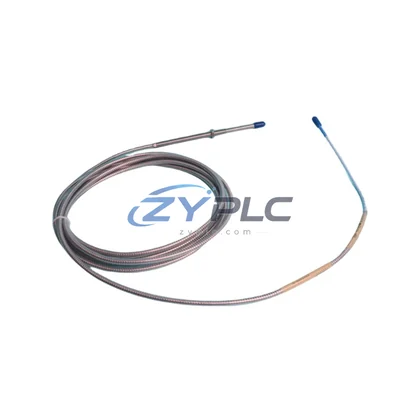
Bently Nevada 177230-01-02-05 Seismic Transmitter for 16710 Series
The Bently Nevada 177230-01-02-05 is a precision seismic transmitter engineered for seamless integration within the 16710 Series continuous machinery monitoring architecture. Designed to operate as a critical node in multi-layer industrial control systems, this module delivers reliable velocity-based vibration signal conditioning across demanding process environments including power generation, petrochemical refining, rotating machinery protection, and heavy industrial manufacturing. Rather than functioning as a standalone instrument, the 177230-01-02-05 is purpose-built to serve as a coherent element within a broader Bently Nevada system architecture — contributing to signal integrity, system redundancy, and long-term operational continuity.
In modern industrial automation, seismic transmitters occupy a foundational role at the field instrumentation layer. The 177230-01-02-05 interfaces directly with velocity-type seismic sensors and converts raw vibration signals into standardized 4–20 mA analog outputs suitable for direct ingestion by the 16710-30 monitor module. This signal chain ensures that upstream control layers — including the System 1 condition monitoring software platform, DCS integration gateways, and safety instrumented systems — receive clean, calibrated data without signal degradation or noise interference. The module’s architecture-ready design means it can be deployed within both simplex and redundant monitoring configurations, supporting the high-availability requirements of critical rotating equipment such as steam turbines, gas compressors, centrifugal pumps, and large electric motors.
From a system architecture perspective, the 177230-01-02-05 participates in a layered control hierarchy. At the field layer, it works in conjunction with seismic velocity sensors and proximity probes to capture machine vibration signatures. At the signal conditioning layer, it normalizes and transmits these signals to the 16710-30 monitor, which performs threshold comparison, alarm generation, and relay output activation. At the communication layer, the 16710 Series rack integrates with Modbus RTU or 4–20 mA hardwired interfaces to relay machine health data to plant-level SCADA systems or DCS platforms. At the supervisory layer, System 1 software aggregates multi-channel vibration data for trend analysis, predictive maintenance scheduling, and compliance reporting. The 177230-01-02-05 is the essential first link in this chain — without accurate seismic signal input, the entire downstream architecture loses its diagnostic foundation.
system integration is a defining characteristic of this module. Unlike generic transmitters, the 177230-01-02-05 is calibrated and validated for use within the Bently Nevada 16710 Series ecosystem, ensuring parameter compatibility with the 16710-30 monitor’s input specifications, alarm setpoint logic, and relay output behavior. This native compatibility eliminates the integration risk associated with third-party signal conditioning components and reduces commissioning time significantly. Engineers deploying this module within an existing 16710 Series rack can expect plug-compatible installation, minimizing downtime during maintenance or module replacement cycles.
The module also supports architecture scalability. As plant monitoring requirements expand — adding new measurement points, extending to additional machine trains, or upgrading to higher-channel-count configurations — the 177230-01-02-05 can be replicated across multiple rack positions without requiring reconfiguration of the central monitoring platform. This modularity is particularly valuable in greenfield projects where phased commissioning is planned, as well as in brownfield upgrades where existing Bently Nevada infrastructure is being extended rather than replaced.
Long-term maintenance efficiency is another key advantage. The 177230-01-02-05’s standardized form factor and well-documented electrical interface allow maintenance teams to perform module-level replacements without specialized tooling or extended calibration procedures. Spare module inventory management is simplified by the module’s single-SKU applicability across multiple 16710 Series rack configurations. Combined with a Warranty and support terms confirmed before quote covering manufacturing defects and performance specifications, this module represents a low total-cost-of-ownership solution for critical machinery protection applications.
Product Specification Table
| Parameter |
Specification |
| System Role |
Seismic Signal Transmitter — Field Instrumentation Layer |
| Compatible Monitor |
Bently Nevada 16710-30 Monitor Module |
| Compatible Rack |
Bently Nevada 16710 Series Monitoring Rack |
| Signal Type |
Velocity (Seismic) — 4–20 mA Analog Output |
| Input Sensor Type |
Seismic Velocity Transducer |
| Output Signal |
4–20 mA (2-wire or 3-wire, loop-powered) |
| Supply Voltage |
18–32 VDC (nominal 24 VDC) |
| Frequency Response |
2 Hz – 1000 Hz (typical seismic band) |
| Communication Interface |
Hardwired 4–20 mA; compatible with Modbus RTU via 16710 rack gateway |
| Installation Environment |
Industrial — DIN rail or panel mount; IP20 enclosure rating |
| Operating Temperature |
-20°C to +70°C |
| Country of Origin |
United States |
| Warranty |
Warranty and support terms confirmed before quote — covers manufacturing defects and performance specifications |
System Compatibility Notes
The 177230-01-02-05 achieves its full operational value when deployed as part of a coordinated Bently Nevada control system architecture. At the monitor layer, the Bently Nevada 16710-30 monitor module receives the 4–20 mA seismic signal and performs real-time threshold comparison against user-configured alarm and danger setpoints. The 16710 Series rack provides the physical backplane and power distribution infrastructure that unifies multiple transmitter and monitor modules into a single, coherent monitoring node. Power to the rack is typically supplied by a Bently Nevada 16710-05 power supply module, which delivers regulated DC power to all installed modules while supporting redundant power input configurations for high-availability installations.
At the sensor interface layer, the 177230-01-02-05 connects to Bently Nevada seismic velocity sensors — such as those from the 9000 Series or compatible third-party velocity transducers — via standard two-conductor shielded cable. For installations requiring simultaneous radial vibration and axial position monitoring, the 177230-01-02-05 operates alongside Bently Nevada 3300 Series proximity probes and their associated 3300 XL 8mm extension cables and proximitor sensors, which handle eddy-current displacement measurement on the same machine train. This multi-parameter approach provides a comprehensive vibration signature that supports both protection and predictive maintenance functions.
At the communication and integration layer, the 16710 Series rack interfaces with plant-level systems through Modbus RTU communication gateways or direct 4–20 mA hardwired connections to DCS analog input cards. For plants operating on a System 1 condition monitoring software platform, the 16710 rack’s data is aggregated alongside inputs from Bently Nevada 3500 Series rack-based monitoring systems, enabling unified fleet-wide machinery health dashboards. In safety-critical applications, relay outputs from the 16710-30 monitor are wired to safety relay modules or directly to machine trip circuits, ensuring that dangerous vibration levels trigger automatic protective shutdown without reliance on software-layer intervention.
For human-machine interface requirements, plant operators interact with the monitoring system through SCADA workstations running System 1 or third-party condition monitoring software, receiving real-time vibration trend data, alarm notifications, and historical waveform records. This complete architecture — from the 177230-01-02-05 seismic transmitter at the field layer through to the operator interface at the supervisory layer — represents a fully integrated machinery protection solution built on proven Bently Nevada platform components.
Industrial Application Notes
The 177230-01-02-05 finds application across a broad range of heavy industrial sectors where rotating machinery protection is a safety and operational priority. In power generation facilities — including coal-fired, gas turbine, and combined-cycle plants — the module is deployed on steam turbine generator sets, boiler feed pumps, and induced draft fans, where seismic vibration monitoring provides early warning of bearing degradation, rotor imbalance, and structural resonance conditions. Continuous seismic monitoring at these critical assets directly supports plant availability targets and regulatory compliance with machinery protection standards.
In petrochemical and refining environments, the 177230-01-02-05 is installed on centrifugal compressors, process pumps, and agitator drives operating in hazardous area classifications. The module’s robust signal conditioning ensures reliable vibration data transmission even in electrically noisy environments typical of large motor control centers and variable frequency drive installations. Integration with the plant DCS via the 16710 Series rack allows process engineers to correlate vibration trends with process variables such as flow rate, pressure, and temperature, enabling condition-based maintenance decisions that reduce downtime.
In mining and mineral processing applications, the module supports vibration monitoring on ball mills, SAG mills, conveyor drive systems, and crusher drives — equipment categories characterized by high mechanical loads, frequent start-stop cycles, and challenging environmental conditions. The 177230-01-02-05’s wide operating temperature range and industrial-grade construction make it suitable for both surface and underground installations. In water and wastewater treatment plants, the module monitors large vertical turbine pumps and centrifugal blowers, where early detection of bearing wear or impeller imbalance prevents costly pump failures and service interruptions. Across all these applications, the 177230-01-02-05 delivers consistent, architecture-integrated seismic monitoring performance Warranty terms are confirmed during quotation.
Product Compatibility FAQ
Q1: Is the 177230-01-02-05 directly compatible with the Bently Nevada 16710-30 monitor module, and does it require any additional signal conditioning?
The 177230-01-02-05 is specifically designed for use with the Bently Nevada 16710-30 monitor within the 16710 Series rack architecture. It provides a calibrated 4–20 mA output that matches the 16710-30’s input specifications directly, eliminating the need for additional signal conditioning hardware. Installation involves standard two-conductor shielded wiring between the transmitter output terminals and the monitor’s analog input, following the wiring diagrams provided in the 16710 Series installation manual. No special adapters or interface modules are required for standard simplex configurations.
Q2: Can the 177230-01-02-05 be used in a redundant monitoring architecture, and how does it integrate with safety shutdown systems?
Yes. The 177230-01-02-05 supports redundant monitoring configurations when paired with dual 16710-30 monitor modules in a voting logic arrangement, providing 1oo2 or 2oo3 protection architectures as required by the application’s safety integrity level. Relay outputs from the 16710-30 monitors can be wired in series or parallel to machine trip circuits or safety relay modules, ensuring that a single module failure does not result in either a spurious trip or a missed dangerous condition. For SIL-rated applications, the overall system architecture should be validated against IEC 61511 requirements using the manufacturer’s published failure rate data.
Q3: What does the Warranty and support terms confirmed before quote cover, and what is the recommended spare parts strategy for long-term maintenance?
The Warranty and support terms confirmed before quote covers manufacturing defects and confirmed deviations from published performance specifications under normal operating conditions. For long-term maintenance planning, it is recommended to maintain at least one spare 177230-01-02-05 module per monitoring rack in critical applications, given the module’s role as a single point of signal input for each monitored measurement point. The module’s standardized form factor and documented electrical interface allow trained maintenance personnel to perform module replacement without specialized calibration equipment, minimizing mean time to repair. Periodic functional verification against known vibration reference sources is recommended as part of the plant’s preventive maintenance program.