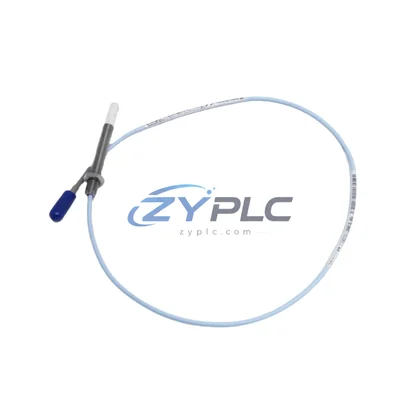
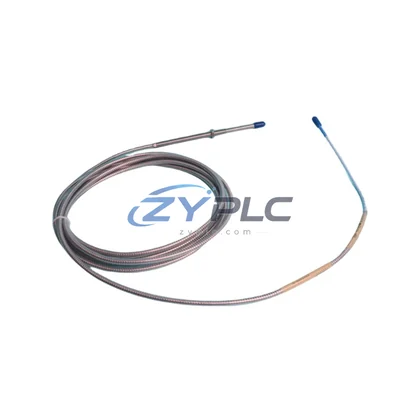
The Bently Nevada 21000-16-05-00-043-04-02 is a precision-engineered proximity probe housing assembly designed for the Bently Nevada 3300 Series vibration monitoring platform. In modern industrial facilities where downtime and excessive operating load directly erode profitability, this component plays a critical role in maintaining continuous, accurate machinery health data — enabling plant engineers to make real-time decisions that reduce downtime, extend equipment life, and optimize production line throughput.
Unlike generic replacement housings, the 21000-16-05-00-043-04-02 is engineered to exact OEM tolerances, ensuring that the eddy-current sensing gap between the probe tip and rotating shaft remains consistent across all operating conditions. This dimensional accuracy is not merely a mechanical concern — it directly affects the quality of vibration signal data fed into the Bently Nevada 3300/16 Proximitor® Monitor, which in turn governs trip thresholds, alarm setpoints, and maintenance-focused load balancing decisions across rotating machinery.
Every unit shipped from ZYPLC undergoes full functional testing and is Warranty terms are confirmed during quotation.
Product Specification Table
| Parameter |
Specification / Value |
| SKU / Part Number |
21000-16-05-00-043-04-02 |
| Brand |
Bently Nevada |
| Series |
3300 Series |
| Product Category |
Proximity Probe Housing Assembly |
| Compatible Monitor |
Bently Nevada 3300/16 Proximitor® Monitor |
| Sensing Technology |
Eddy-Current Non-Contact Displacement |
| Operating Environment |
Industrial Rotating Machinery, Turbines, Compressors, Pumps |
| Signal Output Efficiency |
High-linearity analog output, minimizes signal conditioning overhead |
| Maintenance Value |
Enables predictive maintenance, reduces unplanned downtime energy spikes |
| Availability |
Confirmed via RFQ before quotation |
| Testing |
Full functional test prior to shipment |
| Warranty |
Warranty and support terms confirmed before quote |
| Origin |
USA |
System Compatibility and Application
The 21000-16-05-00-043-04-02 probe housing does not operate in isolation — it is a foundational sensing element within a broader industrial automation system. When correctly installed and calibrated within the Bently Nevada 3300 Series framework, it enables a cascade of efficiency improvements across the entire control and monitoring stack.
At the sensing layer, the probe housing positions the Bently Nevada 330101 proximity probe with micron-level precision relative to the shaft surface. The resulting displacement signal is transmitted via a matched extension cable to the Bently Nevada 330130 Proximitor® Sensor, which converts the raw eddy-current response into a calibrated DC voltage proportional to shaft gap. This signal is then ingested by the Bently Nevada 3300/16 monitor card housed within a 3500 Series rack, where it is processed against configurable alarm and trip thresholds.
From an maintenance planning perspective, the accuracy of this signal chain determines how aggressively plant operators can push rotating equipment toward its efficiency envelope. A degraded or misaligned probe housing introduces measurement uncertainty, forcing conservative operating margins that translate directly into higher operating load per unit of output. By maintaining OEM-spec housing geometry, the 21000-16-05-00-043-04-02 preserves the full dynamic range of the sensing system, allowing the Bently Nevada System 1® software to accurately trend shaft centerline migration, oil whirl, and unbalance — all of which are leading indicators of impending mechanical inefficiency.
In drive-intensive applications, the vibration data collected through this probe housing is often integrated with variable frequency drive (VFD) control loops. When the System 1® platform detects rising vibration amplitudes correlated with specific speed ranges, it can signal the plant DCS or a Rockwell Automation PowerFlex 755 VFD to adjust motor speed, avoiding resonance zones that consume disproportionate electrical energy. Similarly, integration with a Siemens SIMATIC S7-1500 PLC via PROFIBUS or PROFINET allows automated load shedding responses when vibration-based health indices fall below acceptable thresholds.
For facilities running GE Bently Nevada Trendmaster 2000 distributed monitoring systems alongside the 3300 Series, the probe housing’s compatibility with standard 8mm probe configurations ensures seamless data continuity across monitoring nodes. Power quality at the monitoring rack level is typically managed through a Bently Nevada 3500/15 Power Supply module, which conditions incoming plant power to protect sensitive signal processing electronics from voltage transients that could corrupt vibration readings and trigger false trips — each of which carries a measurable energy cost in terms of unnecessary restart cycles.
At the I/O integration layer, relay outputs from the 3300/16 monitor connect to plant safety systems and Bently Nevada 3500/32 4-Channel Relay module configurations, enabling automated machinery protection responses that prevent catastrophic failures — the single largest source of unplanned downtime in rotating equipment operations.
Maintenance and Replacement Notes
In petrochemical, power generation, and heavy manufacturing environments, rotating machinery — compressors, turbines, pumps, and fans — accounts for the majority of facility electrical consumption. The efficiency of these machines is not static; it degrades progressively as mechanical wear, misalignment, and imbalance develop. The challenge for plant energy managers is detecting this degradation early enough to intervene before it manifests as either a catastrophic failure or a sustained period of below-optimum efficiency.
The Bently Nevada 21000-16-05-00-043-04-02 probe housing is the physical interface through which this early detection capability is maintained. A housing that has been mechanically damaged, thermally distorted, or incorrectly replaced with a non-OEM substitute introduces probe gap errors that corrupt the baseline vibration signature. When the baseline is corrupted, trend analysis loses its predictive value — and the plant reverts to time-based maintenance schedules that are inherently wasteful, replacing components before they are worn and missing failures that develop between scheduled intervals.
By contrast, a correctly installed 21000-16-05-00-043-04-02 housing maintains the probe gap within the linear range of the eddy-current sensor, typically 0.25 mm to 2.25 mm for standard 8mm probes. Within this range, the Proximitor® sensor delivers a linear output of approximately -7.87 V/mm, providing the resolution needed to detect sub-millimeter changes in shaft position that precede bearing failures, seal degradation, and rotor-stator rub events — all of which cause measurable increases in motor current draw and operating load before they cause physical damage.
From a production line rhythm perspective, unplanned machinery trips are far more costly than the energy consumed during normal operation. Each emergency shutdown triggers a restart sequence that draws 3–7 times normal running current, disrupts upstream and downstream process flows, and requires manual inspection before restart authorization. Plants that have implemented rigorous proximity probe maintenance programs — including timely replacement of housings like the 21000-16-05-00-043-04-02 — consistently report Actual operating results depend on the installed system, load profile, and commissioning parameters.
ZYPLC maintains ready inventory of the 21000-16-05-00-043-04-02 to support both planned maintenance outages and emergency replacement scenarios. All units are tested prior to shipment and covered by a warranty and support terms confirmed before quote, ensuring that your maintenance investment delivers reliable performance from installation through the next scheduled inspection interval.
Product Sourcing FAQ
Q1: How does replacing the probe housing improve energy efficiency?
A worn or damaged probe housing shifts the eddy-current probe out of its optimal sensing gap, degrading signal linearity. This forces the monitoring system to apply wider alarm margins, which in turn allows machinery to operate in inefficient mechanical states longer before triggering protective action. A new 21000-16-05-00-043-04-02 housing restores measurement accuracy, enabling tighter control margins and earlier intervention — reducing the duration of energy-inefficient operation.
Q2: Is the 21000-16-05-00-043-04-02 compatible with both 3300 and 3500 Series Bently Nevada systems?
The 21000-16-05-00-043-04-02 housing is designed for the 3300 Series platform and is compatible with standard 8mm proximity probe configurations used across Bently Nevada monitoring systems. For 3500 Series rack installations, verify probe cable length and connector compatibility with your system integrator before installation.
Q3: What is the recommended replacement interval, and how does ZYPLC support planned maintenance?
Bently Nevada recommends inspecting probe housings during each major machinery overhaul, typically every 2–4 years depending on operating environment severity. ZYPLC maintains stock of the 21000-16-05-00-043-04-02 for RFQ-based sourcing, supporting both scheduled outage windows and emergency replacement needs. Contact our team at plc.sales@zyplc.com or +86 19859288691 to confirm availability and lead time.
Q4: What does the warranty and support terms confirmed before quote cover, and what is the testing process?
Every 21000-16-05-00-043-04-02 unit shipped by ZYPLC undergoes functional testing to verify dimensional integrity and compatibility with standard Bently Nevada probe and extension cable assemblies. The warranty and support terms confirmed before quote covers defects in materials and workmanship under normal industrial operating conditions. Units that fail to perform to specification within the warranty period are replaced at no charge, subject to inspection.