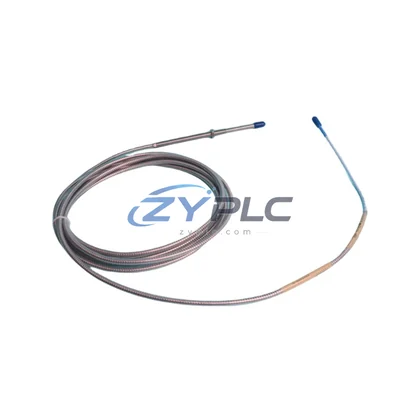
Bently Nevada 21000-16-05-00-064-04-02 Proximity Probe Housing for 21000 Series
The Bently Nevada 21000-16-05-00-064-04-02 is a precision-engineered proximity probe housing assembly designed to serve as a critical sensing node within the Bently Nevada 21000 Series vibration monitoring architecture. In modern industrial automation and machinery protection systems, the integrity of the measurement chain begins at the physical interface between the rotating machine and the monitoring electronics. This housing assembly ensures that the eddy-current proximity probe is mechanically secured, environmentally protected, and electrically isolated in a manner fully consistent with the signal conditioning and data acquisition requirements of the broader 21000 Series platform.
Unlike standalone sensor components, the 21000-16-05-00-064-04-02 is engineered for system integration — meaning its dimensional tolerances, thread specifications, and material properties are optimized to work in concert with the full 21000 Series signal chain, from the probe tip through the extension cable, proximitor module, and ultimately into the rack-mounted monitoring system. This contextual design philosophy reduces installation variability, minimizes signal noise at the source, and ensures that the vibration data delivered to the control layer is accurate, repeatable, and traceable across the full operating lifecycle of the machine.
In layered automation architectures, the proximity probe housing occupies the lowest tier of the sensing hierarchy — the field instrumentation layer — yet its influence propagates upward through every subsequent layer. A poorly installed or mechanically compromised housing introduces gap voltage errors that corrupt the displacement waveform, leading to false alarms or, more critically, missed fault conditions at the machinery protection layer. The 21000-16-05-00-064-04-02 eliminates this risk by providing a rigid, repeatable mounting interface that maintains the probe-to-target gap within the linear range of the eddy-current measurement system under all specified operating conditions.
Product Specification Table
| Parameter |
Specification |
| System Role |
Field Instrumentation — Proximity Probe Mechanical Interface |
| Compatible Series |
Bently Nevada 21000 Series Vibration Monitoring System |
| Part Number |
21000-16-05-00-064-04-02 |
| Assembly Type |
Proximity Probe Housing Assembly |
| Probe Compatibility |
Bently Nevada 21000 Series Eddy-Current Proximity Probes |
| Thread Specification |
Per Bently Nevada 21000 Series mechanical interface standard |
| Material |
Stainless steel / corrosion-resistant alloy (series standard) |
| Environmental Rating |
Suitable for industrial machinery environments; oil mist, vibration, and temperature resistant |
| Electrical Isolation |
Maintains probe-to-housing electrical isolation per 21000 Series requirements |
| Communication Layer |
Passive mechanical component; interfaces with proximitor signal conditioning module |
| Installation Environment |
Rotating machinery bearing housings, turbines, compressors, pumps, motors |
| Warranty |
Warranty and support terms confirmed before quote |
System Compatibility Notes
The 21000-16-05-00-064-04-02 housing assembly does not operate in isolation. Its value is fully realized only when considered as part of a coordinated machinery protection and condition monitoring architecture. In a typical turbomachinery protection system built on the Bently Nevada 21000 Series platform, the probe housing interfaces directly with the Bently Nevada 21000 Series proximity probe — the active sensing element whose gap voltage output is the primary measurement signal. The probe is connected via a Bently Nevada 21000 Series extension cable, which routes the high-frequency signal from the machine casing to the Bently Nevada 3300 XL proximitor module or equivalent 21000 Series signal conditioner mounted in the instrument enclosure.
At the rack level, the conditioned displacement signal is received by the Bently Nevada 3500 Series rack-mounted monitoring system, which provides the computational and relay output infrastructure for machinery protection. The 3500 rack accepts inputs from multiple proximitor channels simultaneously, enabling the system to monitor radial vibration, axial position, differential expansion, and eccentricity across multiple measurement planes on a single machine train. The rack communicates with the plant DCS or safety instrumented system via Modbus TCP, PROFIBUS, or OPC-UA communication modules installed within the 3500 chassis, ensuring that vibration data is available at the control layer for integration with process variables such as bearing temperature, lube oil pressure, and shaft speed.
For redundant machinery protection architectures — common in critical rotating equipment such as steam turbines, gas compressors, and boiler feed pumps — dual-probe configurations are employed at each measurement plane. In these installations, two 21000-16-05-00-064-04-02 housings are mounted 90 degrees apart on the bearing housing, each carrying an independent proximity probe. The dual-channel inputs are processed by redundant Bently Nevada 3500/42M position monitor or 3500/40M proximitor I/O module cards within the protection rack, providing voting logic that prevents spurious trips while maintaining sensitivity to genuine fault conditions.
The instrument enclosure housing the 3500 rack is typically powered by a Bently Nevada 3500/15 power supply module, which provides regulated DC power to all rack-mounted cards and supports hot-swap replacement without interrupting monitoring continuity. For installations requiring uninterrupted protection during power grid disturbances, the rack power supply is backed by a dedicated UPS system integrated into the control cabinet power distribution layer. The overall system architecture — from the 21000-16-05-00-064-04-02 probe housing at the machine surface through the proximitor, extension cable, rack monitor, and DCS integration — represents a fully coordinated signal chain in which each component’s performance specification is matched to the requirements of the adjacent layer.
Industrial Application Notes
The 21000-16-05-00-064-04-02 proximity probe housing assembly finds application across a broad range of heavy industrial sectors where rotating machinery protection is a regulatory and operational imperative.
In power generation facilities — including coal-fired, gas turbine, and combined-cycle plants — the 21000 Series monitoring architecture is deployed on steam turbines, gas turbines, and generator sets. The probe housing is installed at each radial and thrust bearing measurement point, providing the mechanical foundation for continuous shaft displacement monitoring. Turbine protection systems in this sector are typically integrated with the plant DCS via hardwired relay outputs for trip and alarm functions, supplemented by digital communication links for condition monitoring data trending.
In petrochemical and refinery applications, the 21000-16-05-00-064-04-02 is used on centrifugal compressors, expanders, and large process pumps operating in hazardous area classifications. The housing assembly’s material and sealing properties are selected to withstand hydrocarbon atmospheres, high ambient temperatures, and the mechanical vibration levels characteristic of high-speed rotating equipment in these environments. The monitoring system integrates with the plant safety instrumented system (SIS) to provide automatic shutdown on high-high vibration exceedance.
In mining and mineral processing operations, large grinding mills, crushers, and conveyor drive systems benefit from continuous vibration monitoring using the 21000 Series platform. The rugged construction of the probe housing ensures reliable operation in the high-dust, high-vibration environments typical of these facilities, where downtime carries significant production cost penalties.
In water and wastewater treatment plants, the 21000 Series monitoring system is applied to large vertical turbine pumps and blower units, where bearing condition monitoring supports predictive maintenance programs and reduces the risk of catastrophic pump failure in critical service applications.
Product Compatibility FAQ
Q1: Is the 21000-16-05-00-064-04-02 housing compatible with all Bently Nevada 21000 Series proximity probes, or only specific configurations?
The 21000-16-05-00-064-04-02 housing assembly is designed within the Bently Nevada 21000 Series mechanical interface standard, which defines thread form, probe body diameter, and housing bore geometry. It is compatible with the range of 21000 Series proximity probes that share the same mechanical interface specification. When integrating this housing into an existing installation, engineers should verify the probe body diameter and thread specification against the housing datasheet to confirm dimensional compatibility. For new system designs, specifying the complete probe-housing-extension cable assembly from the 21000 Series catalog ensures full mechanical and electrical compatibility across the signal chain.
Q2: How does the probe housing affect the overall gap voltage calibration of the 21000 Series measurement system, and what steps are required during commissioning?
The probe housing establishes the physical reference plane from which the probe tip-to-target gap is measured. During commissioning, the gap voltage is set by adjusting the probe position within the housing until the proximitor output voltage falls within the linear measurement range specified for the 21000 Series system — typically the midpoint of the proximitor’s output range, corresponding to the nominal gap distance. The housing’s thread pitch determines the gap adjustment resolution per turn of the probe body. After gap setting, the probe locknut is torqued to the specified value to prevent gap drift under operating vibration levels. The Warranty and support terms confirmed before quote covers manufacturing defects in the housing that could affect gap stability or probe retention.
Q3: What long-term maintenance considerations apply to the 21000-16-05-00-064-04-02 housing in continuous service applications, and how does the Warranty and support terms confirmed before quote support maintenance planning?
In continuous service applications, the primary long-term maintenance consideration for the probe housing is thread condition and probe retention integrity. Periodic inspection during planned outages should verify that the probe locknut torque is maintained and that the housing bore shows no signs of corrosion or mechanical damage that could affect probe alignment. The housing should be replaced if thread wear exceeds the manufacturer’s tolerance or if physical damage is observed. The Warranty and support terms confirmed before quote provided with each 21000-16-05-00-064-04-02 unit covers manufacturing defects and supports maintenance planning by ensuring that replacement units supplied within the warranty period meet the original dimensional and material specifications, maintaining system calibration continuity without requiring full recommissioning of the measurement chain.