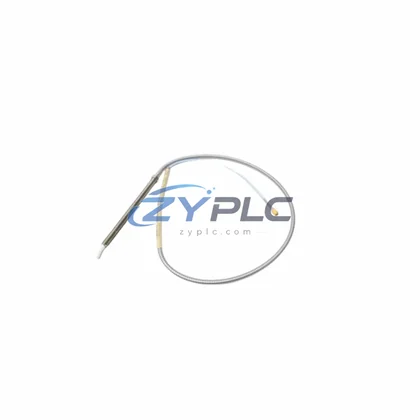
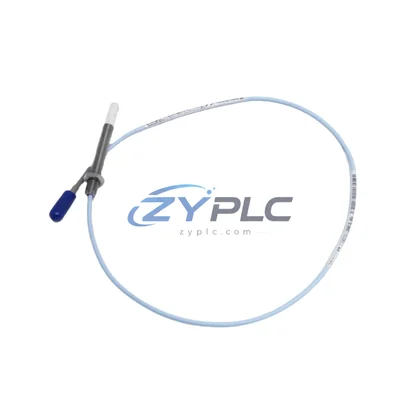
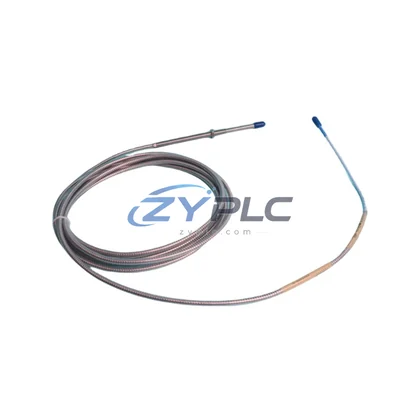
Bently Nevada 21000-16-05-40-049-04-02 Proximity Probe Housing for 21000 Series
The Bently Nevada 21000-16-05-40-049-04-02 is a precision-engineered proximity probe housing assembly designed to serve as a critical sensing node within the Bently Nevada 21000 Series vibration monitoring and machinery protection architecture. In modern industrial control environments — spanning rotating machinery protection, turbine supervisory instrumentation, compressor train monitoring, and critical asset management — the physical integrity and dimensional accuracy of the probe housing directly determines the quality of the eddy-current signal chain from the machine shaft to the monitoring system. This component is not merely a mechanical enclosure; it is a system-compatible interface element that ensures consistent gap calibration, signal linearity, and long-term installation stability across the full 21000 Series platform.
Within a layered automation architecture, the 21000-16-05-40-049-04-02 housing occupies the field sensing layer, working in close coordination with the proximitor/extension cable assembly, the 3300 XL or 3500 Series rack-mounted monitor modules, the I/O termination boards, and the plant-level DCS or safety instrumented system (SIS). The housing’s dimensional tolerances are matched to the 21000 Series probe tip geometry, ensuring that the installed gap — typically 1.0 mm to 2.0 mm for standard eddy-current probes — remains within the linear range of the proximitor output, which feeds a 4–20 mA or ±24 VDC analog signal to the monitor card. Any deviation in housing geometry or thread engagement directly propagates as a calibration offset into the control loop, making the selection of the correct, system-matched housing assembly essential for architecture integrity.
From a system architecture perspective, the probe housing interfaces with multiple upstream and downstream components. On the field side, it accepts the 21000 Series proximity probe body, which is typically paired with a 330130 or 330180 extension cable and a 3300 XL 8mm proximitor. On the monitor side, the signal is received by a 3500/40M or 3500/42M proximitor I/O module housed within the 3500 Series rack, which provides relay outputs to the turbine control system or emergency shutdown device (ESD). The housing’s stainless steel construction and NPT or metric thread options allow direct integration into bearing housing bosses, seal housings, or custom probe brackets, maintaining the mechanical reference plane required for accurate radial vibration, axial position, or differential expansion measurement.
In redundant architecture designs — common in power generation, petrochemical, and LNG processing facilities — dual-probe configurations are standard. The 21000-16-05-40-049-04-02 housing supports side-by-side installation of two probes at 90-degree orientation, feeding independent channels of a 3500/40M dual-channel monitor. This redundancy eliminates single-point failure at the sensing layer and satisfies SIL 2 or SIL 3 functional safety requirements when combined with a voted logic solver. The housing’s thread-lock and lock-nut design prevents probe migration under vibration, ensuring that the installed gap remains stable over extended operating cycles without requiring frequent field recalibration.
For engineering teams managing multi-train installations — such as gas turbine generator sets, centrifugal compressor strings, or steam turbine-driven pumps — standardizing on the 21000-16-05-40-049-04-02 housing across all measurement points simplifies spare parts inventory, reduces installation training requirements, and ensures that field technicians can perform probe replacement or gap adjustment using a single, familiar procedure. This standardization also supports predictive maintenance programs by eliminating housing-related variables from vibration trend analysis, allowing condition monitoring engineers to attribute signal changes to actual machine behavior rather than installation inconsistencies.
The housing is compatible with the full range of 21000 Series probe configurations, including the 21000-16-05-40 standard probe body and associated extension cable assemblies. It is also cross-compatible with installation environments designed for the 3300 Series and 7200 Series probe systems when adapter fittings are used, providing flexibility for facilities that operate mixed-generation Bently Nevada monitoring platforms. Integration with the System 1 Evolution software platform is achieved through the monitor rack, with the housing contributing to the overall measurement chain accuracy that System 1 uses for alarm management, trend logging, and machinery diagnostics.
All units supplied by ZYPLC are covered by a warranty terms confirmed during quotation and undergo functional verification prior to shipment. Each housing assembly is inspected for thread integrity, dimensional conformance, and surface finish to ensure drop-in compatibility with existing 21000 Series installations. ZYPLC maintains ready stock of the 21000-16-05-40-049-04-02 to support urgent maintenance requirements, planned turnaround outages, and capital project procurement schedules across global industrial facilities.
Product Specification Table
| Parameter |
Specification |
| Part Number |
21000-16-05-40-049-04-02 |
| Brand |
Bently Nevada |
| Series |
21000 Series |
| System Role |
Proximity Probe Housing Assembly — Field Sensing Layer |
| Compatible Probe |
21000 Series Proximity Probe (eddy-current type) |
| Compatible Monitor |
3500/40M, 3500/42M, 3300 XL Series Monitor Modules |
| Signal Type |
Eddy-Current / Inductive, feeds ±24 VDC or 4–20 mA proximitor output |
| Thread Configuration |
NPT / Metric (per installation variant) |
| Material |
Stainless Steel |
| Installation Environment |
Bearing housing, seal housing, custom probe bracket; industrial plant environments |
| Operating Temperature |
–50°C to +120°C (typical for 21000 Series field components) |
| Redundancy Support |
Dual-probe 90° configuration for SIL 2/3 redundant architectures |
| Communication Path |
Analog signal via extension cable to proximitor, then to 3500 Series rack I/O |
| Warranty |
warranty terms confirmed during quotation (ZYPLC) |
| Origin |
United States |
System Compatibility Notes
The 21000-16-05-40-049-04-02 housing functions as the mechanical anchor of the eddy-current measurement chain within a coordinated Bently Nevada control system architecture. Its role becomes fully apparent when viewed alongside the complete set of components that constitute a machinery protection loop. The 21000 Series proximity probe body threads into the housing and establishes the sensing face-to-shaft gap. The probe connects via a 330130-090-00-05 extension cable to a 3300 XL 8mm proximitor, which conditions the raw inductance change into a calibrated voltage signal. This signal is routed to a 3500/40M proximitor I/O module installed in a 3500 Series monitoring rack, where it is processed against alarm setpoints configured in the rack’s non-volatile memory.
The 3500 rack communicates machine health data to the plant DCS — typically a Honeywell Experion PKS or ABB System 800xA — via Modbus TCP or OPC DA/UA, enabling operators to view real-time vibration trends alongside process variables such as bearing temperature, lube oil pressure, and shaft speed. In facilities using System 1 Evolution software, the rack data is aggregated into a centralized machinery diagnostics platform, where the 21000-16-05-40-049-04-02 measurement point contributes to multi-channel orbit plots, Bode diagrams, and waterfall spectra used for predictive maintenance decisions.
For power and ESD integration, the 3500 rack relay outputs connect to a Triconex Tricon or Rockwell Automation GuardLogix safety PLC, which executes the trip logic for the turbine or compressor train. The 3500/15 power supply module within the rack provides redundant 24 VDC to all I/O modules, ensuring that a single power supply failure does not interrupt the protection function. At the field level, the housing’s lock-nut and thread-lock design works in conjunction with 3300 Series probe brackets and 21000 Series armored cable assemblies to maintain measurement integrity under the mechanical vibration, thermal cycling, and process fluid exposure typical of rotating machinery environments.
Industrial Application Notes
The 21000-16-05-40-049-04-02 proximity probe housing is deployed across a wide range of heavy industrial applications where continuous, high-reliability shaft vibration monitoring is a regulatory or operational requirement. In power generation facilities — including gas turbine combined-cycle plants, steam turbine generators, and hydro turbine units — the housing is installed at radial bearing measurement planes to provide the continuous vibration data required by API 670 machinery protection standards. The housing’s stainless steel construction withstands the high-temperature, high-humidity environments adjacent to turbine casings and bearing pedestals.
In petrochemical and refinery applications, the housing is used on centrifugal compressors, reactor charge pumps, and main air blowers, where unplanned shutdowns carry significant safety and financial consequences. The dual-probe redundancy capability of the housing supports the voted 2oo3 or 1oo2D protection architectures required by IEC 61511 for safety instrumented functions in hazardous areas. In LNG liquefaction trains, the housing is installed on main refrigerant compressors and expander-compressor units, where the combination of cryogenic process temperatures and high shaft speeds demands the highest level of measurement chain integrity.
For water and wastewater treatment facilities operating large vertical turbine pumps or centrifugal blowers, the housing provides a cost-effective means of implementing continuous vibration monitoring without the complexity of full machinery protection systems. In mining and mineral processing environments — including SAG mill drives, ball mill pinion bearings, and slurry pump trains — the housing’s robust construction and compatibility with the 3500 Series monitor enables integration of vibration data into the plant SCADA system for condition-based maintenance scheduling. In steel and metals processing, the housing is used on rolling mill main drives and continuous caster withdrawal units, where bearing condition directly affects product quality and production continuity.
Product Compatibility FAQ
Q1: Is the 21000-16-05-40-049-04-02 housing directly compatible with existing 3500 Series and 3300 XL Series monitor installations without additional adapters?
A: Yes. The 21000-16-05-40-049-04-02 housing is dimensionally matched to the 21000 Series probe body and is designed for direct installation into standard bearing housing bosses used with 3300 and 3500 Series monitoring systems. The housing thread and probe tip geometry maintain the gap calibration range required by the 3300 XL proximitor and 3500/40M I/O module. No signal conditioning adapters are required; the housing is a mechanical component that does not alter the electrical characteristics of the measurement chain. For installations transitioning from 7200 Series probes, a thread adapter may be required depending on the existing boss configuration.
Q2: How does standardizing on the 21000-16-05-40-049-04-02 housing across a multi-train facility improve long-term maintenance efficiency and reduce architecture risk?
A: Standardization on a single housing part number eliminates the risk of incorrect probe installation caused by housing geometry mismatches, which can introduce gap errors that are difficult to detect during routine inspection. It reduces the number of unique spare parts that must be stocked, simplifies technician training, and ensures that gap-setting procedures are consistent across all measurement points. In facilities using System 1 Evolution for fleet-wide machinery diagnostics, consistent hardware at the field sensing layer improves the reliability of cross-machine vibration comparisons and alarm threshold validation. ZYPLC’s warranty terms confirmed during quotation on all supplied units further reduces the financial risk associated with field component replacement programs.
Q3: What installation and commissioning steps are required to ensure the 21000-16-05-40-049-04-02 housing meets API 670 gap calibration requirements after replacement?
A: After installing the housing and threading in the replacement 21000 Series probe, the installed gap must be set using a calibrated gap-setting tool or a digital multimeter measuring the proximitor output voltage. For a standard 8mm eddy-current probe with a 3300 XL proximitor, the target gap is typically 1.0 mm (corresponding to approximately –10 VDC output), verified against the probe/proximitor calibration curve. The lock-nut must be torqued to the manufacturer’s specification to prevent probe migration. Following gap setting, the monitor channel should be verified against the alarm and danger setpoints configured in the 3500 rack, and a functional trip test should be performed to confirm the protection loop integrity before returning the machine to service. All ZYPLC-supplied housings include documentation supporting the commissioning record requirements of API 670 Section 9.