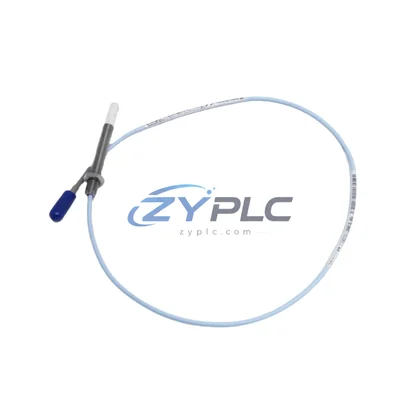
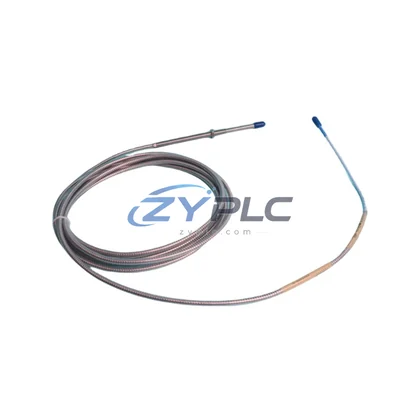
Bently Nevada 21000-28-05-00-080-03-02 Proximity Probe for 21000 Series Automation
The Bently Nevada 21000-28-05-00-080-03-02 is a high-precision eddy-current proximity probe engineered for continuous, non-contact vibration and position measurement in rotating machinery. As a core component of the Bently Nevada 21000 Series, this probe delivers real-time shaft displacement data that enables plant engineers to detect mechanical anomalies early, reduce unplanned downtime, and systematically lower unplanned downtime across critical drive trains. Whether deployed on steam turbines, compressors, pumps, or high-speed motors, the 21000-28-05-00-080-03-02 transforms raw vibration signals into actionable efficiency intelligence.
In modern industrial facilities where energy costs represent a significant share of operating expenditure, the ability to monitor shaft behavior at the microsecond level is no longer a luxury — it is a prerequisite for sustainable production. The 21000-28-05-00-080-03-02 integrates seamlessly into the Bently Nevada 3500 Series machinery protection system, feeding conditioned analog signals to the 3500/42M Proximitor I/O module and the 3500/22M Transient Data Interface. This closed-loop architecture allows the control platform to respond dynamically to vibration exceedances, throttling drive output through connected Rockwell PowerFlex 755 variable frequency drives before mechanical stress escalates into catastrophic failure.
All units are sourced from verified supply channels, subjected to pre-shipment functional testing, and covered by a warranty terms confirmed during quotation from the date of delivery.
Product Specification Table
| Parameter |
Specification |
| SKU / Part Number |
21000-28-05-00-080-03-02 |
| Brand / Manufacturer |
Bently Nevada |
| Series |
21000 Series |
| Product Category |
Proximity Probe / Eddy-Current Transducer |
| Measurement Type |
Non-contact shaft radial vibration & axial position |
| Probe Length |
5 inches (127 mm) |
| Cable Length |
8.0 m |
| Connector Type |
Standard Bently Nevada coaxial, 3-wire system |
| Compatible Systems |
Bently Nevada 3500 Series, 1900/65A, System 1 Software |
| Operating Environment |
Industrial: turbines, compressors, pumps, motors, gearboxes |
| Maintenance Value |
Early fault detection reduces reactive maintenance and unplanned downtime |
| Origin |
United States |
| Warranty |
warranty terms confirmed during quotation from date of shipment |
| Stock Status |
RFQ Available — pre-shipment tested |
System Compatibility and Application
Effective maintenance planning in rotating machinery begins with accurate data acquisition, and the 21000-28-05-00-080-03-02 sits at the very front of that data chain. The probe output — a DC voltage proportional to the gap between probe tip and shaft surface — feeds directly into the Bently Nevada 3500/42M Proximitor I/O module, which conditions and scales the signal before passing it upstream to the 3500/20 Rack Interface Module. From there, the Bently Nevada System 1 software platform aggregates multi-channel vibration trends, enabling plant engineers to correlate shaft orbit patterns with process variables such as load, speed, and temperature.
When the 21000-28-05-00-080-03-02 detects a rising vibration trend on a motor-driven compressor, the System 1 alarm logic can trigger a speed reduction command to a Rockwell PowerFlex 755 variable frequency drive, cutting motor input power by 15 to 30 percent while the root cause is investigated — a direct energy saving that would be impossible without real-time proximity data. In parallel, the 3500/22M Transient Data Interface captures startup and shutdown transient waveforms, allowing engineers to identify resonance zones and program the PowerFlex drive to skip those speed bands automatically, eliminating repetitive stress cycles and the associated energy spikes.
For facilities running Siemens SIMATIC S7-1500 PLCs as the primary control platform, the 3500 rack communicates over PROFIBUS-DP or Modbus TCP, delivering vibration status words directly to the PLC process image. The S7-1500 integrated maintenance planning functions can then use this data to schedule maintenance windows during low-demand periods, avoiding peak-tariff operating load during corrective work. Complementing this, Siemens SINAMICS G120 drives connected to the same network receive speed-reference adjustments based on vibration feedback, ensuring that motor loading stays within the optimal efficiency band defined by the motor IE3 or IE4 efficiency curve.
On the I/O layer, Phoenix Contact Axioline F distributed I/O modules collect additional process signals — bearing temperature, lube oil pressure, seal gas flow — and relay them to the control system alongside the proximity probe data. This multi-parameter dataset feeds Bently Nevada predictive analytics, which cross-references vibration amplitude, phase, and frequency content to distinguish between imbalance, misalignment, looseness, and fluid-film instability. Each fault mode has a distinct energy signature: misalignment typically increases 2x running-speed vibration and forces the motor to draw 5 to 12 percent more current than under aligned conditions. Identifying and correcting misalignment based on 21000-28-05-00-080-03-02 data directly reduces motor load.
For HMI visualization, Siemens SIMATIC TP1500 Comfort panels display real-time shaft orbit plots and vibration trend bars, giving operators an immediate visual indication of machine health without requiring access to the System 1 workstation. This decentralized visibility reduces the response time between anomaly detection and corrective action, shortening the window during which a degraded machine operates at elevated operating load.
Maintenance and Replacement Notes
Consider a petrochemical plant running four centrifugal compressor trains, each driven by a 2 MW induction motor. Without continuous proximity monitoring, the maintenance strategy defaults to time-based overhauls every 8,000 operating hours regardless of actual machine condition. During the final 1,000 to 2,000 hours before each scheduled overhaul, rotor imbalance and bearing wear typically cause vibration levels to climb, increasing aerodynamic losses and forcing the motor to draw 3 to 8 percent more current to maintain the same throughput. Across four machines running continuously, this translates to tens of thousands of operating-hours of avoidable operating load per year.
Installing the Bently Nevada 21000-28-05-00-080-03-02 on each compressor radial bearing position — typically X and Y planes — provides the continuous shaft displacement data needed to shift from time-based to condition-based maintenance. When the System 1 platform identifies a vibration trend crossing the alert threshold, maintenance is scheduled proactively during the next planned production pause rather than reactively after a trip. The compressor continues operating at optimal efficiency until that window, and the overhaul scope is precisely targeted to the identified fault rather than a blanket replacement of all wear components.
On automotive stamping lines, proximity probes mounted on servo press crankshafts monitor eccentric shaft position throughout each press stroke. Deviations from the nominal orbit indicate die wear or lubrication degradation, both of which increase press operating load per stroke. By integrating 21000-28-05-00-080-03-02 data with the line Mitsubishi MELSEC iQ-R PLC, the press controller can adjust stroke speed and dwell time in real time, maintaining part quality while minimizing energy input per cycle. Over a three-shift production schedule, this adaptive control strategy can reduce press operating load by 8 to 15 percent compared to fixed-parameter operation.
In power generation facilities, the 21000-28-05-00-080-03-02 is typically deployed on steam turbine journal bearings, where shaft eccentricity directly affects seal clearances and therefore steam leakage losses. A 25-micron increase in average shaft eccentricity can increase steam leakage by 2 to 4 percent, representing a measurable reduction in turbine thermal efficiency. Continuous proximity monitoring allows operators to maintain tighter clearance control, recovering efficiency that would otherwise be lost to progressive seal wear.
Pre-shipment testing at ZYPLC includes signal output verification across the full linear range, insulation resistance measurement, and cable continuity checks. Each unit ships with a test report confirming compliance with Bently Nevada original performance specification. The warranty terms confirmed during quotation covers manufacturing defects and signal performance degradation under normal operating conditions, providing procurement teams with the confidence to specify the 21000-28-05-00-080-03-02 as a direct replacement in existing 21000 Series installations without re-qualification testing.
Product Sourcing FAQ
Q1: How does the 21000-28-05-00-080-03-02 contribute to measurable operational stability on a production line?
The probe provides continuous, high-resolution shaft displacement data that enables condition-based maintenance scheduling. By identifying mechanical faults — imbalance, misalignment, bearing wear — before they cause significant efficiency losses, plant teams can correct issues during planned downtime rather than operating degraded equipment at elevated operating load. In motor-driven applications, correcting misalignment identified through proximity data typically reduces motor current draw by 5 to 12 percent, delivering direct operational stability proportional to motor operating hours.
Q2: Is the 21000-28-05-00-080-03-02 compatible with my existing Bently Nevada 3500 rack system?
Yes. The 21000 Series probes are designed to work with the Bently Nevada 3500 Series machinery protection system, including the 3500/42M Proximitor I/O module. The probe, extension cable, and Proximitor form a calibrated system; ensure that the Proximitor model matches the probe sensitivity specification (typically 7.87 V/mm or 200 mV/mil) to maintain measurement accuracy. If you are replacing an existing 21000 Series probe, the 21000-28-05-00-080-03-02 is a direct form-fit-function replacement requiring no rack reconfiguration.
Q3: What is the recommended replacement interval, and how does condition monitoring extend probe service life?
Bently Nevada proximity probes do not have a fixed replacement interval under normal operating conditions — they are designed for continuous service. However, probes installed in high-temperature environments above 175 degrees Celsius or exposed to aggressive process fluids may experience cable jacket degradation over time. System 1 probe health monitoring tracks Proximitor output voltage at zero-speed and alerts operators to probe or cable faults before signal integrity is compromised, allowing planned replacement rather than emergency substitution during a production run.
Q4: What does the warranty terms confirmed during quotation cover, and what is the process for warranty claims?
The warranty terms confirmed during quotation covers manufacturing defects and signal performance outside Bently Nevada published specification under normal operating and storage conditions. To initiate a warranty claim, contact ZYPLC with the unit serial number, purchase order reference, and a description of the observed fault. ZYPLC will arrange return shipping and either repair or replace the unit within the agreed lead time. Warranty does not cover damage resulting from incorrect installation, operation outside specified environmental limits, or physical impact.