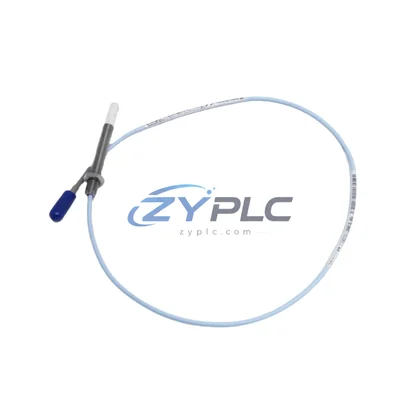
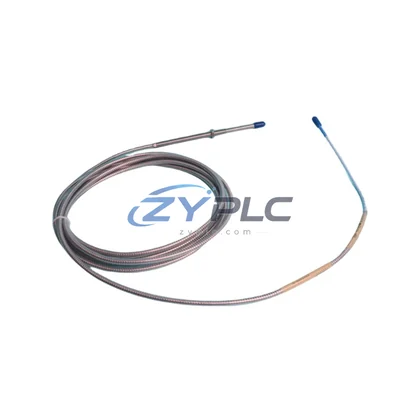
Bently Nevada 31000-00-00-00-082-03-02: Industrial Data Link for 3300 Series Condition Monitoring Systems
The Bently Nevada 31000-00-00-00-082-03-02 is a precision-engineered Proximity Probe Housing Assembly designed for the 3300 Series continuous vibration monitoring platform. In modern smart factory environments, reliable signal acquisition at the machine level is the foundation of every data-driven maintenance strategy. This housing assembly provides the mechanical and electrical interface that connects eddy-current proximity probes directly to the 3300 Series monitor rack, ensuring low-noise, high-integrity signal transmission from rotating machinery to the plant’s condition monitoring network.
From the moment a shaft begins to rotate, the 31000-00-00-00-082-03-02 captures displacement signals with micron-level precision. These raw analog signals travel through the probe cable into the 3300 Series proximitor/driver module, where they are conditioned and converted into standardized voltage outputs. The conditioned data then feeds into the 3300 Series monitor cards — such as the 3300/16 Dual Voting or 3300/20 Radial Vibration Monitor — which apply alarm logic, gap voltage checks, and direct/gap/1X/2X vector analysis before forwarding structured data upstream to the plant DCS or SCADA layer.
Within a fully integrated condition monitoring architecture, the 3300 Series rack communicates with supervisory systems via the Bently Nevada System 1 software platform, enabling real-time trending, spectrum analysis, and predictive maintenance scheduling. The 31000-00-00-00-082-03-02 sits at the very origin of this data chain — without a correctly specified and properly installed probe housing, the entire signal path from machine to control room is compromised.
Compatibility & Integration Notes
| Parameter |
Specification |
| Product SKU |
31000-00-00-00-082-03-02 |
| Brand |
Bently Nevada |
| Series |
3300 Series |
| Product Type |
Proximity Probe Housing Assembly |
| Sensing Technology |
Eddy-Current (Non-Contact) |
| Signal Output |
Analog DC Voltage (–24 VDC system) |
| Compatible Monitor Modules |
3300/16, 3300/20, 3300/25, 3300/46, 3300/55 |
| System Integration |
Bently Nevada System 1, DCS, SCADA, HMI |
| Communication Protocol |
Analog signal → Modbus RTU / TCP, OPC-UA (via System 1 gateway) |
| Network Compatibility |
Ethernet/IP, Modbus TCP, OPC-UA, 4–20 mA loop |
| Industrial Application |
Rotating Machinery, Turbines, Compressors, Pumps, Motors |
| Warranty |
12 Months |
| Availability |
Verified Availability by RFQ |
| Origin |
USA |
Connected Automation Data Flow
The 31000-00-00-00-082-03-02 operates as the first node in a layered industrial data architecture. At the field level, the proximity probe — typically an 8mm or 5mm eddy-current tip from the Bently Nevada 3300 XL probe series — is threaded into the housing and locked at the correct gap distance from the shaft surface. The housing assembly provides mechanical protection, precise positioning, and electrical continuity between the probe tip and the armored extension cable.
The signal travels through the Bently Nevada 3300 XL 8mm Extension Cable to the 3300 XL Proximitor Sensor, which supplies the –24 VDC excitation voltage and outputs a conditioned DC voltage proportional to the gap between probe tip and shaft. This output connects to the 3300/20 Radial Vibration Monitor or 3300/16 Dual Voting Monitor card seated in the 3300 Series rack. The monitor card performs real-time signal processing — computing direct (overall) vibration amplitude, 1X and 2X vector components, and gap voltage — and compares these values against user-configured alert and danger setpoints.
When alarm thresholds are crossed, the 3300 Series rack activates relay outputs that can trip the machine or trigger a DCS interlock via hardwired I/O. Simultaneously, the Bently Nevada System 1 software — running on a plant historian server connected via Ethernet — receives continuous waveform and trend data from the rack through the 3300/95 Communication Gateway or a dedicated Modbus TCP interface. System 1 archives this data, generates alarm notifications, and presents real-time orbit plots, trend charts, and spectrum waterfalls to the plant engineer at the HMI workstation.
For plants running a broader automation architecture, the System 1 OPC-UA server publishes vibration tags directly to the plant SCADA platform — such as Wonderware, iFIX, or Ignition — where they appear alongside process variables from the DCS, flow transmitters, temperature sensors, and variable frequency drives (VFDs) controlling the driven equipment. This unified data view allows operators to correlate mechanical vibration events with process upsets, load changes, or electrical anomalies in real time.
In multi-machine installations, multiple 3300 Series racks — each populated with 3300/20 radial vibration monitors, 3300/25 axial position monitors, and 3300/46 temperature monitors — are networked together through the plant Ethernet backbone. The 31000-00-00-00-082-03-02 housing assemblies deployed across these machines ensure consistent signal quality at every measurement point, giving the condition monitoring system the reliable field data it needs to support predictive maintenance decisions across the entire rotating equipment fleet.
Solving Data Isolation in Industrial Sites
One of the most persistent challenges in industrial condition monitoring is data isolation — the gap between what the machine is doing and what the control room can see. Legacy installations often rely on periodic manual checks with handheld vibration analyzers, leaving long windows of undetected deterioration between inspections. The Bently Nevada 3300 Series platform, anchored by precision components like the 31000-00-00-00-082-03-02 housing assembly, eliminates this blind spot by providing continuous, online vibration monitoring with direct integration into plant-wide SCADA and DCS systems.
Protocol fragmentation is another common barrier. Older vibration monitoring systems output only hardwired relay contacts or 4–20 mA analog signals, making it difficult to bring rich waveform data into modern digital control systems. The 3300 Series addresses this through the 3300/95 Communication Gateway, which translates the rack’s internal data into Modbus RTU, Modbus TCP, and OPC-UA formats — enabling seamless integration with any modern DCS, SCADA, or MES platform without custom engineering.
Remote diagnostics capability is increasingly critical for plants operating with reduced on-site staffing. With System 1 connected to the 3300 Series rack via Ethernet, maintenance engineers can access full waveform data, alarm histories, and machine trend plots from any networked workstation — or remotely via VPN — without physically visiting the machine. This capability supports faster root-cause analysis, reduces unplanned downtime, and enables condition-based maintenance scheduling that extends equipment life and reduces spare parts consumption.
Production line transparency is achieved when vibration data from the 31000-00-00-00-082-03-02 measurement points is integrated with process data from the plant historian. Operators can see not just that a machine is vibrating, but why — correlating vibration spikes with process events such as load changes, startup transients, or cavitation conditions. This level of insight transforms the condition monitoring system from a simple alarm device into a genuine production optimization tool.
System scalability is built into the 3300 Series architecture. Additional measurement points can be added by installing new monitor cards into existing rack slots, and additional racks can be networked together without disrupting existing monitoring. The 31000-00-00-00-082-03-02 housing assembly is compatible across the full range of 3300 Series monitor types, ensuring that as the monitoring system grows, field hardware remains standardized and interchangeable.
Industrial Connectivity FAQ
Q1: What communication protocols does the Bently Nevada 3300 Series support for SCADA and DCS integration?
The 3300 Series supports Modbus RTU, Modbus TCP, and OPC-UA communication through the 3300/95 Communication Gateway module. This allows the rack to publish vibration data — including direct amplitude, gap voltage, 1X/2X vectors, and alarm status — directly to any SCADA, DCS, or MES platform that supports these standard industrial protocols. For plants using Ethernet/IP or PROFIBUS, third-party protocol converters can bridge the gap without modifying the 3300 Series rack configuration.
Q2: How does the 31000-00-00-00-082-03-02 housing assembly affect signal quality and network stability?
The housing assembly provides mechanical rigidity and electrical shielding that directly impact signal integrity. A correctly installed 31000-00-00-00-082-03-02 maintains the probe at the optimal gap distance — typically 1.0 mm for an 8mm probe — minimizing gap voltage drift and ensuring that the proximitor output remains within the linear range of the measurement system. Stable gap voltage is essential for accurate vibration amplitude readings and reliable alarm setpoint performance across the entire monitoring network.
Q3: Can the 3300 Series system be expanded to monitor additional machines without replacing existing hardware?
Yes. The 3300 Series is designed for modular expansion. Additional monitor cards can be added to existing racks up to the rack’s slot capacity, and additional racks can be networked to the same System 1 server via Ethernet. Each new measurement point requires a compatible probe, extension cable, proximitor, and housing assembly — such as the 31000-00-00-00-082-03-02 — but the communication infrastructure and software configuration scale automatically. This makes the 3300 Series a long-term platform investment rather than a fixed-capacity solution.
Q4: What quality assurance and warranty coverage is provided for the 31000-00-00-00-082-03-02?
Every 31000-00-00-00-082-03-02 unit supplied by ZYPLC undergoes pre-shipment inspection including dimensional verification, electrical continuity testing, and compatibility confirmation against the 3300 Series specification. Warranty terms are confirmed during quotation. Verified Availability and dispatch timing are confirmed by RFQ before quotation.
—