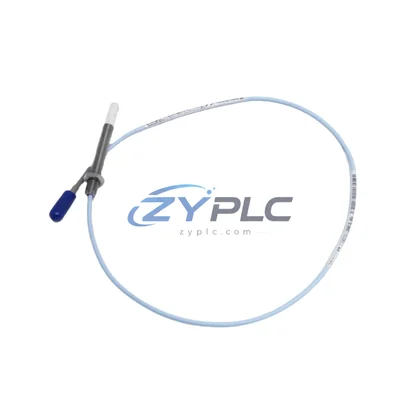
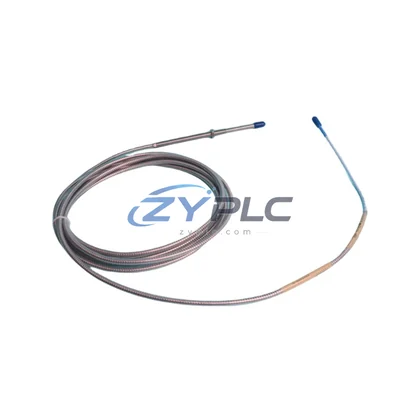
Bently Nevada 31000-16-05-00-035-02-02: Industrial Data Link for Smart Factory Vibration Networks
The Bently Nevada 31000-16-05-00-035-02-02 is a precision-engineered Proximity Probe Housing Assembly designed for the 3300 Series continuous vibration monitoring platform. In modern smart factory environments, reliable signal acquisition at the machine level is the foundation of every data-driven maintenance strategy. This housing assembly serves as the critical mechanical and electrical interface between the proximity probe tip and the broader industrial network — enabling uninterrupted data flow from rotating machinery through to SCADA systems, DCS controllers, and cloud-based analytics platforms.
Engineered to Bently Nevada’s exacting standards, the 31000-16-05-00-035-02-02 ensures that eddy-current proximity signals are transmitted with maximum fidelity from the sensor installation point to the 3300 Series signal conditioning modules. Whether deployed on turbines, compressors, pumps, or gearboxes, this housing assembly maintains the mechanical integrity and electromagnetic shielding necessary for accurate shaft displacement measurement in high-vibration, high-temperature industrial environments.
Compatibility & Integration Notes
| Parameter |
Specification |
| Compatible Series |
Bently Nevada 3300 Series |
| Signal Protocol |
Eddy-Current Proximity (Analog, 4–20 mA compatible output via transducer) |
| Interface Type |
Proximity Probe Housing / Mechanical-Electrical Assembly |
| Transmission Capability |
High-fidelity shaft displacement signal, radial and axial vibration |
| Network Compatibility |
Compatible with 3300 Series monitors, Bently Nevada System 1 software, SCADA/DCS integration via 4–20 mA or Modbus RTU gateway |
| System Application |
Turbine, Compressor, Pump, Gearbox Condition Monitoring; Predictive Maintenance Networks |
| Communication Gateway |
Supports integration with Modbus RTU/TCP, PROFIBUS, OPC-UA via 3300 Series rack modules |
| Origin |
United States |
| Warranty |
warranty terms confirmed during quotation |
| Stock Status |
Verified Availability confirmed by RFQ | Global Shipping Available |
Connected Automation Data Flow
In a fully integrated smart factory, the 31000-16-05-00-035-02-02 sits at the very beginning of the vibration data chain. The proximity probe, housed within this assembly, continuously measures the gap between the probe tip and the rotating shaft surface. This raw displacement signal travels through the armored extension cable to the Bently Nevada 3300/16 proximitor/seismometer module, where it is conditioned and converted into a standardized analog output.
From the 3300 Series rack, the conditioned signal feeds into the Bently Nevada 3500 Series machinery protection system — a multi-channel monitor capable of simultaneously processing radial vibration, axial position, speed, and temperature data from multiple machine trains. The 3500 rack communicates upstream via its Ethernet TCP/IP or Modbus RTU interface, delivering real-time machine health data to the plant’s DCS (Distributed Control System), such as a Honeywell Experion PKS or ABB System 800xA controller.
At the SCADA layer, platforms such as GE iFIX, Wonderware InTouch, or Ignition by Inductive Automation receive the structured vibration data streams. HMI panels — including Siemens SIMATIC HMI TP1200 or Rockwell Automation PanelView Plus 7 — display real-time shaft orbit plots, trend data, and alarm states directly on the plant floor. Operators can monitor bearing clearance degradation, rotor imbalance, and misalignment conditions without leaving the control room.
For remote diagnostics, the data path extends further: an edge gateway such as the Bently Nevada System 1 software server or a third-party IIoT gateway (e.g., Moxa UC-8112 or Advantech WISE-5000) aggregates machine data and pushes it to cloud analytics platforms. This enables predictive maintenance algorithms to flag anomalies — such as a rising 1X vibration amplitude on a compressor — hours or days before a failure event, dramatically reducing unplanned downtime.
The 31000-16-05-00-035-02-02 housing assembly is also fully compatible with the Bently Nevada TK-3 proximity transducer system and the 330100 series standard proximity probes, ensuring seamless drop-in replacement across existing 3300 Series installations without requiring recalibration of the signal chain.
Solving Data Isolation in Industrial Sites
One of the most persistent challenges in legacy industrial facilities is data isolation — machines equipped with proprietary vibration monitoring hardware that cannot communicate with modern SCADA or ERP systems. The Bently Nevada 3300 Series ecosystem, anchored by components like the 31000-16-05-00-035-02-02 housing assembly, directly addresses this problem through its open protocol architecture.
By pairing the 3300 Series monitors with a Modbus RTU-to-Ethernet gateway or an OPC-UA server module, plant engineers can bridge the gap between legacy analog vibration signals and modern digital plant networks. This eliminates the need for manual data collection rounds, where technicians historically walked the plant floor with handheld vibration analyzers — a process prone to human error and incapable of capturing transient fault events.
Protocol unification is achieved by routing the 3300 Series analog outputs through signal converters or directly into DCS analog input cards, then mapping the engineering-unit values (µm pk-pk, mm/s RMS) into the plant historian — such as OSIsoft PI System or Aspentech IP.21 — for long-term trend analysis. This creates a single, unified data layer where vibration, temperature, pressure, and flow data coexist, enabling cross-parameter correlation that is essential for root-cause analysis.
Production line transparency is further enhanced by integrating the vibration data into MES (Manufacturing Execution System) platforms, where machine health KPIs are displayed alongside OEE (Overall Equipment Effectiveness) metrics. When a vibration alarm triggers on a critical compressor, the MES can automatically generate a work order in the CMMS (Computerized Maintenance Management System), assign it to the on-call technician, and log the event — all without human intervention.
System scalability is a core advantage of the 3300 Series architecture. Additional probe channels can be added to the existing rack without disrupting live monitoring on other channels, and the network topology supports both star and daisy-chain configurations for flexible plant layouts. Whether expanding a single-machine monitoring point into a full plant-wide condition monitoring network, the 31000-16-05-00-035-02-02 provides the reliable mechanical foundation that the entire data chain depends upon.
Industrial Connectivity FAQ
Q1: What communication protocols are supported when integrating the Bently Nevada 3300 Series into a SCADA or DCS system?
The 3300 Series monitors output standard analog signals (4–20 mA, 0–10 V) that are compatible with virtually all DCS analog input modules. For digital integration, the 3300 Series can be paired with Modbus RTU or Modbus TCP gateway modules, enabling direct communication with SCADA platforms such as Ignition, Wonderware, or GE iFIX. OPC-UA connectivity is available through the Bently Nevada System 1 software layer, providing a standardized, vendor-neutral data interface for enterprise-level integration.
Q2: How does the 31000-16-05-00-035-02-02 housing assembly affect signal transmission latency and data accuracy?
The housing assembly itself introduces no active latency — it is a passive mechanical and electrical interface. Signal latency in the 3300 Series system is determined by the proximitor module’s response time, which is typically less than 1 ms for dynamic vibration signals. The housing’s primary contribution to data accuracy is its mechanical rigidity and EMI shielding, which prevent signal noise from electrical interference sources common in industrial environments, such as VFDs (Variable Frequency Drives) and high-current motor cables.
Q3: Is the 31000-16-05-00-035-02-02 compatible with existing 3300 Series installations, and does replacement require system recalibration?
Yes, the 31000-16-05-00-035-02-02 is a direct replacement component for compatible 3300 Series probe installations. In most cases, replacement does not require full system recalibration, provided the probe gap is set correctly during installation per Bently Nevada’s standard commissioning procedure. The housing maintains the same dimensional and electrical specifications as the original component, ensuring continuity of the signal chain without disrupting adjacent monitoring channels.
Q4: What quality assurance and warranty coverage is provided with this component?
Every 31000-16-05-00-035-02-02 unit supplied by ZYPLC undergoes pre-shipment functional verification to confirm mechanical integrity and electrical continuity. All units are covered by a warranty terms confirmed during quotation against manufacturing defects and functional failure under normal operating conditions. Availability is confirmed via RFQ for shipment arranged after confirmation with global shipping support, minimizing lead times for critical maintenance and emergency replacement scenarios.