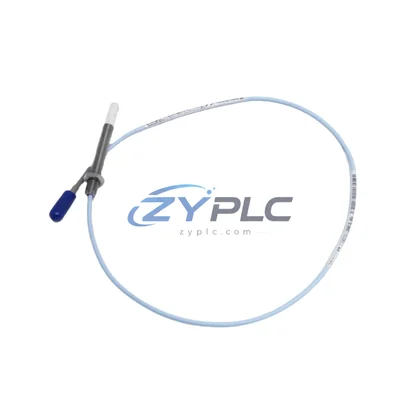
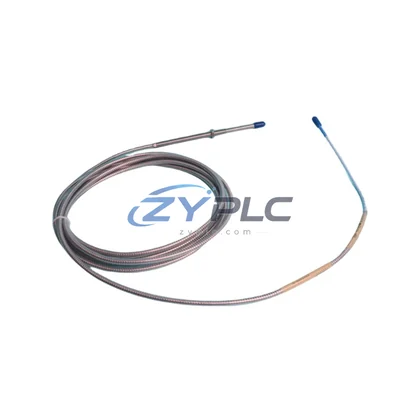
Bently Nevada 3300/25-XX Proximity Sensor for 3300: Compatibility and Replacement Notes
The Bently Nevada 3300/25-XX proximity sensor is not simply a standalone measurement device — it is a precision-engineered component designed to function as an integral node within the Bently Nevada 3300 Series machinery protection and condition monitoring architecture. In modern industrial automation environments, where rotating machinery must be continuously monitored across multiple control layers, the 3300/25-XX delivers the signal fidelity, installation consistency, and long-term reliability that system architects demand. Understanding this sensor’s role requires examining how it interacts with every layer of the control hierarchy: from the physical measurement layer through the signal conditioning layer, the monitoring and protection layer, the data acquisition and communication layer, and ultimately the supervisory and human-machine interface layer.
At the field level, the 3300/25-XX operates as an eddy-current proximity transducer, generating a voltage output proportional to the gap between the probe tip and the observed rotating shaft. This raw signal is the foundation upon which the entire 3300 system architecture is built. The sensor is designed to work in conjunction with the Bently Nevada 3300 XL 8mm Extension Cable and the 3300 XL Proximitor® Sensor (driver), forming a complete transducer system. The Proximitor converts the probe’s impedance change into a calibrated DC voltage signal, which is then routed to the 3500 Series Rack-based monitoring system or the 3300 Series rack for processing, alarming, and protection logic execution.
Within the 3500 Series Rack — which may house modules such as the 3500/42M Proximitor/Seismic Monitor Module, the 3500/22M Transient Data Interface, and the 3500/92 Communication Gateway Module — the 3300/25-XX’s output is continuously evaluated against user-configured alarm setpoints for radial vibration, axial position, and differential expansion. The rack’s backplane architecture ensures that all I/O modules share a common timing reference and communication bus, enabling synchronized multi-channel monitoring that is essential for turbine, compressor, pump, and motor protection applications.
From a network and communication perspective, the 3500/92 Communication Gateway Module bridges the 3500 rack to plant-level DCS and SCADA systems via Modbus TCP, OPC-DA, or OPC-UA protocols. This means that the vibration and position data originating from the 3300/25-XX sensor ultimately flows into the plant historian, the operator workstation HMI, and the asset management platform — creating a seamless data pipeline from the rotating shaft to the control room. Integration with systems such as the System 1 Evolution software platform further enhances the system integration capability, enabling trend analysis, alarm rationalization, and predictive maintenance scheduling based on real-time proximity data.
Redundancy is a critical design consideration in high-availability machinery protection systems. The 3300/25-XX supports dual-redundant transducer configurations, where two proximity probes are mounted at the same measurement plane to provide voting logic within the 3500 rack. This architecture ensures that a single sensor failure does not result in a spurious trip or, conversely, a missed protection event. The 3500 rack’s I/O module redundancy, combined with redundant power supply modules such as the 3500/15 Power Supply Module, creates a fault-tolerant monitoring system that meets the requirements of SIL-rated safety instrumented systems in petrochemical, power generation, and offshore applications.
Installation and commissioning of the 3300/25-XX within a 3300 or 3500 architecture follows a structured engineering workflow. The probe is mounted in a machined bracket at the correct gap distance — typically 1.0 mm to 2.0 mm from the shaft surface — and the extension cable is routed through conduit to the Proximitor housing, which is mounted in a junction box or directly on the machine casing. The Proximitor output is then wired to the 3500 rack I/O terminal block, where the system engineer configures the channel for the correct transducer type, sensitivity, and alarm setpoints using the Rack Configuration Software. This systematic commissioning process ensures that the 3300/25-XX delivers accurate, repeatable measurements from the first moment of machine startup.
Long-term maintenance efficiency is another key advantage of specifying the 3300/25-XX within a standardized 3300/3500 architecture. Because the sensor, extension cable, and Proximitor form a matched transducer system with a defined sensitivity of 7.87 V/mm (200 mV/mil), replacement of any component in the field requires only re-gapping and re-verification — not full system recalibration. Maintaining a stock of 3300/25-XX sensors alongside compatible extension cables and Proximitor drivers ensures that maintenance teams can restore full monitoring capability within minutes of a sensor failure, minimizing unplanned downtime and protecting production continuity.
Product Specification Table
| Parameter |
Specification |
| System Role |
Eddy-Current Proximity Transducer — Radial Vibration & Axial Position Measurement |
| Full SKU |
3300/25-XX-15-15-00-00-03-02 |
| Brand / Series |
Bently Nevada / 3300 XL Series |
| Probe Diameter |
8 mm (standard) |
| Sensitivity |
7.87 V/mm (200 mV/mil) |
| Linear Range |
0.25 mm to 2.26 mm (10 mil to 90 mil) |
| Operating Temperature |
-35°C to +177°C (probe); -35°C to +85°C (Proximitor) |
| Supply Voltage |
-24 VDC (nominal), via Proximitor driver |
| Output Signal |
DC voltage proportional to gap distance |
| Communication Compatibility |
Modbus TCP, OPC-DA, OPC-UA (via 3500/92 Gateway) |
| Compatible Rack Systems |
Bently Nevada 3500 Series, 3300 Series |
| Installation Environment |
Industrial — turbines, compressors, pumps, motors; IP65+ enclosure recommended |
| Certifications |
CE, ATEX, IECEx (zone-dependent configurations) |
| Warranty |
warranty terms confirmed during quotation — covers manufacturing defects and functional performance |
System Compatibility Notes
The 3300/25-XX achieves its full potential only when deployed as part of a coordinated, multi-layer control system. At the transducer level, the sensor pairs with the Bently Nevada 3300 XL Extension Cable and the 3300 XL Proximitor® Sensor to form a complete, factory-matched transducer chain. This chain feeds into the Bently Nevada 3500/42M Proximitor/Seismic Monitor Module, which performs real-time vibration and position calculations and executes relay-based protection outputs through the 3500/32 Relay Module.
Power integrity across the 3500 rack is maintained by the 3500/15 Power Supply Module, which supports dual-redundant power feeds to eliminate single-point power failures. Transient data capture — essential for startup, shutdown, and trip event analysis — is handled by the 3500/22M Transient Data Interface Module, which stores high-resolution waveform data for post-event engineering review. Communication between the 3500 rack and the plant DCS or SCADA system is managed by the 3500/92 Communication Gateway Module, supporting Modbus TCP and OPC protocols for seamless integration with Emerson DeltaV, Honeywell Experion, ABB System 800xA, and Siemens PCS 7 platforms.
At the supervisory layer, the System 1 Evolution asset performance management software aggregates proximity data from multiple 3300/25-XX sensors across an entire machine train — including driver, gearbox, and driven equipment — enabling fleet-wide vibration trending, alarm management, and predictive maintenance scheduling. For installations requiring local indication, the Bently Nevada 3500/94 Display Interface Module provides panel-mounted numeric display of key vibration and position parameters without requiring a separate HMI workstation.
Industrial Application Notes
The 3300/25-XX proximity sensor is specified across a wide range of heavy industrial applications where continuous shaft monitoring is a regulatory or operational requirement. In power generation facilities — including gas turbines, steam turbines, and hydro generators — the sensor monitors shaft radial vibration and axial thrust position, providing the early warning data needed to prevent catastrophic bearing failures and rotor rubs. In petrochemical and refinery environments, the 3300/25-XX is deployed on centrifugal compressors, expanders, and boiler feed pumps, where API 670 compliance mandates continuous proximity monitoring with automatic machine trip capability.
In LNG liquefaction and gas processing plants, the sensor’s ATEX and IECEx certifications enable deployment in Zone 1 and Zone 2 hazardous areas, where explosive atmospheres require intrinsically safe or explosion-proof transducer systems. Mining and mineral processing operations rely on the 3300/25-XX for monitoring large induced-draft fans, ball mill drives, and slurry pump motors, where shaft misalignment and bearing wear are leading causes of unplanned downtime. In water and wastewater treatment facilities, the sensor monitors vertical turbine pumps and blower units, providing the continuous condition data needed to support predictive maintenance programs and extend equipment service intervals.
For steel and metallurgical plants, the 3300/25-XX is integrated into rolling mill drive monitoring systems, where high-speed shaft dynamics and thermal expansion must be tracked simultaneously across multiple measurement planes. In pharmaceutical and food processing environments, the sensor’s stainless-compatible installation options and hygienic cable routing support GMP-compliant machinery monitoring without compromising process integrity.
Product Compatibility FAQ
Q1: Is the 3300/25-XX compatible with both the 3300 Series and 3500 Series rack systems, and what configuration changes are required when migrating between platforms?
The 3300/25-XX transducer system is fully compatible with both the Bently Nevada 3300 Series and 3500 Series rack architectures. The transducer’s output characteristics — sensitivity of 7.87 V/mm and linear range of 0.25 mm to 2.26 mm — are consistent across both platforms. When migrating from a 3300 rack to a 3500 rack, the primary configuration change involves re-entering channel parameters (transducer type, sensitivity, alarm setpoints, and relay logic) in the 3500 Rack Configuration Software. No physical modification to the probe, extension cable, or Proximitor is required, provided the gap setting is verified during recommissioning.
Q2: How does the 3300/25-XX support redundant monitoring architectures, and what is the recommended voting logic configuration for critical machinery protection?
For critical machinery protection applications — such as gas turbine or centrifugal compressor protection — the recommended architecture uses two 3300/25-XX probes mounted 90° apart at each measurement plane, feeding independent channels in the 3500/42M module. The 3500 rack’s configurable voting logic (1oo2, 2oo2, or 2oo3 depending on the number of channels) ensures that a single sensor failure or cable fault does not generate a spurious machine trip, while still providing full protection against genuine vibration exceedances. This dual-probe, dual-channel architecture is consistent with API 670 Fifth Edition requirements for critical service machinery.
Q3: What does the warranty terms confirmed during quotation cover, and how does ZYPLC support long-term spare parts availability for the 3300/25-XX?
The warranty terms confirmed during quotation covers all manufacturing defects and functional performance deviations from the published Bently Nevada specification for the 3300/25-XX transducer system. Warranty claims are supported by ZYPLC’s technical team, who can assist with failure analysis documentation and replacement unit coordination. For long-term spare parts planning, ZYPLC supports RFQ sourcing for 3300/25-XX sensors, compatible extension cables, and 3300 XL Proximitor drivers, enabling rapid replacement without extended lead times. Customers are encouraged to contact ZYPLC at plc.sales@zyplc.com or +86 19859288691 to discuss consignment stock arrangements and multi-year supply agreements tailored to their maintenance schedules.