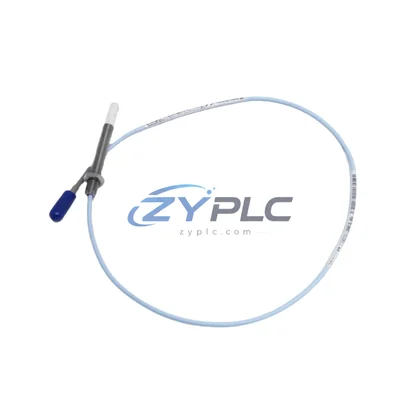
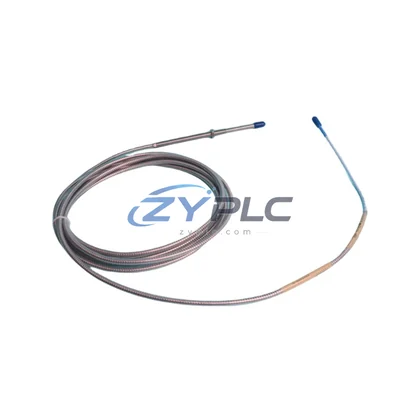
Bently Nevada 330101-00-11-10-02-00 Proximity Probe for 3300 XL
The Bently Nevada 330101-00-11-10-02-00 is a precision eddy-current proximity probe module engineered for seamless integration within the 3300 XL Series machinery protection and condition monitoring architecture. Rather than functioning as a standalone sensor, this probe is a foundational element of a layered automation system — one that spans the control layer, I/O layer, network layer, power layer, human-machine interface layer, and the mechanical execution layer. Understanding its role within this full-stack architecture is essential for engineers designing high-availability rotating machinery protection systems in power generation, petrochemical, mining, metallurgy, and heavy process industries.
Within the 3300 XL platform, the 330101-00-11-10-02-00 probe operates in conjunction with the 330130 Proximitor® Sensor (signal conditioning module), which converts the raw eddy-current signal into a calibrated DC voltage proportional to the gap between the probe tip and the target shaft. This conditioned signal is then routed to the 3300/16 Monitor or 3300/20 Monitor for real-time vibration, position, and speed measurement. The monitor modules reside on the 3300 Rack backplane, which provides both the mechanical housing and the internal signal bus connecting all monitoring channels. The rack itself is powered by the 3300/05 Power Supply, a redundant-capable unit that ensures uninterrupted monitoring even during single-point power failures — a critical requirement in continuous-process environments.
At the network and integration layer, the 3300 XL system communicates upstream to distributed control systems (DCS) or safety instrumented systems (SIS) via the 3500/92 Communication Gateway or through hardwired relay outputs from the monitor modules. This system integration capability allows the 330101-00-11-10-02-00 probe data to be consumed by plant-wide SCADA platforms, historian servers, and advanced process control loops without requiring additional signal conversion hardware. The result is a unified data flow from the mechanical execution layer — the rotating shaft — all the way to the operator HMI and control room displays.
For facilities operating redundant machinery trains, the 330101-00-11-10-02-00 is typically deployed in paired configurations alongside a second probe mounted 90° apart on the same shaft plane, enabling full XY vibration vector analysis. This dual-probe arrangement, combined with the 330180 Velomitor® CT Sensor for absolute vibration measurement and the 330500 Tachometer Probe for speed and phase reference, creates a complete vibration measurement suite capable of supporting advanced diagnostics such as orbit analysis, Bode plots, and cascade spectrum trending.
From an engineering and maintenance perspective, the 330101-00-11-10-02-00 probe’s standardized cable length and connector configuration simplify field replacement and calibration verification. The probe is compatible with the 330130-080-00-00 and 330130-045-00-00 Proximitor® Sensor variants, allowing system architects to select the appropriate cable extension length based on installation geometry. All replacement activities can be performed without interrupting adjacent monitoring channels on the same rack, minimizing planned maintenance windows and reducing the risk of unplanned shutdowns.
In layered automation systems, long-term inventory availability of critical sensor components is as important as the initial system design. The 330101-00-11-10-02-00 is stocked and tested, with a warranty terms confirmed during quotation covering full functional performance under normal operating conditions. This warranty commitment supports maintenance planning cycles, spare parts management programs, and capital expenditure justification for reliability engineering teams.
Product Specification Table
| System Role |
Eddy-Current Proximity Probe — Vibration & Position Sensing Layer |
| SKU / Part Number |
330101-00-11-10-02-00 |
| Brand |
Bently Nevada |
| Series |
3300 XL Machinery Protection System |
| Probe Type |
Eddy-Current (Non-Contact) Proximity Probe |
| Probe Tip Diameter |
11 mm (standard) |
| Cable Length |
1.0 m (integral cable) |
| Extension Cable |
Compatible with 330130 Proximitor® Sensor series |
| Linear Range |
Approx. 0.25 mm – 2.25 mm (gap to target) |
| Scale Factor |
7.87 V/mm (200 mV/mil) nominal |
| Target Material |
AISI 4140 steel or equivalent ferromagnetic alloy |
| Operating Temperature |
-35°C to +177°C (probe body) |
| Communication / Output |
Analog DC voltage via Proximitor® Sensor to 3300 Monitor |
| Mounting |
Threaded body, bracket or bearing housing installation |
| Installation Environment |
Industrial — suitable for turbines, compressors, pumps, motors |
| Warranty |
warranty terms confirmed during quotation — full functional performance guarantee |
System Compatibility Notes
The 330101-00-11-10-02-00 achieves its full diagnostic value only when integrated within a coordinated system architecture. A typical 3300 XL-based machinery protection system for a steam turbine-generator train would include the following coordinated components:
- 330101-00-11-10-02-00 Proximity Probe — radial vibration sensing at the bearing plane (this module)
- 330130 Proximitor® Sensor — signal conditioning, gap voltage output, system power supply to probe
- 3300/16 or 3300/20 Monitor Module — channel processing, alarm setpoint management, relay output control
- 3300 Rack / Backplane — mechanical housing, internal signal bus, module interconnection
- 3300/05 Redundant Power Supply — dual-feed DC power to all rack-mounted modules
- 330500 Tachometer Probe — shaft speed and phase reference for vector analysis and Bode plots
- 330180 Velomitor® CT Sensor — absolute casing vibration measurement, seismic reference channel
- 3500/92 Communication Gateway — Modbus TCP / Ethernet integration to DCS, SCADA, or historian
- 3300/55 Temperature Monitor — bearing metal temperature monitoring on the same rack for correlated diagnostics
- HMI / Operator Workstation — System 1 Evolution software for real-time trending, orbit display, and alarm management
This coordinated architecture ensures that every signal — from the rotating shaft surface to the control room display — passes through a validated, calibrated, and redundancy-capable signal chain. The 330101-00-11-10-02-00 probe is the origination point of this chain, and its dimensional and electrical consistency directly determines the accuracy of all downstream diagnostics.
Industrial Application Notes
The 330101-00-11-10-02-00 proximity probe is deployed across a wide range of critical rotating machinery applications in layered industrial automation environments:
- Power Generation: Steam turbine and gas turbine shaft vibration monitoring in utility-scale power plants, where continuous operation and early fault detection are mandatory for grid stability compliance.
- Petrochemical & Refining: Centrifugal compressor and pump protection in hydrocarbon processing units, where API 670 compliance requires certified proximity probe systems with documented calibration traceability.
- Water Treatment: Large pump station motor and impeller shaft monitoring, integrated with plant DCS for automated shutdown on high-vibration alarm conditions.
- Mining & Minerals Processing: Ball mill, SAG mill, and crusher drive shaft monitoring in high-dust, high-vibration environments where probe durability and signal stability are critical for uptime.
- Metallurgy & Steel: Rolling mill drive train and continuous caster shaft monitoring, where thermal gradients and electromagnetic interference require robust probe shielding and calibrated signal conditioning.
- Packaging & Process Lines: High-speed rotary equipment monitoring in food, beverage, and pharmaceutical production lines, where predictive maintenance programs depend on reliable vibration baseline data.
In each of these environments, the system integration capability of the 3300 XL system — enabled by the 330101-00-11-10-02-00 probe as the primary sensing element — allows vibration data to flow seamlessly into plant-wide asset management, condition monitoring, and process control platforms without manual data extraction or protocol conversion overhead.
Product Compatibility FAQ
Q1: Is the 330101-00-11-10-02-00 compatible with existing 3300 XL racks and monitor modules already installed in my plant?
Yes. The 330101-00-11-10-02-00 is a standard 3300 XL series proximity probe and is fully compatible with all 3300/16, 3300/20, and related monitor modules when paired with the appropriate 330130 Proximitor® Sensor. No rack modifications or firmware updates are required for direct replacement of an existing probe of the same part number. Always verify the Proximitor® Sensor model and cable extension length match the installation geometry before commissioning.
Q2: How does this probe support redundant architecture and long-term system reliability?
The 330101-00-11-10-02-00 is designed for deployment in dual-probe XY configurations, providing full radial vibration vector coverage at each bearing plane. Combined with the 3300/05 redundant power supply and the 3500/92 communication gateway’s dual-port Ethernet capability, the overall system architecture supports N+1 redundancy at the power, communication, and sensing layers. For critical machinery trains, a spare probe should be maintained on-site as part of the plant’s critical spare parts inventory program. Our warranty terms confirmed during quotation covers the probe against manufacturing defects and functional performance degradation under normal operating conditions.
Q3: What commissioning steps are required when installing the 330101-00-11-10-02-00 in a new or replacement application?
Commissioning requires verification of the probe gap voltage at the nominal operating clearance (typically 1.0 mm to 1.5 mm for most shaft diameters), confirmation of the Proximitor® Sensor output scale factor (7.87 V/mm), and calibration of the monitor module alarm and danger setpoints per the OEM machinery protection specification. The probe body thread and mounting bracket should be inspected for mechanical integrity, and the integral cable should be routed to avoid contact with hot surfaces or high-voltage conductors. After installation, a slow-roll vibration baseline should be recorded and compared against the historical reference to confirm correct probe orientation and signal polarity before returning the machine to service.