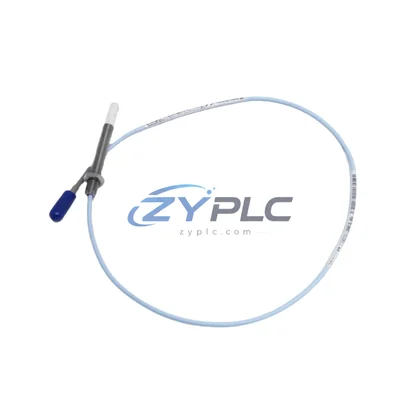
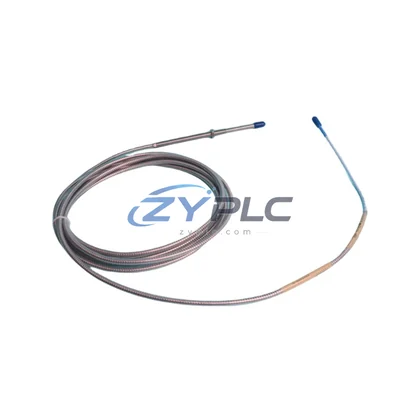
Bently Nevada 330101-00-15-05-11-00: Industrial Data Link for 3300 Series Vibration Monitoring Networks
The Bently Nevada 330101-00-15-05-11-00 Proximity Probe is a precision eddy-current sensing device engineered for continuous, non-contact vibration and position measurement in rotating machinery environments. As a core signal acquisition node within the Bently Nevada 3300 Series ecosystem, this proximity probe serves as the critical front-end transducer that feeds real-time shaft displacement data into plant-wide condition monitoring networks, SCADA platforms, and predictive maintenance systems. With a 5mm probe tip diameter and a 1-metre armoured extension cable, the 330101-00-15-05-11-00 is designed to operate reliably in high-temperature, high-vibration, and chemically aggressive industrial environments — from gas turbines and steam turbines to compressors, pumps, and large electric motors.
In modern smart factory architectures, the value of the 330101-00-15-05-11-00 extends far beyond simple vibration detection. It functions as the originating data source in a layered industrial communication chain: raw analogue signals from the probe are transmitted through matched extension cables to the Bently Nevada 3300/16-24-01-01-00-00 proximitor/seismic transducer, which conditions and converts the signal into a standardised voltage output. This conditioned signal is then ingested by the Bently Nevada 3500/42M Proximitor/Seismic Monitor rack module, where it is digitised, alarm-thresholded, and made available over the plant communication bus. From there, data flows upstream to DCS controllers, Modbus TCP/IP gateways, and OPC-UA servers — enabling seamless integration with Emerson DeltaV, Honeywell Experion, or Siemens PCS 7 SCADA systems for centralised real-time monitoring and remote diagnostics.
Compatibility & Integration Notes
| Parameter |
Specification |
| SKU / Part Number |
330101-00-15-05-11-00 |
| Brand / Series |
Bently Nevada / 3300 Series |
| Sensor Type |
Eddy-Current Proximity Probe |
| Probe Tip Diameter |
5 mm |
| Cable Length |
1 metre (armoured extension) |
| Output Signal Protocol |
Analogue voltage (–24 VDC bias, linear range) |
| Compatible Monitor |
Bently Nevada 3500 Series Rack System |
| Communication Gateway |
Modbus RTU / Modbus TCP/IP / OPC-UA (via 3500 rack) |
| Network Compatibility |
Ethernet/IP, Profibus DP, Foundation Fieldbus (via gateway modules) |
| SCADA / HMI Integration |
Emerson DeltaV, Honeywell Experion, Siemens WinCC, GE iFIX |
| System Application |
Rotating Machinery Condition Monitoring, Predictive Maintenance |
| Operating Temperature |
–50°C to +177°C (probe body) |
| Warranty |
warranty terms confirmed during quotation — Tested Before Shipment |
Connected Automation Data Flow
Understanding the 330101-00-15-05-11-00 within its full automation data flow reveals why it is indispensable to industrial connectivity strategies. The probe is typically paired with the Bently Nevada 330130-045-00-00 extension cable, which maintains signal integrity over distances up to 9 metres between the probe tip and the proximitor driver. The proximitor — commonly the Bently Nevada 330180-X1-05 or the 3300/16-24-01-01-00-00 module — converts the raw eddy-current field disturbance into a calibrated –24 VDC to 0 VDC analogue output, which is then wired into the Bently Nevada 3500/42M or 3500/40M monitor card installed in the 3500 rack chassis.
Within the 3500 rack, the 3500/20 Communication Gateway module acts as the protocol bridge, translating the monitor’s internal data bus into Modbus RTU over RS-485 or Modbus TCP/IP over Ethernet — making vibration amplitude, phase, gap voltage, and alarm status available to any Modbus-capable PLC, such as a Rockwell Automation ControlLogix L7x or a Siemens S7-400H redundant controller. For plants running Foundation Fieldbus or Profibus DP backbones, the 3500/22M Communication Module provides native fieldbus connectivity, allowing the vibration data to appear as standard process variables on the fieldbus segment alongside flow transmitters, pressure sensors, and temperature elements.
At the SCADA and HMI layer, operators viewing a Wonderware InTouch or Ignition SCADA screen can see live shaft vibration trends, overall vibration levels, and 1X/2X vector data sourced directly from the 330101-00-15-05-11-00 probe — without any manual data entry or polling delays. When vibration exceeds a configured danger threshold, the 3500 rack issues a relay output to the machine protection system and simultaneously pushes an alarm event over OPC-UA to the plant historian, such as OSIsoft PI or Aspentech IP.21, for long-term trend analysis and maintenance scheduling. Edge computing nodes — for example, a Moxa UC-8112 industrial computer running a condition monitoring analytics engine — can subscribe to the OPC-UA server and apply machine learning models to detect early-stage bearing wear, rotor imbalance, or misalignment, enabling true predictive maintenance rather than reactive repair.
Solving Data Isolation in Industrial Sites
One of the most persistent challenges in industrial plants is the fragmentation of machinery health data across incompatible monitoring systems. Older installations may have standalone vibration monitors with no network output, leaving operators dependent on manual rounds with handheld data collectors. The Bently Nevada 330101-00-15-05-11-00, when integrated into a fully networked 3500 Series rack, directly addresses this data isolation problem by converting what was previously a local analogue measurement into a digitised, network-accessible process variable.
Protocol unification is achieved through the 3500 rack’s communication modules, which support simultaneous Modbus TCP/IP and OPC-UA output — meaning the same vibration data can be consumed by a legacy DCS running Modbus and a modern cloud-based SCADA platform running OPC-UA at the same time, with no data duplication or conversion loss. For plants undergoing digital transformation, this dual-protocol capability eliminates the need to replace existing control infrastructure while still enabling connectivity to Industry 4.0 analytics platforms.
Remote monitoring and diagnostics are further enhanced by the probe’s compatibility with Bently Nevada’s System 1 condition monitoring software, which aggregates data from multiple 3500 racks across a plant — or across multiple plant sites — into a single dashboard. Maintenance engineers can remotely review vibration spectra, trend historical data, and acknowledge alarms from any location with network access, dramatically reducing the need for on-site inspections and enabling faster response to developing machinery faults. Production line transparency is achieved when every critical rotating asset — turbines, compressors, pumps, fans — is equipped with 330101-series probes feeding into a unified System 1 database, giving plant managers a real-time view of overall equipment effectiveness (OEE) and machinery health across the entire facility.
System expansion is straightforward: additional 330101-00-15-05-11-00 probes and their associated proximitor modules can be added to spare slots in the existing 3500 rack chassis, or new rack chassis can be networked to the same Modbus/OPC-UA backbone without disrupting existing monitoring points. This scalability makes the 3300 Series probe ecosystem a long-term investment for growing industrial facilities.
Industrial Connectivity FAQ
Q1: What is the communication latency between the 330101-00-15-05-11-00 probe and the SCADA system?
The analogue signal from the proximity probe is updated continuously in real time at the proximitor output. Within the 3500 rack, data is digitised and made available on the Modbus or OPC-UA interface with a typical scan cycle of 20–100 milliseconds, depending on the communication module configuration and network load. This latency is well within the requirements of most SCADA and DCS systems for machinery protection and condition monitoring applications.
Q2: Is the 330101-00-15-05-11-00 compatible with Profibus DP and Foundation Fieldbus networks?
Yes. When used with the Bently Nevada 3500/22M Communication Module installed in the 3500 rack, the probe’s vibration data can be transmitted over Profibus DP or Foundation Fieldbus H1 segments. This allows the 3300 Series monitoring system to integrate natively into plant-wide fieldbus architectures without requiring additional protocol converters or gateways.
Q3: How is network stability ensured in high-vibration or electrically noisy environments?
The 330101-00-15-05-11-00 uses a shielded, armoured coaxial cable construction that provides excellent immunity to electromagnetic interference (EMI) from variable frequency drives, large motors, and high-voltage switchgear. The 3500 rack’s communication modules support redundant Ethernet configurations (dual-port with automatic failover) to ensure uninterrupted data transmission even in the event of a network cable fault or switch failure.
Q4: What does the warranty terms confirmed during quotation cover, and is the unit tested before shipment?
Every Bently Nevada 330101-00-15-05-11-00 Proximity Probe supplied by ZYPLC undergoes functional testing prior to shipment, verifying probe sensitivity, cable continuity, and connector integrity. The warranty terms confirmed during quotation covers manufacturing defects and functional failures under normal operating conditions. Our inventory is sourced from authorised distribution channels, and we confirm availability by RFQ for rapid dispatch to minimise plant downtime.