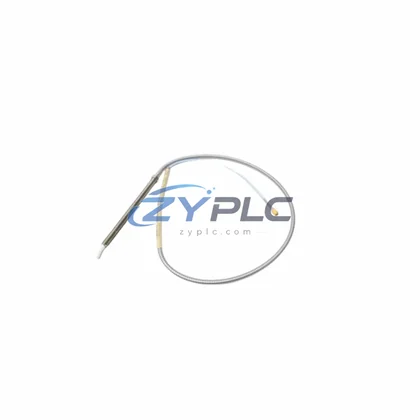
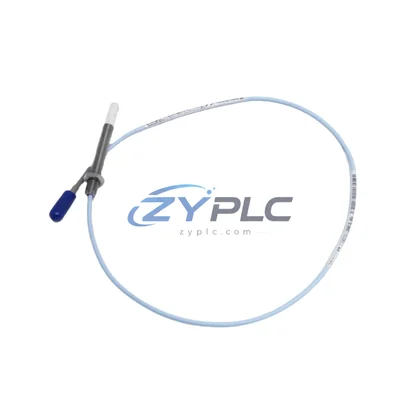
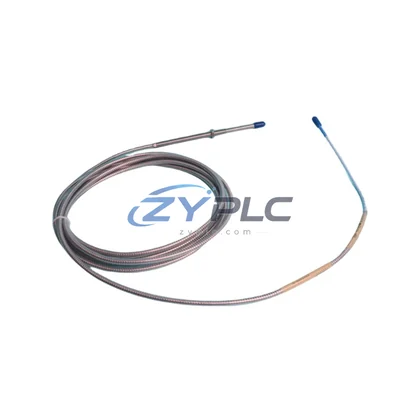
Bently Nevada 330101-00-40-10-02-05 Proximity Sensor for 3300 XL
The Bently Nevada 330101-00-40-10-02-05 is a high-precision eddy-current proximity transducer engineered for seamless integration within the Bently Nevada 3300 XL continuous vibration monitoring platform. Designed to operate as a core sensing element in multi-layer industrial control architectures, this transducer delivers reliable radial vibration, axial position, and differential expansion measurements across rotating machinery in demanding process environments. Its role extends far beyond a standalone sensor — it is a foundational component in a coordinated system architecture that spans the control layer, I/O layer, network layer, power layer, human-machine interface layer, and actuation layer.
In modern industrial automation, the integrity of a vibration monitoring system depends not only on the accuracy of individual sensors but on the coherence of the entire signal chain. The 330101-00-40-10-02-05 is factory-calibrated to interface directly with the Bently Nevada 3300 XL proximitor/seismic monitor, ensuring that signal conditioning, gap voltage output, and sensitivity specifications are matched end-to-end without field recalibration. This plug-and-play compatibility reduces commissioning time and eliminates the risk of signal mismatch that can arise when mixing unvalidated third-party components.
Product Specification Table
| Parameter |
Specification |
| System Role |
Radial Vibration / Axial Position Proximity Transducer |
| Compatible Platform |
Bently Nevada 3300 XL Monitoring System |
| Probe Length |
40 mm (standard) |
| Cable Length |
10 ft (3.0 m) integral cable |
| Extension Cable |
02 (standard extension) |
| Connector Type |
05 (standard connector) |
| Sensitivity |
200 mV/mil (7.87 V/mm) |
| Linear Range |
10–90 mil (0.25–2.29 mm) |
| Supply Voltage |
-24 VDC (nominal) |
| Output Signal |
DC voltage proportional to gap distance |
| Frequency Response |
DC to 10,000 Hz |
| Operating Temperature |
-35°C to +121°C (probe tip) |
| Target Material |
Steel or iron-based rotating shaft |
| Installation Environment |
Turbines, compressors, pumps, motors, gearboxes |
| Communication Layer |
Analog signal to 3300 XL monitor rack |
| Warranty |
warranty terms confirmed during quotation — all units tested prior to shipment |
System Compatibility Notes
The 330101-00-40-10-02-05 proximity probe is most effective when deployed as part of a fully coordinated Bently Nevada monitoring architecture. In a typical turbine or compressor protection system, this probe pairs with the 330180-51-05 proximitor extension cable to bridge the distance between the probe tip and the monitor rack, maintaining signal integrity across long cable runs in high-noise industrial environments.
At the monitor rack level, the probe interfaces with the Bently Nevada 3300/16 dual-channel monitor or the more advanced 3500/22M transient data interface, both of which provide configurable alarm setpoints, buffered output channels, and direct integration with plant DCS or safety instrumented systems via 4–20 mA or relay outputs. For installations requiring API 670-compliant machinery protection, the 3500/15 power supply module provides stable, isolated DC power to the entire 3500 rack, ensuring that voltage fluctuations at the plant level do not propagate into the measurement chain.
In multi-shaft or multi-bearing configurations, the 330101-00-40-10-02-05 is typically deployed alongside the 330104-00-06-10-02-00 proximity probe (a shorter-range variant) to cover both radial and thrust measurement points on the same rotor train. The 3500/42M temperature monitor complements the vibration data by correlating bearing temperature trends with displacement readings, enabling condition-based maintenance decisions that reduce unplanned downtime.
For systems requiring network-layer integration, the 3500/25 keyphasor module provides once-per-revolution reference signals that synchronize vibration data with shaft rotational speed, enabling spectrum analysis and phase-referenced diagnostics within the System 1 Evolution software platform. This software layer aggregates data from all monitor modules across the rack, presenting operators with a unified view of machine health through a centralized HMI or SCADA interface.
In redundant architecture designs — common in power generation and petrochemical applications — dual-probe configurations using the 330101-00-40-10-02-05 alongside the 330130-080-00-00 proximity probe provide voting logic inputs to the safety layer, ensuring that a single sensor failure does not trigger a spurious trip or mask a genuine machinery fault. The 3300 XL NSv (non-contacting speed and vibration) monitor further extends the system’s diagnostic capability by combining speed measurement with vibration trending in a single rack slot, reducing hardware footprint in space-constrained control cabinets.
Industrial Application Notes
Across manufacturing, power generation, petrochemical refining, water treatment, mining, metallurgy, and process packaging industries, the 330101-00-40-10-02-05 serves as the primary sensing element in rotating machinery protection systems. In combined-cycle power plants, it monitors turbine shaft displacement to detect rotor instability before it escalates to catastrophic bearing failure. In centrifugal compressor trains at LNG facilities, it provides continuous axial position feedback that protects labyrinth seals from contact under surge or load-change conditions.
In water treatment and pumping stations, where maintenance access is infrequent and unplanned outages carry significant operational penalties, the long-term stability and low drift characteristics of this probe reduce the frequency of manual calibration checks. In mining and mineral processing environments, where ambient vibration, dust, and temperature extremes challenge sensor reliability, the robust construction of the 330101-00-40-10-02-05 — combined with its factory-verified calibration — ensures consistent performance over extended service intervals.
For metallurgical rolling mills and continuous casting lines, where shaft speeds and load profiles vary dynamically, the probe’s wide frequency response (DC to 10,000 Hz) captures both low-speed runout and high-frequency structural resonances within a single measurement channel, simplifying the sensor architecture and reducing the number of penetrations required in the machine housing.
Product Compatibility FAQ
Q1: Is the 330101-00-40-10-02-05 compatible with both the 3300 XL and 3500 series monitor racks?
A: Yes. This probe is designed for the 3300 XL platform but is also compatible with 3500 series monitors when used with the appropriate proximitor and extension cable assembly. The key requirement is that the total system — probe, extension cable, and proximitor — must be matched to achieve the specified sensitivity of 200 mV/mil. Mixing unmatched components from different series can result in out-of-specification gap voltage and erroneous alarm behavior. Always verify the complete system part number against the Bently Nevada system compatibility matrix before installation.
Q2: What installation and commissioning steps are required to integrate this probe into an existing 3300 XL architecture?
A: Installation involves mounting the probe at the correct gap distance (typically 50 mil / 1.27 mm from the shaft surface for mid-range linearity), routing the integral cable to the proximitor junction box, and connecting the extension cable to the monitor rack input. After physical installation, the gap voltage should be verified at the monitor’s buffered output using a calibrated voltmeter. The monitor’s alarm setpoints should then be configured based on the machine’s baseline vibration signature and the OEM’s recommended trip levels. No field calibration of the probe itself is required — the factory calibration is traceable and valid for the warranty terms confirmed during quotation period.
Q3: What does the warranty terms confirmed during quotation cover, and how does it support long-term maintenance planning?
A: The warranty terms confirmed during quotation covers manufacturing defects, calibration drift beyond specification, and premature failure under normal operating conditions. Each unit is tested prior to shipment to verify sensitivity, linearity, and electrical integrity. For maintenance planners, this warranty period aligns with typical annual turnaround cycles in process industries, allowing probe replacement to be scheduled as part of planned outage work rather than reactive maintenance. Warranty claims are supported with documentation of the original test results, facilitating root-cause analysis if a failure occurs within the coverage period.